
Light & Wonder’s Q1 2026: Strategy Shift and Market Challenges Reshape Gaming Outlook
Q1 2026 results reveal key operational adjustments, credit agreement refinements, and ongoing geopolitical risks impacting Light & Wonder’s gaming business.
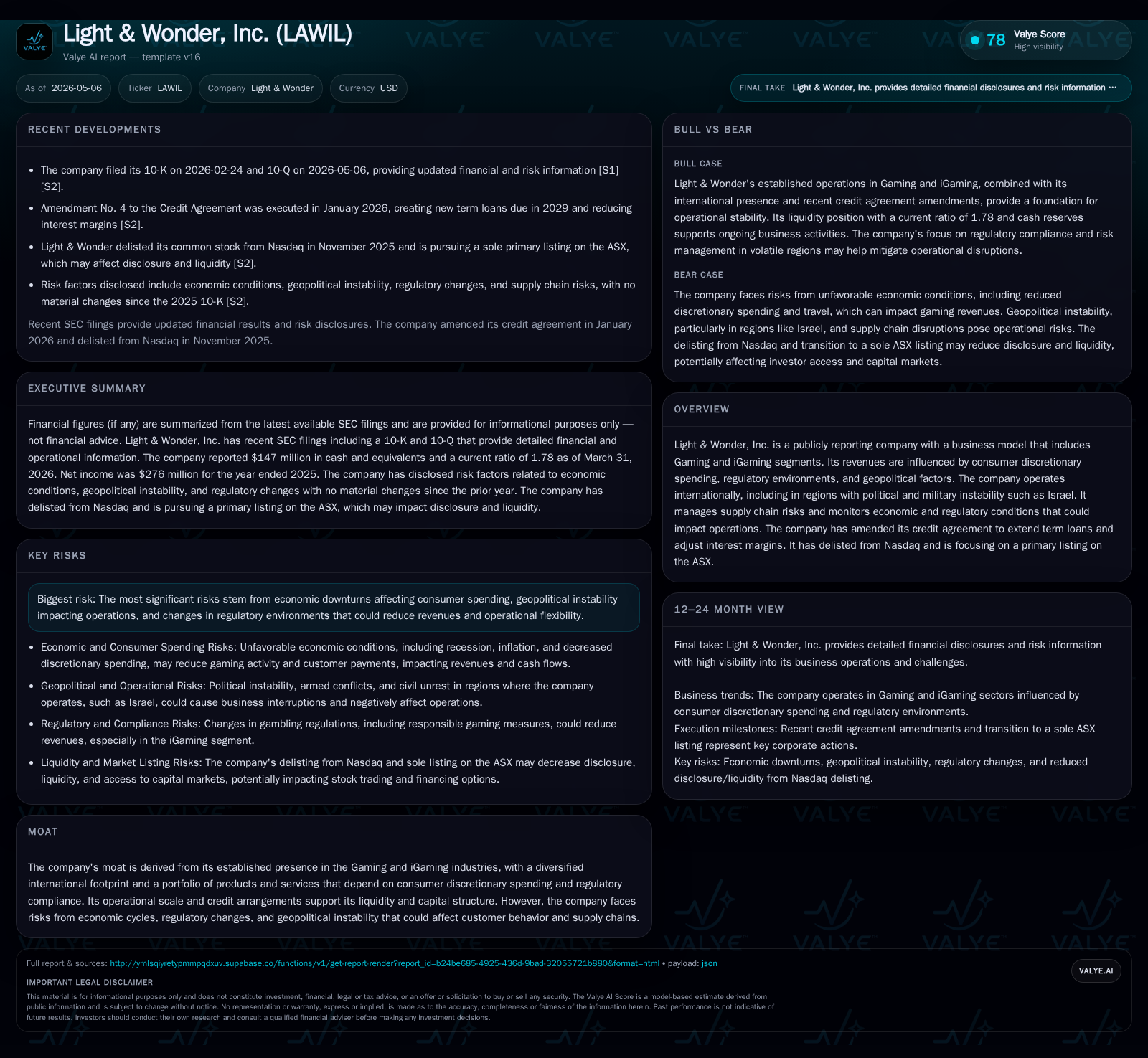
Light & Wonder's Q1 2026 operating update highlights continued strategic realignment including delisting from Nasdaq to focus on the ASX, amendments to its credit facility improving borrowing terms, and heightened geopolitical risks that affect supply chains and market access. The company’s core business model weaves together traditional Gaming hardware and growing iGaming platforms, with revenues highly sensitive to discretionary consumer spending and complex global regulatory environments. While growth drivers include geographic expansion and technology innovation, significant risks stem from macroeconomic headwinds, regulatory variability, and a substantial leverage burden. Upcoming quarters will be pivotal as the firm executes on credit adjustments and navigates geopolitical uncertainties.
Quarterly Operating Developments Shape Near-Term Prospects
Light & Wonder's latest quarterly filing dated May 6, 2026 [S2], accompanied by a same-day 8-K update [S3], delineate key strategic and operational developments shaping its near-term trajectory. The company formally announced its intention to delist from Nasdaq to consolidate its listing solely on the Australian Securities Exchange (ASX), a move designed to enhance liquidity and market capitalization efficiency within its primary investor base. This shift reflects an effort to streamline regulatory oversight and investor relations in line with evolving shareholder geography.
On the financial front, Light & Wonder executed Amendment No. 4 to its existing credit agreement [S20], creating a new tranche of term loans amounting to approximately $2.13 billion due in April 2029. This amendment reduced interest margins significantly (to 2.00% for term benchmark rate loans and 1.00% for ABR loans), thus optimizing interest expense outlays amidst a capital-intensive business profile reliant on considerable debt leverage.
Operationally, the Management’s Discussion highlights no material changes in risk factors since the last annual report but brings attention to ongoing geopolitical tensions—specifically conflicts impacting logistics through the Red Sea near Israel—that may require inventory buffer adjustments leading to elevated holding or freight costs. These concentrates underscore near-term cost pressures that could compress gross margins if unresolved [S2].
Parallelly, revenue dynamics continue to be shaped by discretionary consumer spending patterns deeply influenced by macroeconomic conditions and pandemic recovery trajectories across international markets where Light & Wonder operates.
Core Business Model and Product Ecosystem
Light & Wonder’s business model bifurcates into two principal segments: physical Gaming—encompassing electronic gaming machines deployed globally—and iGaming platforms delivering digital content across multiple regulated jurisdictions [S1]. Revenue derives primarily from sales of gaming equipment, software licensing fees, recurring content deployment contracts, and platform service agreements.
The company leverages a diversified product ecosystem ranging from traditional slot machines integrated with advanced gamification features to immersive digital gambling experiences tailored for online operators. Such dual exposure enables capturing incremental market share in the rapidly expanding digital gaming space while maintaining a foothold in land-based casino venues.
A critical feature underpinning their offering is compliance agility: given regulatory variations worldwide, Light & Wonder continuously adapts game certification processes and platform security provisions to maintain licenses—a prerequisite for sustainable revenue streams. This regulatory layering adds complexity but erects barriers to entry safeguarding incumbents.
Supply chain sensitivity is palpable due to global electronics demand volatility compounded by recent geopolitical instabilities affecting shipping lanes near Israel [S22]. Anticipatory inventory management becomes instrumental wherein the firm must balance between minimizing stock obsolescence given rapid product cycles versus ensuring sufficient availability amidst logistic interruptions.
At a unit economic level, customer adoption hinges on platform reliability, diverse content portfolios that engage users effectively, and innovation velocity surpassing competitive benchmarks—attributes central to player retention metrics emphasized across industry ecosystems.
Industry Environment and Competitive Positioning
The broader gaming industry remains subject to cyclical swings modulated by discretionary income fluxes and leisure travel trends. However, structural growth in iGaming driven by technology adoption offsets some cyclicality by catalyzing digital penetration in previously untapped markets.
Light & Wonder sustains competitive positioning through established global footprints spanning mature markets such as Europe/North America alongside emerging regions where licensing regimes are progressively liberalizing [S1]. Nonetheless, competitors advancing faster digital innovations or securing exclusive regional licenses constitute tangible threats.
Pricing power varies regionally but generally is pressured by intensified operator negotiations amid commoditized hardware offerings balanced against differentiated content IP portfolios securing premium contract terms for iGaming deployments.
Regulatory environments differ starkly: stringent frameworks in North America contrast with more fluid conditions in Latin America or parts of Europe/Southern Hemisphere jurisdictions forming part of Light & Wonder’s expansion strategy.
Geopolitical hotspots like Israel introduce non-trivial risk overlays as disrupted transport corridors induce supply delays impacting installation cycles at customer venues—an example of exogenous variables shaping operational cadence beyond internal control [S22].
Growth Catalysts: What Could Unlock Further Expansion
The company’s midterm growth blueprint hinges on several interlocking catalysts. Firstly, expanding iGaming user bases through enhanced content integration presents an avenue for recurring revenue upside supported by strong engagement KPIs tracked internally [S1].
Secondly, geographic market expansion into newly regulated territories offers blue-sky opportunities conditional upon achieving timely certification approvals—a process carefully monitored given its gatekeeper role on revenue recognition.
Thirdly, product innovation initiatives targeting immersive gamification mechanics tailored for hybrid physical-digital deployments could unlock incremental wallet share from operators seeking differentiated player experiences.
Operational scale improvements linked to optimized supply chain management—especially adaptive inventory holdings counteracting logistic disruptions—could improve gross margin profiles over time.
Cost efficiency programs entwined with favorable credit terms afforded by Amendment No. 4 enable further margin facilitation by lowering finance charges while preserving capex flexibility necessary for technological investment [S20].
Industry-wide trends such as escalating esports integration or social casino synergies may materialize as additional strategic levers over longer horizons.
Risk Profile: Regulatory, Geopolitical, and Financial Constraints
Light & Wonder confronts a risk set deeply embedded in external volatility vectors. Regulatory discontinuities pose perennial challenges given jurisdictional licensing dependencies; any revocation or delay can materially impair revenue generation capacity [S1].
Geopolitical instability remains acute particularly around Middle East zones impacting trade routes; disrupted Red Sea access exemplifies tangible supply chain vulnerabilities elevating costs or delaying fulfilment timelines [S22].
Macroeconomic downturns prompt contraction in discretionary entertainment spending directly curtailing demand elasticity within both land-based casinos and online betting channels—creating cyclical dampening patterns requiring strategic countermeasures.
Financially, the net debt load exceeds $5 billion placing significant leverage pressure compounded by ongoing need for working capital amidst inventory expansions necessitated by logistical uncertainties [F1]. The extended loan maturities reduce immediate refinancing risks but still maintain pronounced interest obligations despite margin improvements achieved via credit amendment [S20].
Liquidity appears adequate in the near term—as signaled by a current ratio of approximately 1.78—but capital structure remains stretched presenting execution risks if adverse industry shocks coincide with operational setbacks [F1]. Sensitivity analyses around cash flow generation under stress scenarios will be critical risk monitors going forward.
Operational readiness must also contend with swift technology cycles demanding continuous R&D investment lest product offerings become stale relative to accelerated competitor innovations posing substitution threats.
Upcoming Milestones and Key Variables to Monitor
Key markers defining Light & Wonder’s near-to-medium term outlook include:
- Monitoring Q2 earnings releases assessing execution against guidance especially cash flow adequacy given high leverage profile [S2].
- Progress updates regarding finalization of exclusive primary listing transition on ASX impacting trading volumes and capital access [N/A but implied from S3 / S25].
- Regulatory developments especially licensing approvals or enforcement actions within newer growth markets influencing top-line visibility.
- Supply chain normalization post-geopolitical disruptions granting insight into margin stabilization prospects.
- Innovation pipeline deliverables including new platform launches or content partnerships gauged via management commentary during quarterly calls.
- Utilization metrics from iGaming platforms reflecting user engagement trends tied directly to recurring revenue sustainability.
- Monitoring competitor innovations that could disrupt pricing structures or intensify market share battles within core segments.
- Tracking cost of borrowing movements indirectly affected by macroeconomic interest rate environments possibly influencing financing costs beyond current agreement.
Latest Financial Condition Snapshot
Latest financial snapshot
| Metric | Value | Period |
|---|---|---|
| Cash & equivalents | $147mm | |
| 2026-03-31 | ||
| Total debt | $5.18bn | |
| 2026-03-31 | ||
| Net debt | $5.04bn | |
| 2026-03-31 | ||
| Current assets | $1.21bn | |
| 2026-03-31 | ||
| Current liabilities | $676mm | |
| 2026-03-31 | ||
| Current ratio | 1.78x | |
| 2026-03-31 |
Source: SEC companyfacts cache [F1].
This snapshot underscores that while Light & Wonder maintains solid near-term liquidity buffers supported by cash holdings of $147 million allowing a current ratio near 1.8x, the company continues carrying heavy gross debt exceeding $5.18 billion resulting in net debt approximating $5.04 billion after cash offsets [F1]. The recent credit facility amendment extends loan maturity horizons while optimizing interest costs yet does not materially alleviate principal repayment obligations slated over subsequent years [S20].
This analysis synthesizes publicly available SEC filings up to May 6, 2026, without incorporating speculative projections or non-public information. It does not constitute investment advice.
Disclaimer: This is research-only, informational analysis and not investment advice. It may include AI-generated interpretation and general industry context. Always verify important details using primary sources.

Comments