
Energy Fuels Advances Rare Earth Integration While Maneuvering Uranium Market Dynamics
Energy Fuels reported Q1 2026 results highlighting ongoing operational flexibility and strategic moves in rare earths amid uranium market challenges.
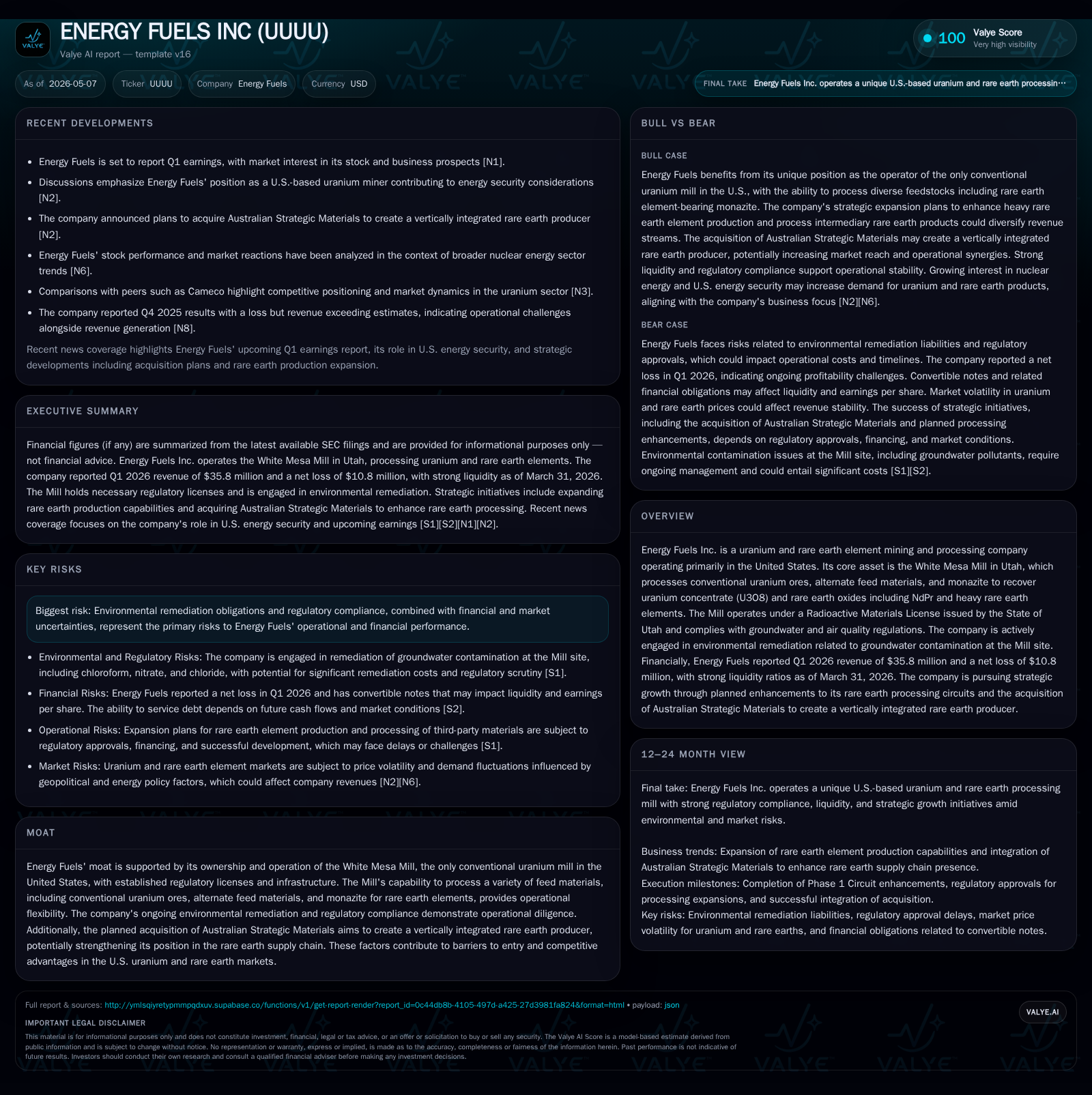
In the first quarter of 2026, Energy Fuels Inc. maintained active uranium production at its White Mesa Mill while progressing on rare earth element (REE) processing expansions and the acquisition of Australian Strategic Materials. The company posted $35.8 million in revenue but incurred a net loss reflecting investment in growth initiatives and environmental remediation. Energy Fuels’ competitive edge stems from exclusive U.S. uranium milling infrastructure and an expanding REE value chain footprint. Growth is driven by uranium production ramp-up opportunities, rare earth processing advancement, and acquisitions targeting vertical integration. Key risks include regulatory compliance costs, environmental remediation liabilities, and capital structure leverage pressures.
Latest Operating Update: Q1 2026 Results
Energy Fuels Inc.’s latest quarterly filing dated May 6, 2026 ([S2]) presents key operational data ahead of the full year context that frames its evolving business model. The company reported revenue of approximately $35.8 million driven primarily by uranium concentrate sales and alternate feed material processing at its White Mesa Mill in Utah.
However, despite top-line generation, Energy Fuels recorded a net loss of $10.8 million reflecting ongoing costs related to mining operations, mill campaigns run according to feed availability, planned environmental cleanup activities, as well as continued investments into rare earth processing capabilities.
Liquidity metrics remain robust with a current ratio of roughly 27.5 supported by nearly $108 million cash and equivalents against modest current liabilities of about $36 million ([F1]). Nonetheless, total debt outstanding stood high near $700 million as of March 31, 2026 reflecting previous financing activities tied to growth projects ([F1]).
Additional disclosure from an April 17 event filing ([S3]) notes upcoming changes in board composition with two directors not seeking re-election at the June annual meeting; this does not appear to reflect governance disruptions.
Business Model: Uranium Milling Meets Rare Earth Expansion
At its core, Energy Fuels operates the White Mesa Mill — currently the sole conventional uranium mill licensed in the United States — capable of processing up to 2,000 tons of uranium ore daily and annually over 8 million pounds of U3O8 ([S1]). This facility holds a unique strategic position enabling it to accept feedstock not only from Energy Fuels’ own properties across the Colorado Plateau region but also third-party ore purchase or toll milling arrangements.
Significantly, the Mill’s capabilities extend beyond uranium to process alternate feed materials including low-grade ores and monazite sands rich in rare earth elements (REEs), notably neodymium-praseodymium (NdPr) oxides and heavy REEs such as dysprosium (Dy) and terbium (Tb). This dual capacity affords commercial flexibility depending on commodity markets while enhancing asset utilization.
Energy Fuels further differentiates itself through initiatives aimed at recovering specific radioisotopes (Ra-226 and Ra-228) from existing process streams for use in emerging targeted alpha therapy (TAT) cancer treatments — a diversification into medical isotopes signaling innovation beyond traditional mining operations ([S1]).
Revenue mechanics pivot primarily on uranium assay grades processed at the Mill, volumes of alternate feed materials accepted, and sales contracts executed with utilities under long-term agreements—six such contracts were noted as active at year-end 2025 ([S1]). Pricing power is largely exposed to spot uranium prices but partially insulated through these contracts.
Rare earths represent an emerging growth vector where planned enhancements in processing infrastructure coupled with new supply sources aim to upgrade product mix quality and deepen margins. The acquisition arrangement with Australian Strategic Materials (ASM), discussed later, complements this strategy by integrating upstream monazite harvesting with downstream REE processing capacity ([S13],[S24]).
Operationally, the company's campaign-driven milling approach permits nimble response to feedstock availability and market demand fluctuations but places emphasis on efficient inventory management and market timing to optimize profitability.
Industry Structure & Competitive Position
Energy Fuels occupies a singular niche as owner/operator of the White Mesa Mill – a critical asset underpinning U.S. domestic uranium production capability given limited conventional milling infrastructure nationwide ([S1]). This advantage creates substantial regulatory barriers to entry given stringent NRC/State licensing requirements combined with complex environmental compliance standards.
In uranium mining, it competes alongside ISR operators focused on sandstone-hosted deposits in Wyoming and Texas but enjoys differentiation through conventional milling scale and feedstock versatility. With U.S. nuclear utilities seeking secure domestic supplies amid growing geopolitical concerns over foreign-sourced uranium, Energy Fuels stands as a key supplier poised to benefit from national energy security initiatives.
The company's extended portfolio covers multiple permitted or ready-to-permit mines (Pinyon Plain, La Sal Complex, Bullfrog Project among others), forming a flexible production base capable of scaling output following favorable market signals ([S1]).
Within critical minerals policy frameworks emphasizing supply chain resilience for rare earths critical to clean energy technologies and defense applications, Energy Fuels’ REE recovery builds on White Mesa’s monazite processing expertise complemented by the Donald Project JV in Australia — notable for its heavy REE content required for permanent magnets—positioning it competitively versus fragmented global producers reliant on China-dominated supply chains ([S1]).
However, industry headwinds include prevailing price volatility for both uranium and rare earth products coupled with environmental liabilities impacting cost structures.
Growth Drivers
Uranium Production Expansion
Energy Fuels anticipates producing between 2.0 to 2.5 million pounds of U3O8 from its three main conventional mines during 2026: Pinyon Plain, La Sal Complex, and Pandora ([S1]). Additional mines like Whirlwind (Colorado) are being prepared for potential production increases as market fundamentals improve.
Forward-looking strategies also encompass advancing larger scale projects such as Roca Honda and Bullfrog that could together yield over five million pounds annually upon successful permitting and capital deployment within future years ([S1]). Flexible ore purchase agreements or toll arrangements enable production buffering linked closely to spot pricing trends.
Rare Earth Integration & Verticalization
A cornerstone growth thesis is the ASM acquisition effort which intends to establish Energy Fuels as an integrated producer across monazite mining through downstream separation — addressing bottlenecks common in REE supply chains ([S13],[S24]).
The Donald Project is strategically important due to high grades of heavy REEs like Dy/Tb required for permanent magnet applications vital to electric vehicles and wind turbines; targeted production start-up is slated for H2 2027 ([S1]).
Enhancements planned at White Mesa will broaden separated REE oxide outputs including NdPr business lines valuable due to higher pricing power relative to bulk oxides. This offers margin improvement potential over prior campaign milling focused solely on uranium recovery.
Medical Isotope Development
While earlier stage relative to core commodities operations, ongoing work on recovering Ra-226/Ra-228 radioisotopes introduces optionality tied to burgeoning demand for alpha-particle therapies designed for targeted cancer treatment modalities; successful commercialization could diversify revenue streams significantly ([S1]).
Risks & Constraints
Environmental Remediation Obligations
Continuing efforts addressing groundwater contamination associated with milling tailings impose persistent compliance costs alongside reputational risks ([S1]). Regulatory agencies maintain strict oversight via Utah’s Radioactive Materials License conditions requiring remediation activities potentially shaping operating costs unpredictably.
Regulatory & Permitting Complexity
Permitting expansion projects locally illustrates protracted timelines along with uncertainty inherent in federal/state approvals particularly linked to indigenous consultations or land use restrictions affecting mine development trajectories ([S1],).
Market Price Volatility
Uranium prices remain influenced by global inventory cycles modulated by geopolitical decision-making over nuclear fuel sourcing; similarly rare earth prices fluctuate based on Chinese export policies influencing global supply-demand disequilibria affecting Energy Fuels’ commodity realization levels.
Capital Structure Leverage
The company’s Q1 balance sheet evidences a sizable total debt load near $700 million compared with cash holdings around $108 million — net debt thus approximately $592 million ([F1],[S2]). Servicing this debt amidst potentially volatile commodity markets constitutes an ongoing financial risk requiring prudent liquidity management.
Conversion features embedded within recent notes issuance could pressure liquidity if triggered requiring cash or share settlement potentially diluting equity holders or constraining operational funding flexibility ([S18],).
What To Watch Next
- Successful closing and integration milestones relating to the ASM acquisition expected post regulatory approvals confirming verticalization execution timetable ([S13],[S24]).
- Progress on capital deployment toward scaling Donald Project construction including finalizing financing arrangements especially debt tranche drawdowns under Export Finance Australia conditional support letter ([S1]).
- Updates on permitting timelines or government communications regarding expansion projects such as Roca Honda or Bullfrog that would materially expand future uranium output capacity ([S1]).
- Quarterly revenue trend evolution especially any shifts attributable to rare earth sales contributions versus traditional uranium concentrate revenues indicating product-mix improvements ([Coming quarters filings/Natural linkage]).
- Environmental remediation cost disclosures serving as barometer for regulatory compliance risk exposure changes going forward.
- Market pricing trends in both nuclear fuel markets globally plus critical mineral pricing backdrop influencing contract renewal negotiations or spot-based sales volume decisions.
- Debt servicing cost disclosures or any refinancing efforts impacting capital structure sustainability metrics measured against operating cash flows.
- Board governance developments pertinent given recent director departures potentially signaling shifts in strategic oversight priorities.[S3]
Financial Profile Snapshot Q1 2026 End [F1][S2]
Latest financial snapshot
| Metric | Value | Period |
|---|---|---|
| Cash & equivalents | $108mm | |
| 2026-03-31 | ||
| Total debt | $700mm | |
| 2026-03-31 | ||
| Net debt | $592mm | |
| 2026-03-31 | ||
| Current assets | $993mm | |
| 2026-03-31 | ||
| Current liabilities | $36mm | |
| 2026-03-31 | ||
| Current ratio | 27.51x | |
| 2026-03-31 |
Source: SEC companyfacts cache [F1].
The balance sheet reflects strong short-term liquidity capable of supporting operational needs but highlights heightened leverage demanding careful management amid uncertain commodity price environments.
This analysis synthesizes SEC filings through May 2026 combined with contextual industry insights relevant to Energy Fuels’ strategic positioning within U.S. domestic uranium production and critical minerals supply chain expansion via rare earth elements integration.
Disclaimer: This document presents factual analysis without investment advice or recommendations.
Disclaimer: This is research-only, informational analysis and not investment advice. It may include AI-generated interpretation and general industry context. Always verify important details using primary sources.

Comments