
Bitwise Solana Staking ETF Seeks to Capitalize on Growing Crypto Staking Demand
The trust’s May 2026 quarterly report reveals operational nuances in staking returns and expense dynamics as it broadens access to Solana exposure via a liquid exchange-traded structure.
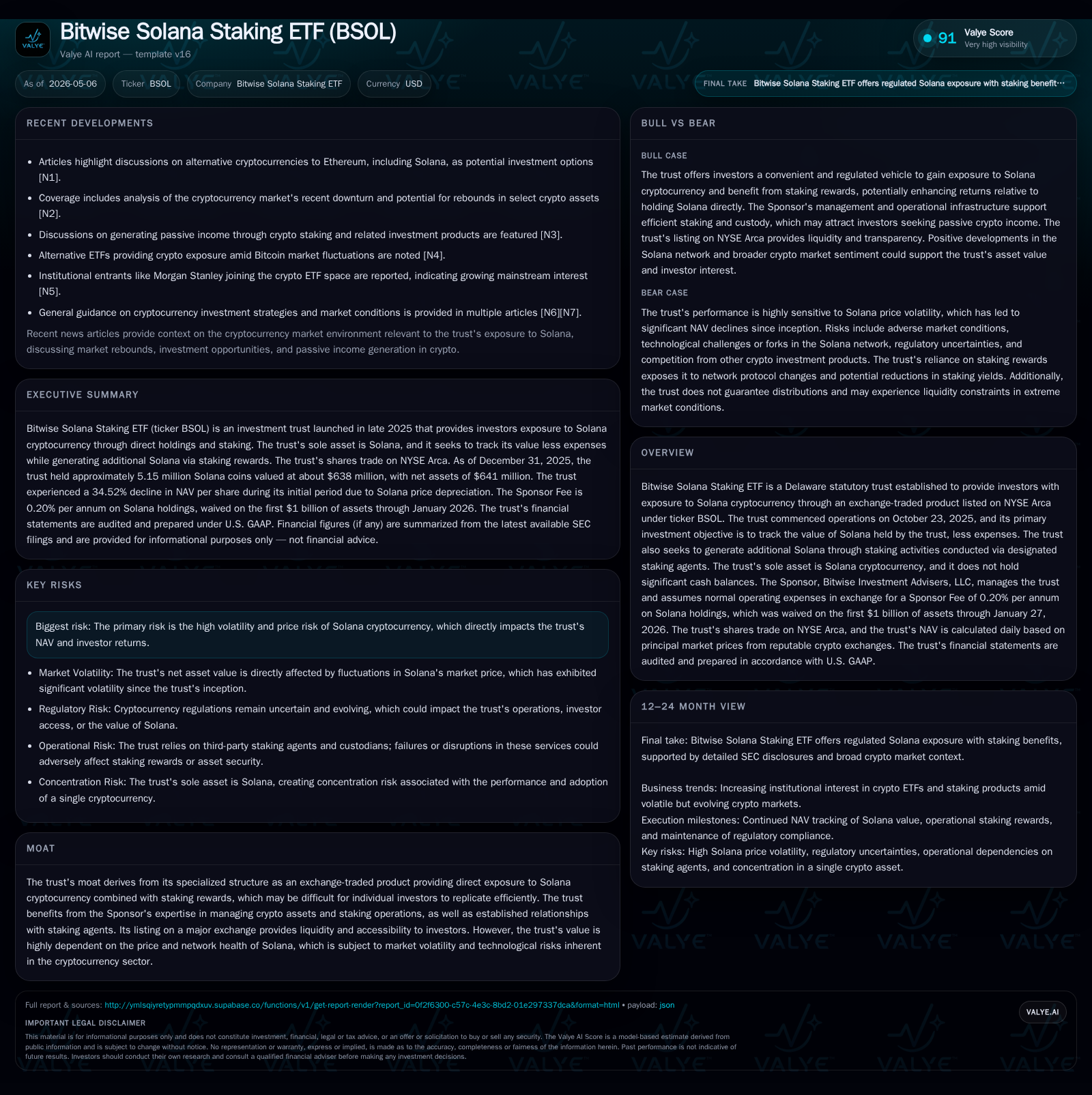
Bitwise Solana Staking ETF (BSOL) launched trading in late 2025, offering a unique investment vehicle combining direct Solana cryptocurrency exposure with institutional-grade staking rewards. Its latest quarterly filing highlights ongoing reliance on Solana price performance and staking yields amidst resumed sponsor fees post-waiver. The trust leverages Bitwise’s custody and staking relationships to overcome operational complexities typical of crypto assets. While market volatility and regulatory uncertainty remain substantial risks, BSOL’s structure provides retail and institutional investors an accessible, liquid proxy for Solana staking, positioning it well within the evolving digital asset investment landscape.
Latest Quarterly Operating Update and Implications
Bitwise Solana Staking ETF’s most recent quarterly filing dated May 6, 2026 [S2] offers insightful updates into its operational standing since commencing trading in late October 2025. Key among these developments is the expiration of the initial Sponsor Fee waiver that covered the first $1 billion of assets through January 27, 2026. Post-waiver, the Trust began accruing the standard Sponsor Fee at an annualized rate of 0.20% on its Solana holdings. This transition from effectively zero net expenses to a modest fee base represents a meaningful influence on operating costs borne by the trust.
In addition to structural expense shifts, the quarterly disclosures highlight continued generation of incremental Solana tokens through staking activities delegated via designated agents authorized by the Sponsor. These staking rewards furnish a supplemental income stream that accrues directly to the Trust’s NAV, adding a layer of return not available from mere direct holding of crypto assets without active participation in network validation processes.
Notably, no additional debt facilities or leverage mechanisms have been introduced or utilized in this period [S2]. This conservative capital approach underscores reliance solely on inflows from new share issuance or redemption activity tied directly to underlying asset movements.
The net asset value per share continues to track closely with Solana’s market price fluctuations as reported by principal markets designated by the Sponsor under U.S. GAAP fair value rules [S1]. Consequently, BSOL is exposed fully to market volatility inherent in large-cap utility tokens like Solana. The latest filings confirm no material legal proceedings or regulatory actions targeting BSOL or its Sponsor during this recent quarter [S2][S3], maintaining operational stability.
Trust Business Model and Product Highlights
BSOL operates as a Delaware statutory trust structured to hold solely Solana cryptocurrency for investor exposure via an exchange-traded product listed on NYSE Arca under ticker symbol "BSOL" [S1][S6]. Investors acquire shares representing proportional interest in the Trust’s aggregate Solana holdings less expenses.
What differentiates BSOL is its integrated staking strategy—rather than passively holding Solana, the Trust delegates coins to specialized staking agents who run validator nodes in the Solana network protocol. This active participation generates additional tokens distributed back to the Trust, creating potential for compounded growth beyond mere appreciation in Solana spot prices.
The offering benefits from Bitwise Investment Advisers LLC’s role as Sponsor managing daily operations including asset custody secured via contractual arrangements with recognized service providers such as BNY Mellon for administration and Coinbase-affiliated entities for execution [S1][S8]. This layered custody architecture mitigates individual investor friction points like key management, transaction settlement risks, and counterparty credit exposure common in self-managed crypto holdings.
Shares are created or redeemed in baskets of 10,000 units with Authorized Participants facilitating flow between primary market operations and secondary liquidity pools [S27]. This mechanism maintains tight price alignment between NAV and market trading price while offering deep liquidity uncommon among direct cryptographic asset funds.
Fee arrangement comprises a unitary Sponsor Fee of 0.20% per annum applied to Solana holdings; notably waived initially up to $1B AUM but now active since early 2026 [S25][S26]. The Sponsor assumes ordinary operating costs including trustee fees, audit expenses, marketing fees, and legal oversight up to stipulated ceilings —a cost structure designed for scalability without layering incremental charges onto investors.
Industry Positioning within Cryptocurrency Investment Vehicles
Within the nascent realm of cryptocurrency exchange-traded products (ETPs), BSOL occupies a specialized niche targeting exposure not just to token price movements but also embedding staking income streams—a feature relatively rare among comparable offerings focused solely on Bitcoin or Ethereum spot exposures.
Competition includes other crypto ETPs offering selective coin baskets or derivatives; however, BSOL’s focus on a single-layer stakeable asset provides clear differentiation particularly as demand grows for yield-enhanced crypto exposures. Furthermore, Bitwise’s pedigree as an established institutional sponsor with advanced infrastructure mitigates many operational risks often associated with newer entrants lacking robust service provider networks.
Regulatory context remains fluid: while prior SEC enforcement actions questioned security status of various digital assets including Solana references [S18], official designations have softened following recent litigation dismissals though regulatory scrutiny persists [S22]. Thus BSOL operates within a cautiously evolving compliance framework balancing innovation against oversight uncertainty.
Liquidity afforded by listing on NYSE Arca confers notable accessibility advantages versus decentralized finance (DeFi) platforms or over-the-counter purchases requiring heightened technical sophistication and custody responsibility. Moreover, retail investors can transact BSOL shares using standard brokerage accounts without separate wallet handling complexities intrinsic to native cryptocurrency ownership.
Staking as a Differentiated Growth Driver
The core value proposition rests heavily on staking economics—staking allows holders to lock up tokens within blockchain consensus mechanisms rewarding validators with new coins based on network participation and performance. For BSOL shareholders this translates into an ongoing accrual of additional Solana increasing overall NAV if conditions remain favorable.[S1]
This approach creates an economic moat: replicating such node-level engagement independently demands significant technical expertise, capital allocation precision, network risk assumptions (slashing penalties), and custodial safeguards—barriers overcome through centralized stewardship by Bitwise. As institutional demand grows for yield-bearing digital asset instruments amid low-rate environments elsewhere, this factor strengthens BSOL's relevance.
However, sustainability of yield depends fundamentally upon healthy network dynamics such as validator uptime quality, token inflation schedules embedded in protocol revisions (Solana’s tokenomics), and market appetite for locked coins affecting liquidity premiums.[S1] These variables must be closely monitored given their direct material impact on realized staking returns overtime.
Identified Risks and Market Constraints
Heavy dependence on underlying Solana price introduces acute volatility risk: continuous wide price swings induce corresponding NAV fluctuations adversely affecting shareholder wealth absent compensating returns elsewhere.[S1] Regulatory ambiguity around digital asset classification poses ongoing existential risk if classification shifts reclassify tokens as securities mandating enhanced registration compliance potentially disrupting product distribution.[S18][S22]
Technological vulnerabilities intrinsic to blockchain networks—including software bugs or consensus attacks—could imperil staked coins causing losses or devaluation. Custodial counterparty risk alongside operational risk related to trade execution especially under trade credit financing models (Agent Execution Model) may expose the trust to liquidation risks should counterparties face distress.[S7][S13]
Operationally, rising expenses beyond planned fee structure—particularly extraordinary legal costs triggered by emerging litigation—or impaired liquidity restricting creation/redemption activity could constrain growth strategies.[S5][S19]
Forward-Looking Milestones and Investor Considerations
Investors should track several upcoming indicators signaling BSOL’s trajectory:
- Staking yield data published periodically reflecting network health impacts on incremental Token generation rates;
- Total Assets Under Management growth beyond $1 billion mark potentially correlating with changes in fee revenue dynamics post-waiver;
- Trading volume and bid-ask spreads on NYSE Arca serving as metrics for secondary market acceptance;
- Regulatory pronouncements from SEC Crypto Task Force initiatives clarifying digital asset ETF frameworks affecting product legitimacy;
- Operational disclosures relating to new strategic partnerships or enhancements in custody/staking protocols improving efficiency or expanding capacity.[S2][S1]
These data points will shape confidence levels about BSOL’s capacity to deliver combined capital appreciation plus consistent staking income necessary for sustainable investor appeal.
Disclaimer: This analysis is informative only and does not constitute investment advice or recommendations regarding any securities or investment products mentioned herein.
Disclaimer: This is research-only, informational analysis and not investment advice. It may include AI-generated interpretation and general industry context. Always verify important details using primary sources.

Comments