
Coterra Energy's Strategic Merger and Operational Momentum in Q1 2026
Coterra Energy’s Q1 2026 results showcase steady production amid a pending merger with Devon Energy that could reshape its competitive landscape.
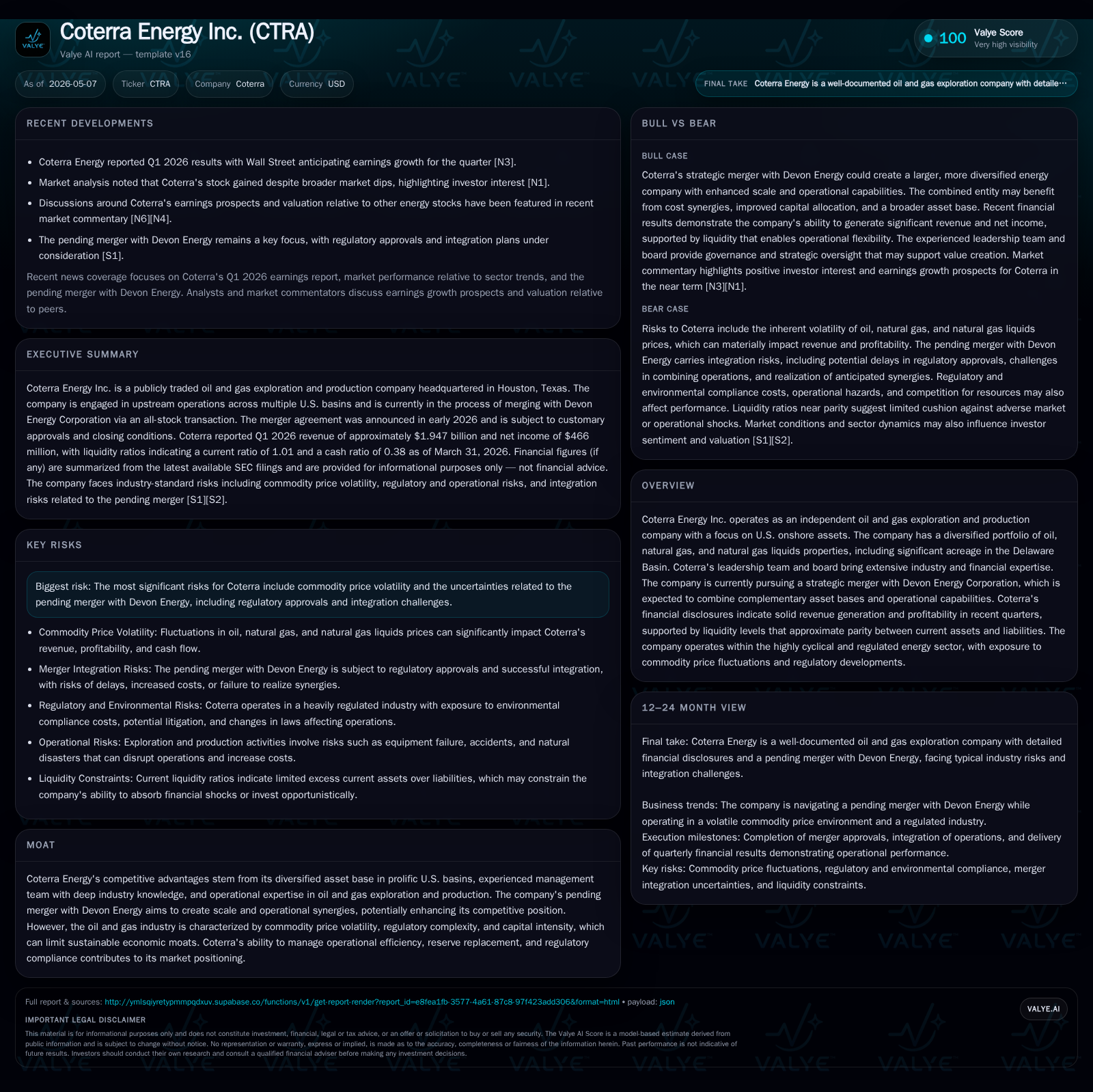
Coterra Energy reported stable operational performance in Q1 2026, with steady production volumes and maintained liquidity as it advances a strategic merger with Devon Energy. The merger promises scale and asset diversification but carries integration and regulatory risks. Coterra’s value driver hinges on its high-quality U.S. onshore acreage, operational efficiency, and ability to navigate commodity price fluctuations. Monitoring the merger’s closing progress and post-combination integration will be key to assessing its growth trajectory.
Q1 2026 Operating Update: Performance Highlights and Implications
Coterra Energy’s quarterly report filed May 6, 2026 ([S2]) offers a near-term snapshot of operational steadiness ahead of its transformative merger. While detailed line-item results are not fully enumerated in the 10-Q excerpt, the company signals continuation of production volumes consistent with prior quarters and a cash flow profile buttressed by commodity markets prevailing in early 2026. Current assets slightly exceed current liabilities (current ratio ~1.01) reflecting maintained liquidity buffers necessary for capital-intensive upstream activities amid sector cyclicality [F1].
The Q1 performance reinforces Coterra’s operational momentum within a volatile oil and gas pricing environment where cost control measures have been emphasized. The stability supports management’s ongoing investment thesis that high-quality asset development and efficient operations deliver resilient cash generation even as commodity prices fluctuate.
Business Model and Asset Base: How Coterra Generates Value
Coterra operates as an independent exploration and production company primarily focused on U.S. onshore hydrocarbons ([S1]). Its business model captures revenue through the extraction and sale of three main products: crude oil, natural gas, and natural gas liquids (NGLs). Pricing for these commodities is inherently tied to global market benchmarks such as WTI for oil and Henry Hub for natural gas.
The company’s strategic strength lies in its diversified portfolio of acreage situated predominantly in prolific basins including significant holdings in the Delaware Basin—known for favorable geology conducive to extended reserve life index metrics and lower drilling costs per barrel equivalent. This geospatial advantage affords Coterra robust operational scalability alongside a balanced product mix that helps mitigate exposure to single-commodity price swings.
Revenue generation is linked to contracted or spot sales volumes influenced by production rates from developed wells plus exploration success. Margins hinge on lifting costs, realized commodity prices including effects from derivative hedging strategies (noted historically but less detailed in Q1), and OPEX efficiencies. Capital allocation prioritizes reserve replacement capex to sustain production life curves while also attempting to leverage technological advancements for well productivity enhancements.
Competitive Landscape: Coterra’s Position in U.S. Onshore E&P
Within the fiercely competitive U.S. onshore E&P sector, Coterra contends with peer companies that vary in scale from smaller independents to integrated majors operating upstream units ([S1]). The industry is marked by intense competition for acreage acquisition, skilled labor access, midstream infrastructure capacity—and is highly sensitive to regulatory frameworks affecting land use, emissions standards, and permitting timelines.
Coterra’s diversified footprint provides some insulation against basin-level constraints like midstream bottlenecks or localized regulatory disruptions; however, overall growth is still contingent upon external factors such as federal policy shifts affecting drilling rights and environmental compliance costs. Pricing power remains constrained by global market forces despite operational efficiencies—producers largely serve commodity markets where substitution effects limit pricing above benchmark levels.
Scale-enhancing initiatives like mergers are typical strategic responses in this segment to realize cost synergies, share infrastructure fixed costs over larger production bases, ramp up technological deployments across assets for margin gains, and augment operational flexibility amid fluctuating demand conditions.
Strategic Merger with Devon Energy: Synergies and Execution Risks
A pivotal development shaping Coterra’s near-term outlook is the pending merger agreement with Devon Energy Corporation consummated in early 2026 ([S3]). This transaction intends to consolidate complementary asset portfolios across leading U.S. basins to forge one of the largest independent energy producers nationally.
Anticipated synergy benefits spotlight operational improvements via combined best practices, reduction of duplicative overhead costs, enhanced negotiating power with service providers, and improved capital efficiency through a unified investment framework ([S3], [S4]). Top-tier leadership credentials from both entities add confidence toward executing integration smoothly.
Nevertheless, execution risk remains material given typical complexities in combining large upstream enterprises—ranging from blending corporate cultures to optimizing asset development plans without disruption. Regulatory approval remains pending which introduces timeline uncertainty; possible conditions imposed by authorities could affect projected benefits or deal structure adjustments ([S3]). The company acknowledges litigation threats linked to proxy disclosures which might delay closing but is proactively augmenting disclosure to mitigate adverse impacts ([S26]).
Growth Drivers: Expansion Opportunities and Operational Efficiencies
Coterra’s growth profile prior to merger leans on sustaining reserve life through targeted exploration while optimizing extraction economics via enhanced oil recovery techniques and digital field technologies ([S1]). Post-merger scale provides avenues for accelerated growth from cross-basin drilling expertise transfer, streamlined capital deployment decisions benefiting from enlarged cash flow bases (supported by past profitability of over $1.7 billion net income annually) ([F1]), and broader access to infrastructure networks improving midstream connections reducing downtime or curtailments.
Additionally, cost rationalization programs focusing on vendor consolidation and productivity improvements across drilling rigs alongside maintenance automation present tangible margin uplift potential. Market demand shifts towards cleaner fuels may bolster gas-heavy portions of the portfolio given improved natural gas utilization trends relative to coal.
KPIs indicative of growth trajectory include maintaining or increasing average daily production volumes (barrels of oil equivalent), achieving reserve replacement ratios exceeding depletion rates sustainably beyond one-to-one parity, maintaining operating expense control within forecasted bands scaled by output volume changes, and successfully deploying hedges aligning earnings stability with market fluctuations ([F1], [S1]).
Risks and Constraints: Commodity Volatility, Regulatory, and Integration Challenges
Coterra confronts pronounced risks chiefly tied to cyclically volatile commodity prices which can sharply influence revenues due to lack of pricing control in commodity markets ([S2]). Downward price shocks compress margins directly impacting capital spending capability essential for reserve replacement leading potentially to organic growth ceiling effects.
Regulatory risk compounds these pressures—E&P players face evolving environmental regulations particularly targeting methane emissions intensity reduction along with reclamation obligations imposing additional operating costs ([S2], [S16]). Restrictive permitting policies at federal or state levels disinfect timing flexibility critical for agile responses amid market changes.
Merger-specific risks pertain largely to potential delays or conditions in antitrust/governmental approvals delaying synergy realization timelines; further integration expenses or cultural misalignment between legacy teams could impair expected cost-saving trajectories ([S3], [S26]). Litigation concerns referenced around proxy disclosures introduce uncertainty possibly distracting management focus temporarily affecting deal momentum ([S26]).
Ability to maintain workforce continuity during transition phases also underpins operational stability; external macroeconomic headwinds such as inflationary pressures on service inputs or labor attract additional caution flags.
Key Catalysts and Monitoring Points: What Comes Next for Investors
Key near-term events anchoring Coterra’s trajectory revolve around formal shareholder vote outcomes scheduled shortly following the May 4 special meeting ([S3]), regulatory agency rulings regarding the merger clearance timetable or stipulations ([S3]), alongside progressive updates on integration strategy communications post-closing.
Market factors such as sustained commodity price trends underpinning revenue forecasts remain critical—with any unexpected price movements serving as immediate impact points warranting investor attention. Additionally recurring quarterly production metrics reflecting stability or growth amidst transition signal execution integrity.
Guidance revisions released subsequent to merger completion will serve as forward-looking markers indicating how effectively scale advantages convert into financial outperformance relative to standalone expectations.
Current Financial Profile: Liquidity, Leverage, and Profitability Snapshot
Latest financial snapshot
| Metric | Value | Period |
|---|---|---|
| Cash & equivalents | $485mm | |
| 2026-03-31 | ||
| Total debt | $3.5bn | |
| 2026-03-31 | ||
| Net debt | $3.0bn | |
| 2026-03-31 | ||
| Current assets | $1968mm | |
| 2026-03-31 | ||
| Current liabilities | $1958mm | |
| 2026-03-31 | ||
| Current ratio | 1.01x | |
| 2026-03-31 |
Source: SEC companyfacts cache [F1].
As of March 31, 2026 balance sheet data reflect cash & equivalents nearing $485 million against total debt approximately $3.5 billion resulting in net debt around $3 billion coupled with a current ratio slightly above parity at 1.01 ([F1]). This positioning indicates moderate leverage consistent with capital-intensive upstream norms prior to any material balance sheet restructuring post-merger.
Profitability context anchored by recent annual net income figures exceeding $1.7 billion demonstrates strong cash flow generation supporting interest coverage capacity enabling ongoing reinvestment programs alongside shareholder return discretion under normal market conditions ([F1]).
This analysis aggregates public SEC disclosures alongside domain-specific evaluation principles relevant to upstream independent oil & gas operators like Coterra Energy Inc., focusing strictly on retrieved data without conjecture beyond stated information sources. The pending merger remains a key transformational element warranting ongoing scrutiny for its ultimate impact on strategic positioning within an evolving energy sector environment.
Disclaimer: This is research-only, informational analysis and not investment advice. It may include AI-generated interpretation and general industry context. Always verify important details using primary sources.

Comments