
TG Therapeutics Advances MS Leadership with BRIUMVI Commercial Rollout and Pipeline Expansion Amid Regulatory and Market Challenges
TG Therapeutics reports operational momentum in multiple sclerosis with BRIUMVI commercialization and pipeline trials while navigating market acceptance and regulatory risks.
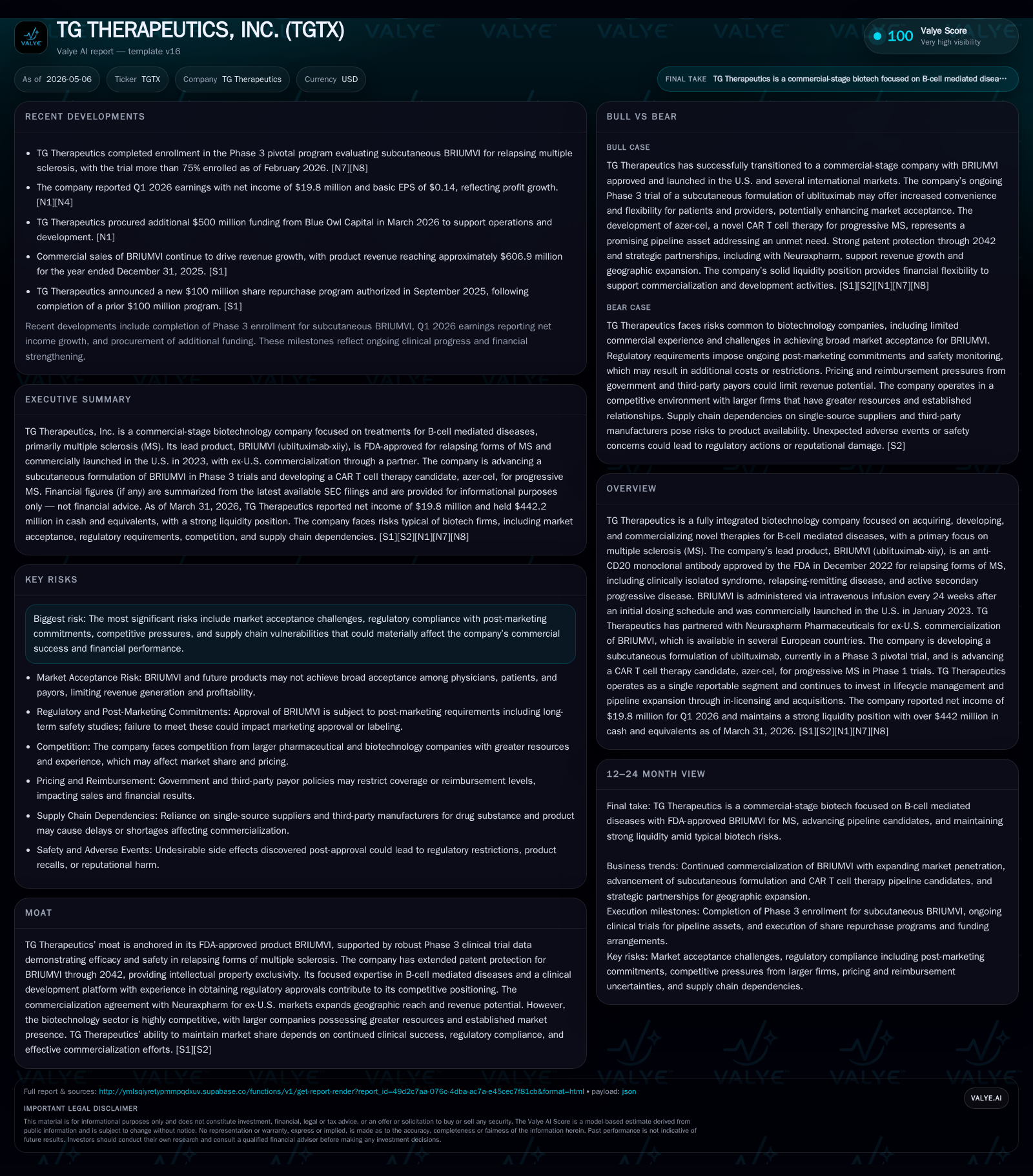
TG Therapeutics, a biotech firm focused on B-cell mediated diseases, continues to commercialize its FDA-approved MS treatment BRIUMVI in the U.S. and Europe, signaled by first-quarter 2026 filings showing progress toward profitability. The company is advancing a subcutaneous formulation of ublituximab in Phase 3 trials and expanding indications including myasthenia gravis and progressive MS. Despite these developments, TG Therapeutics faces constraints from competitive pressures, regulatory scrutiny on marketing practices, and debt covenants that limit strategic flexibility. Success hinges on sustained clinical outcomes, expanding market penetration, and effective execution of commercialization strategies.
Recent Operating Update
TG Therapeutics released its latest quarterly report on May 6, 2026, reaffirming continued commercialization traction for BRIUMVI (ublituximab-xiiy), approved by the FDA in December 2022 for relapsing forms of multiple sclerosis (RMS). The company noted operational progress despite modest top-line revenue disclosure given early-stage commercialization. As of Q1 2026, TG Therapeutics reported cash and equivalents of approximately $442 million and maintained a strong current ratio near 5.8x, reflecting solid short-term liquidity to support its commercial expansion and pipeline initiatives [S2][F1]. A recent event filing reiterated no material legal proceedings or disruptions affecting operations [S3].
The company continues executing its strategy to broaden BRIUMVI's footprint beyond the U.S. through Neuraxpharm’s commercialization in Europe since February 2024, now available in multiple countries. Enrollment completion in a Phase 3 trial investigating a subcutaneous formulation aims to offer an alternative to intravenous dosing, emphasizing convenience via less frequent administration intervals after initiation [N8][N9]. Parallel development programs target autoimmune diseases such as myasthenia gravis (MG) using ublituximab and progressive MS through AZER-CEL cellular therapy candidates initiated into Phase 1 trials recently, diversifying the therapeutic pipeline beyond RMS indications [S1].
Business Model
TG Therapeutics operates as a fully integrated biotechnology entity specializing in acquiring or internally developing therapies that target B-cell mediated diseases. Revenue generation currently hinges predominantly on sales of BRIUMVI—a monoclonal antibody targeting CD20-positive B-cells—which is clinically positioned for relapsing forms of MS including clinically isolated syndrome, relapsing-remitting disease, and active secondary progressive disease.
Revenue mechanisms revolve around physician prescribing patterns influenced by demonstrated clinical efficacy from pivotal Phase 3 trials (ULTIMATE I & II), which showed statistical superiority compared to teriflunomide across relapse rates and MRI lesion metrics. The product's intravenous administration every six months following initiation blends dosing convenience with sustained efficacy claims. Revenue drivers include attaining payer reimbursement coverage across U.S. commercial insurers and government programs, alongside expanding geographic access via partnerships such as with Neuraxpharm for markets outside the U.S.
Margins are subject to gross-to-net adjustments associated with mandatory rebates, chargebacks, discounts, and patient assistance programs. Cost structures are influenced by manufacturing complexity inherent to biologics production partnered with third-party Contract Manufacturing Organizations (CMOs), R&D investing in clinical trial design for new indications or formulations (notably the subcutaneous version), plus selling expenses including direct-to-consumer marketing campaigns—an area flagged for heightened regulatory oversight.
Industry Structure and Competitive Position
The multiple sclerosis therapeutic market is both sizable and growing due to increasing disease prevalence combined with rising utilization of high-efficacy disease-modifying therapies (DMTs). Within this context, anti-CD20 monoclonal antibodies constitute a leading class owing to their mechanism depleting pathogenic B-cells involved in demyelination.
TG Therapeutics' primary differentiation lies in BRIUMVI’s dosing schedule—one-hour infusion every 24 weeks—which competes against other anti-CD20 agents requiring more frequent dosing or longer infusion durations. The ongoing development of a subcutaneous formulation aims to further reduce administration burden by enabling more rapid injection-based delivery instead of IV infusions.
Competitors mainly comprise larger-cap pharmaceutical firms with established MS portfolios such as Roche/Genentech (ocrelizumab) and Biogen (ofatumumab). These incumbents benefit from deeper marketing resources, broader global reach, extensive payer contracts, established physician trust networks, as well as broader pipelines targeting neurological diseases.
TG Therapeutics’ partnership model for ex-U.S distribution expands its presence without absorbing significant capital expenditure but subjects it to partner execution risks. Maintaining patent exclusivity through at least 2042 secures intellectual property protection but continual innovation is critical given the dynamic competitive landscape with potential biosimilar entrants or novel treatment modalities.
Growth Drivers
- Expanded Indications: Advancing clinical programs exploring additional MS types beyond RMS like progressive forms via cellular therapies seeks to tap unmet therapeutic segments.
- Subcutaneous Formulation Launch: Positive Phase 3 outcomes could catalyze increased adoption by improving patient convenience, thereby expanding market share versus existing IV competitors.
- Geographic Expansion: Successful rollout in European markets through Neuraxpharm affiliates extends revenue diversity; further global licensing opportunities remain exploratory.
- Brand Awareness Initiatives: Campaigns such as the "Next In MS™" platform featuring Christina Applegate aim to enhance patient engagement and drive prescription demand through real-world dialogue promotion.
- Pipeline Diversification: Clinical trials enrolling patients for myasthenia gravis extend TG Therapeutics' reach into other autoimmune conditions mediated by aberrant B-cell activity.
Risks and Watchpoints
- Market Acceptance Uncertainty: Achieving physician preference against entrenched competitors requires sustained demonstration of efficacy-safety tradeoffs plus compelling convenience profiles.
- Regulatory Compliance: Heightened scrutiny regarding direct-to-consumer advertising mandates careful adherence; any missteps could result in enforcement actions adversely impacting brand reputation or marketing practices [S25].
- Supply Chain Vulnerabilities: Dependence on third-party manufacturers introduces risks of disruptions or quality control issues that could delay production or increase costs.
- Debt Load Constraints: The company’s current net debt position is negative, reflecting a strong liquidity buffer with cash exceeding total debt as of June 2024, which supports financial flexibility during operational challenges [F1].
- Post-Marketing Obligations: Ongoing monitoring requirements required by FDA approvals necessitate resource allocation towards compliance risking elevated operating expenses if adverse signals emerge.
- Competitive Pressure: Larger pharmaceutical companies possess scale advantages that may intensify pricing pressures or accelerate innovations marginalizing BRIUMVI’s differentiation.
What To Watch Next
Key milestones include interim readouts from the pivotal subcutaneous BRIUMVI Phase 3 trial which may significantly influence commercial adoption dynamics. Expansion announcements around second-generation indications such as progressive MS or MG will indicate pipeline maturation pace. Regulatory feedback addressing simplified dosing schedules submitted for FDA review constitutes another critical timing event impacting label breadth. Monitoring commercial uptake trends from U.S. physician prescribing data alongside European market penetration metrics will reveal competitive traction. Finally, debt covenant compliance reports or amendments could signal evolving balance sheet strategies affecting capital allocation decisions.
Financial Profile Snapshot (Q1 2026 Latest)
Latest financial snapshot
| Metric | Value | Period |
|---|---|---|
| Cash & equivalents | $442mm | |
| 2026-03-31 | ||
| Current assets | $1087mm | |
| 2026-03-31 | ||
| Current liabilities | $187mm | |
| 2026-03-31 | ||
| Current ratio | 5.81x | |
| 2026-03-31 |
Source: SEC companyfacts cache [F1].
Disclaimer: This analysis is based entirely on publicly available SEC filings dated up to May 6, 2026, third-party news sources contemporaneous to that date, and companyfacts financial data snapshots anchored thereto. It contains no investment advice nor price forecasts but provides an independent operating assessment consistent with rigorous industry analysis standards.
Disclaimer: This is research-only, informational analysis and not investment advice. It may include AI-generated interpretation and general industry context. Always verify important details using primary sources.

Comments