
Wintrust Financial Corp’s 2026 Q1: Strengthening Local Banking With Diversified Specialty Finance
Wintrust’s Q1 2026 results highlight robust loan income growth and asset diversification, underpinning its community-focused banking model amid regulatory and competitive challenges.
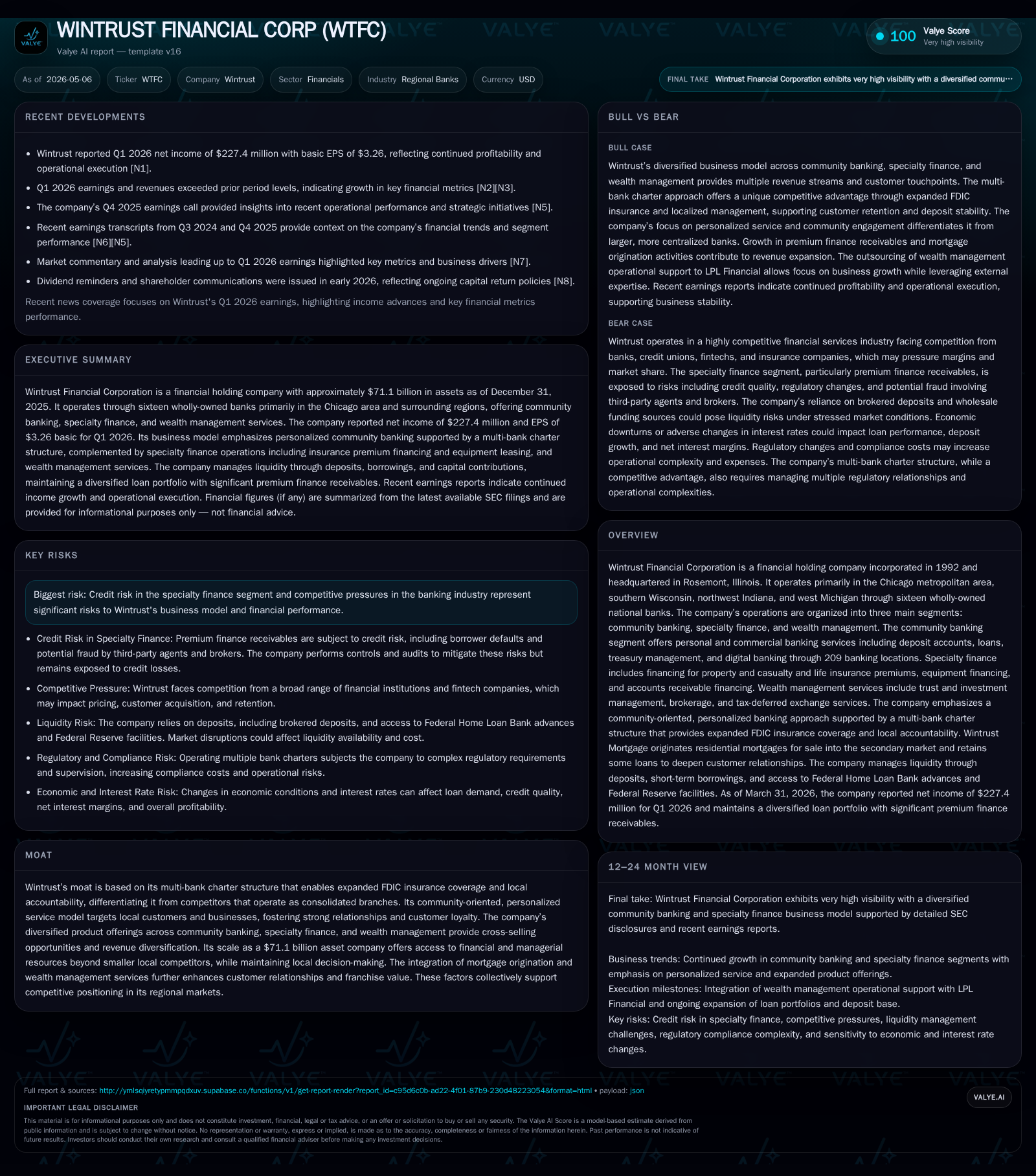
Wintrust Financial Corp demonstrated solid operating momentum in Q1 2026, with net interest income boosted by expanding loan portfolios and increasing yields on investment securities. The company’s multi-bank charter structure continues to support local banking relationships and FDIC insurance expansion, complemented by diversified specialty finance and wealth management units that provide revenue resilience. However, regulatory pressures on debit interchange fees and credit risk within specialty finance remain watchpoints. Looking forward, sustained loan growth, segment innovation, and digital capabilities will be critical to maintaining Wintrust’s competitive positioning and financial stability.
Q1 2026 Operating Results: Revenue and Asset Growth Insights
Wintrust Financial Corp’s first quarter of 2026 reflected sustained strength in its core lending activities and investment portfolio management. Interest income from loans rose to approximately $798 million for the quarter ended March 31, 2026, up from $768 million a year earlier [S2]. This increase was underpinned by expansion in average earning assets alongside improved loan yields amid a market environment characterized by a still upward sloping yield curve.
Simultaneously, interest income from investment securities climbed notably to over $100 million compared with $72 million in Q1 2025 [S2], reflecting both a larger available-for-sale securities portfolio—reported at roughly $7.24 billion at quarter-end versus $4.22 billion a year prior—and generally higher interest rates. The cash and equivalents balance also rose modestly to about $544 million at quarter end [S2], sustaining strong liquidity.
Collectively, these operating shifts bolstered Wintrust’s net interest margin maintenance while providing revenue diversification beyond traditional deposit spreads. The rise in securities holdings indicates strategic rebalancing towards high-quality fixed-income assets supporting steadier income streams.
Wintrust’s Business Model: Multi-Bank Structure and Segment Synergies
Wintrust operates via sixteen wholly owned national banks predominantly serving metropolitan Chicago and surrounding regions including southern Wisconsin and northwest Indiana [S1]. This multi-bank charter approach is central to its business model as it allows the company to extend FDIC insurance limits through deposit distribution across licenses—a notable differentiator from competitors consolidated under single bank charters.
This structure facilitates decentralized decision-making, fostering stronger community ties through localized leadership accountable for tailored customer service and relationship banking. Such proximity creates switching costs through personalized engagement unmatched by centralized megabanks.
Wintrust’s operations are organized into three distinct but synergistic reportable segments:
- Community Banking: Encompassing retail and commercial services such as loans, deposit accounts (including MaxSafe® products enhancing deposit insurance coverage), treasury management, and digital banking offered across 209 branches [S7][S15].
- Specialty Finance: Offering niche financing arrangements nationwide including commercial property casualty premium financing via FIRST Insurance Funding (48% of segment revenues), life insurance premium loans (28%), equipment leasing (2%), and accounts receivable financing (22%) through Tricom Inc. These businesses capitalize on specialized credit underwriting expertise enabling attractive yields with manageable risk profiles [S1][S19].
- Wealth Management: Providing trust services, brokerage solutions, tax-deferred exchanges, and investment advisory primarily focused on clients within Wintrust’s core geographic markets [S1][S15].
Cross-selling opportunities abound between community banking customers needing commercial loans or mortgages and wealth management services. Likewise, specialty finance operations benefit from consistent referral flow anchored in robust local bank relationships.
Industry Position: Competing with Personalized Service and Regulatory Nuance
Wintrust occupies a niche among regional banks leveraging its unique charter design to build a moat based on customer intimacy combined with scale advantages approximating a $71 billion asset base at end-2025 [S1]. Unlike branch-based regional players reliant on centralized service models, Wintrust preserves local accountability which fosters retention amid tight competition.
However, regulatory dynamics present headwinds particularly concerning debit interchange fees governed under Regulation II. As a large issuer subject to these rules, Wintrust faces potential revenue compression following the Federal Reserve’s October 2023 proposed rule lowering maximum debit interchange fees—from 21 cents to an initial baseline of approximately 14.4 cents per transaction—and adjusting other components downward for transactions post-final rule enactment through mid-2025 [S1].
While this may dampen non-interest fee income generated from card payments, Wintrust’s diversified revenue sources provide some insulation. Its community orientation also supports price resilience elsewhere via customized treasury solutions essential for local commercial clients.
Growth Catalysts: Loan Pipeline Expansion and Specialty Finance Innovation
Recent filings confirm Wintrust pursues growth through multiple interconnected levers:
- Expanding loan pipelines organically within existing markets leveraging cross-segment client penetration.
- Targeted acquisitions augmenting presence in adjacent geographies or sectors aligned with strategic product expansion goals.
- Continued diversification of loan portfolios by geography and product mix reducing concentration risks associated with cyclical downturns.
- Significant investments into technology infrastructure aimed at enhancing digital banking capabilities improving client acquisition efficiency while retaining personalized service standards [S1].
Within specialty finance, sector-specific innovation includes refinements in commercial premium finance products that stabilize credit performance despite exposure to insurer counterparty risks. The leasing operation extends equipment financing into varied verticals such as transportation and healthcare, broadening addressable markets.
These initiatives have translated into revenue resilience supported by broader client offerings with less cyclicality than interest rate sensitive mortgage flows.
Risks and Constraints: Credit Exposure in Specialty Finance and Interchange Fee Pressure
Operating risks center around credit exposure primarily within the specialty finance portfolio where premium financing loans rely on collateral backed by insurance policies. Although geographically diversified among insurers primarily across the US, UK, and Canada—with one insurer representing roughly 9% of balances—the concentration remains material enough to warrant close surveillance [S19]. Should carrier ratings deteriorate substantially beyond thresholds embedded in loan covenants, Wintrust has contractual recourse mechanisms but could face impaired asset quality.
Pressure on debit card interchange fees arising from proposed Federal Reserve regulation poses another risk vector that may reduce non-interest fee margins unless offset elsewhere via higher volumes or alternative revenue streams [S1].
Additionally, the intensely competitive regional community banking landscape limits pricing power on deposits and loans requiring Wintrust to maintain operational excellence combined with service differentiation.
Upcoming Milestones and What to Monitor Next
Key near-term metrics that could signal changes in Wintrust’s operating trajectory include:
- Loan growth rates across community banking and specialty finance reflecting both organic demand shifts and acquisition impacts.
- Net interest margin stability amidst evolving interest-rate environments affecting reprice dynamics for deposits versus earning assets.
- Credit quality indicators within specialized lending channels especially premium finance receivables incorporating insurer counterparty health measures.
- Impact assessment updates concerning finalization of Federal Reserve debit interchange fee rules expected post-June 2025 timeline.
- Progress reports on ongoing enhancements to digital platforms facilitating seamless client interactions combining personalization with scale efficiencies.
- Quarterly earnings outcomes relative to forecasts framing sustainability of current profit margins amid external pressures.
These milestones provide tangible evidence enabling evaluation of Wintrust’s adaptive execution against anticipated headwinds.
Financial Profile Overview: Capital, Liquidity, and Earnings Snapshot
Liquidity remained robust entering Q1 2026; liquid assets including cash plus interest-bearing deposits were about $3.6 billion at year end followed by availability exceeding uninsured deposits by over 120%, ensuring operational flexibility under stress scenarios [S4][S24]. Quarterly earnings benefited meaningfully from growing net interest income complemented by investment security yields rising above prior periods. Dividend policy showed continuity indicating confidence in steady cash flow generation capacity balanced against capital planning needs [S6].[F1]
This analysis synthesizes recent quarterly results detailed in SEC filings alongside broader business strategy disclosures to illuminate how Wintrust Financial Corp leverages its unique multi-bank structure coupled with diversified specialty finance segments to drive stable financial performance amid evolving regulatory landscapes and competitive market forces. This report does not constitute investment advice but aims to provide comprehensive insight anchored in verified disclosures.
Disclaimer: This is research-only, informational analysis and not investment advice. It may include AI-generated interpretation and general industry context. Always verify important details using primary sources.

Comments