
Bitwise Bitcoin ETF Reinforces Its Role As A Regulated Gateway To Cryptocurrency
The May 2026 10-Q filing underscores Bitwise Bitcoin ETF's operational position amid bitcoin's volatility and evolving regulatory pressures.
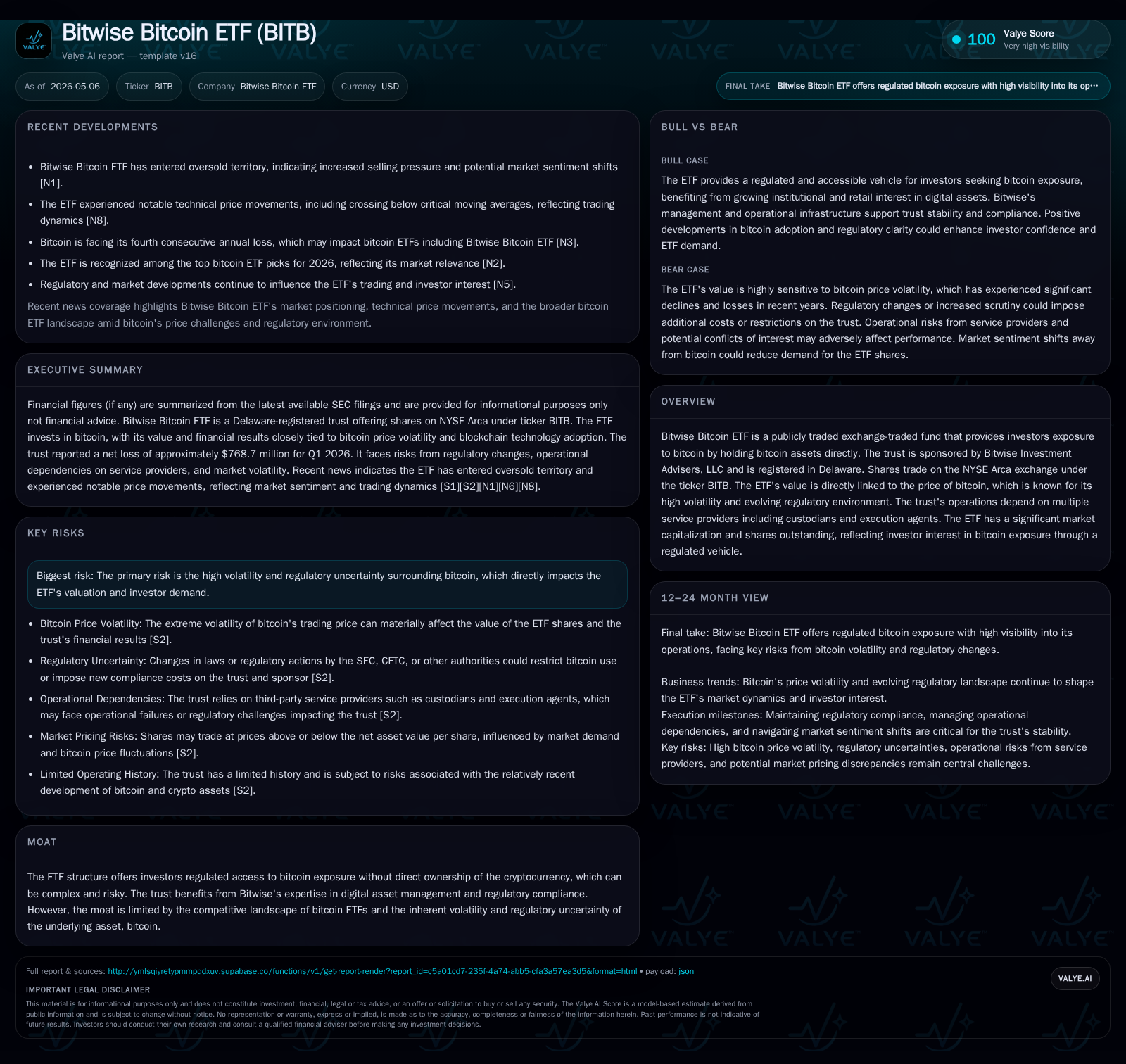
Bitwise Bitcoin ETF (BITB) remains a key regulated vehicle for institutional and retail investors seeking bitcoin exposure without the complexities of direct ownership. The latest quarterly filing reiterates significant risks tied to bitcoin’s price volatility, regulatory uncertainties including potential money transmitter regulations, and service provider dependencies. Despite these headwinds, BITB benefits from growing digital asset adoption and increasing market capitalization, supported by its structure as a physically-backed ETF and Bitwise’s management expertise. Near-term growth will hinge on regulatory clarity and broad acceptance of blockchain technologies, while custodial security and liquidity provision remain critical to sustaining investor confidence.
Latest Quarterly Snapshot: Operational Updates and Market Impact
The May 6, 2026 Form 10-Q serves as the most current disclosure reflecting Bitwise Bitcoin ETF’s (BITB) operational landscape amid unprecedented bitcoin price fluctuations and an evolving regulatory backdrop [S2]. The filing explicitly reiterates that extreme volatility in bitcoin’s trading price continues to materially affect the Net Asset Value (NAV) per share of BITB. This volatility challenges both the stability of the fund's share price in public markets—where shares may trade at a premium or discount to NAV—and investor demand.
Crucially, the filing highlights intensified regulatory scrutiny led by the SEC’s Crypto Task Force which has sharpened attention on digital asset products like bitcoin ETFs [S2]. BITB faces potential classification as a money service business or money transmitter—a shift that could impose substantial extraordinary expenses related to registration, compliance, and reporting. Such burdens could concurrently reduce liquidity in traded shares by raising entry barriers or limiting institutional participation.
Operationally, BITB remains dependent on a network of service providers including custodians specifically managing bitcoin assets, cash custodians for fiat holdings, and prime execution agents facilitating secondary market transactions. The filings disclose inherent risks linked to these intermediaries—from operational failures to geopolitical tariffs impacting service infrastructure—that could adversely impact fund operations or asset security [S2].
Finally, macroeconomic factors such as inflationary pressures and geopolitical tensions further compound disruption risks to the Fund’s holdings in bitcoin assets [S2]. These layered risk elements frame an asset class environment wherein BITB must sustain investor confidence despite frequent market dislocations.
Bitwise Bitcoin ETF’s Fund Structure and Revenue Model
BITB functions as a physically-backed exchange-traded fund registered in Delaware and sponsored by Bitwise Investment Advisers, LLC [S1]. Unlike synthetic or futures-based cryptocurrency ETFs, BITB holds actual bitcoins within its custody framework—allowing shareholders direct economic interest in bitcoin's performance without having to manage private keys or wallets themselves.
The trust generates value indirectly through investor demand for shares that trade on NYSE Arca under ticker BITB. Revenue streams for Bitwise derive primarily from management fees charged on fund assets under management rather than transaction margins since BTC itself varies largely outside control. This fee model favors scale: higher assets under custody increase fee income but expose BITB simultaneously to heightened regulatory compliance costs [S1].
The fund structure offers distinct advantages by addressing accessibility hurdles—providing compliance-verified institutional-grade exposure embedded within traditional brokerage accounts. However, it necessitates reliance on specialized custodians skilled in secure crypto asset storage alongside execution agents ensuring sufficient liquidity during share creation/redemption cycles [S1]. Such ecosystem dependencies underscore ongoing operational complexity unique to digital asset fund vehicles compared with standard equity ETFs.
Competition and Industry Context: The Bitcoin ETF Ecosystem
Bitwise Bitcoin ETF operates within a competitive landscape marked by several regulated bitcoin ETFs competing primarily on custody security, fee structure transparency, liquidity depth, and regulatory positioning [S1]. Key peers include offerings from large asset managers who leverage distribution reach but contend with regulatory fragmentation given diverse interpretations at federal and state levels.
BITB’s moat is narrow; while its physically-backed trust structure offers clear legitimacy advantages over unregulated or derivative-based alternatives, competition intensifies from both established firms introducing bitcoin-linked products as well as emerging fintech platforms innovating in crypto custody solutions [S1]. Regulatory clarity remains a primary determinant shaping product proliferation across jurisdictions—a factor that constrains differentiation beyond basic trust mechanics.
Investor preference hinges significantly on perceived fund safety (custodial risk mitigation), management credibility (regulatory compliance breadth), fees charged versus expected returns given bitcoin price volatility, and ease of trading (market maker participation). Consequently, although BITB leverages Bitwise's management expertise and longstanding compliance initiatives to maintain relevance, its ability to defend market share faces structural limitations fueled by evolving regulation and asset class uncertainty.
Key Growth Drivers: Greater Adoption, Regulatory Clarity, and Market Dynamics
BITB's growth trajectory correlates strongly with accelerating acceptance of cryptocurrency investment vehicles among institutional allocators seeking regulated platforms offering spot exposure [S1][S2]. Momentum toward greater recognition of blockchain technology utility also supports investor interest since it lifts broader confidence frameworks underpinning digital financial products.
Regulatory developments provide another catalyst potential. Incremental clarifications or positive guidance from the SEC regarding crypto ETF rules could alleviate prevailing ambiguities that currently contribute to elevated compliance costs or restrain certain investor categories from participation [S2]. Notably, when regulatory guardrails stabilize favorably, entities like BITB stand poised to broaden their addressable investor base fueling incremental capital inflows.
Moreover, favorable shifts in bitcoin price trends enhance intrinsic product appeal by boosting NAV growth prospects thereby attracting momentum-driven speculative interest alongside strategic portfolio allocation decisions [S2]. Enhanced custodian robustness can serve additionally as an enabling factor promoting trust health.
No explicit quarterly data disclose recent NAV growth rates or issuance volumes but these drivers remain logically aligned with underlying sector dynamics evidenced generally across public crypto funds [S1][S2].
Risks and Constraints: Volatility, Regulation, Custodial Dependence, and Market Sentiment
BITB's risk profile is dominated by bitcoin's notorious price swings which directly influence NAV fluctuations potentially unsettling investor sentiment [S2][S3][S4][S5][S6]. This volatility undermines stable valuation modeling challenging portfolio risk managers reliant on gateway products for consistent exposure.
Regulatory uncertainty represents another major constraint. The potential imposition of money transmitter regulations could introduce significant nonrecurring expenditures altering operating cost structures negatively [S2][S3][S4][S5][S6]. Additionally, ongoing enforcement focus via SEC crypto task forces may mandate expanded reporting or licensing deepening regulatory burden.
Operational risks arise from reliance on third-party custodians—entrusted with securing high-value digital private keys—and executing agents ensuring liquidity provisioning. Failures here generate reputational damage or disrupt redemption mechanisms eroding shareholder trust. Geopolitical conflicts influencing tariffs imposed on vital service providers amplify these vulnerabilities as noted in periodic risk facets disclosed across filings.
Lastly, broader macroeconomic uncertainties including inflation trends or political instability inject further unpredictability into demand for speculative digital assets held indirectly via NFTs such as BITB shares.
Forward-Looking Considerations: What Investors Should Monitor Next
Investors should vigilantly watch forthcoming SEC pronouncements concerning crypto asset regulation especially directives related to money transmission classifications or specialized licensing requirements which carry direct cost implications affecting funds like BITB. Clarification here marks a critical milestone impacting structural growth feasibility.
Share issuance trends revealed through future quarterly filings can uncover investor appetite shifts providing real-time signals about market reception amidst macro turbulence. Monitoring custody partners' announcements or changes similarly informs evaluation of operational reliability—a core component underpinning long-term fund health.
Bitcoin market fundamentals also warrant attention; notable appreciation phases potentially generate renewed inflows into regulated vehicles whereas prolonged bear conditions might depress uptake affecting NAV positively biasing risk-return calculation models.
Finally emerging competitors introducing alternative digital asset exposure options could alter competitive dynamics pressuring existing funds structurally if new product innovations address existing consumer pain points better.
Concise Financial Overview: Quarterly Results and Capital Position
While detailed financial tables are beyond scope per policy constraints, available information indicates that BITB reported a net loss position consistent with the typical cycle tied closely to digital asset performance patterns [-344 million USD net income reported annually ending December 31, 2025; F1]. No material disclosures contradict absence of significant debt on balance sheet nor signal liquidity stress as per latest quarter statements [S2],[F1].
These financial characteristics align with expectations for an actively managed physically-backed bitcoin trust operating in a volatile high-growth segment where capital preservation is secondary relative to providing accessible cryptocurrency exposure.
This analysis synthesizes latest SEC filings alongside foundational business context revealing Bitwise Bitcoin ETF's steadfast role delivering bitcoin exposure amidst volatility-driven valuation challenges compounded by a shifting regulatory environment. Its strategic position benefits from investor desire for regulated access channels although market maturation remains contingent upon regulatory clarity alongside evolving competitive pressure within the crypto-fund ecosystem. Investors tracking this vehicle should focus particularly on operational partner stability signals alongside unfolding regulatory developments that will materially influence cost structures and liquidity profiles going forward.
Disclaimer: This is research-only, informational analysis and not investment advice. It may include AI-generated interpretation and general industry context. Always verify important details using primary sources.

Comments