
Pacira BioSciences’ Q1 2026: Cost Pressures and Pipeline Progress Define Outlook
Pacira’s latest quarterly results reveal revenue growth tempered by increased expenses, alongside meaningful advancements in its gene therapy pipeline shaping future growth expectations.
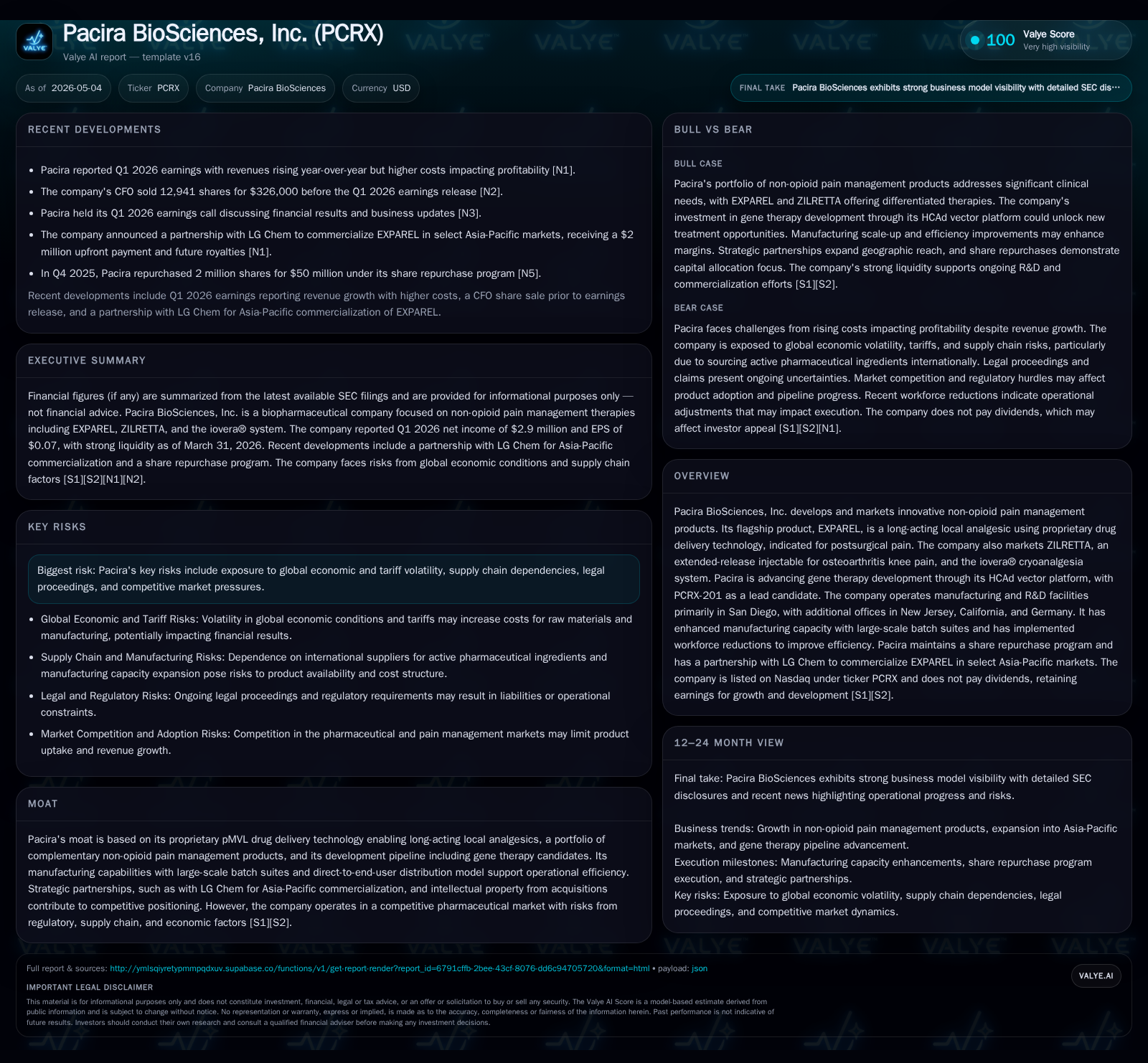
In Q1 2026, Pacira BioSciences posted year-over-year revenue gains driven by its non-opioid pain management portfolio but missed earnings estimates due to elevated operating costs, including increased stock-based compensation and supply chain pressures [S2][N2]. The company is advancing its gene therapy candidate PCRX-201 and strengthening international commercialization efforts via partnerships like LG Chem, underpinning medium-term growth [S1][S9]. Despite a solid liquidity base and manageable leverage, ongoing legal disputes and competitive risks warrant close monitoring. Upcoming milestones include regulatory filings in Asia-Pacific and pipeline trial readouts [S3][N3].
Q1 Operating Update: Earnings Miss and Cost Dynamics
Pacira BioSciences’ first-quarter report ended March 31, 2026 ([S2]) highlights a nuanced balance between topline progress and margin pressure. The company achieved year-over-year revenue growth primarily driven by its flagship product EXPAREL alongside contributions from ZILRETTA and iovera®. However, earnings fell short of market expectations due to elevated operating expenses. Key drivers of cost escalation include increased stock-based compensation expense related to performance share units (PSUs) granted under the company’s equity incentive plan. This compensation expense is systematically recognized over a four-year graded vesting schedule aligned with interim performance objectives, making timing critical to expense recognition patterns.
Notably, workforce reductions implemented previously aimed at enhancing operational efficiency have yet to offset inflationary pressures on labor and supply chain costs fully. These factors combined depressed margins despite operational scale gains. Additionally, while Pacira’s convertible senior notes due in 2029 remain outstanding at $287.5 million principal ([S2]), no conversion conditions were met as of quarter end, indicating investors have yet to exercise the option possibly due to current stock price levels relative to conversion rates.
The company continues proactive cost management while investing meaningfully in pipeline advancement and market expansion initiatives.
Product Portfolio and Business Model Overview
Pacira’s business model centers on innovative non-opioid pain management pharmaceuticals focusing on postsurgical and osteoarthritis-related pain relief. Its proprietary multivesicular liposome (pMVL) drug delivery technology enables extended release formulations delivering prolonged analgesia with single administration. EXPAREL, leveraging pMVL technology, remains the cornerstone product indicated for postsurgical local analgesia. Complementing EXPAREL are ZILRETTA—an extended-release intra-articular corticosteroid injection for osteoarthritis knee pain—and iovera®, a handheld cryoanalgesia device providing drug-free nerve pain control.
Revenue generation stems predominantly from direct sales through wholesalers primarily serving hospitals and ambulatory surgery centers across North America and Europe ([S1]). The direct-to-end-user distribution model grants Pacira greater pricing control relative to competitors relying heavily on traditional pharmaceutical distributors. Manufacturing operations based out of San Diego encompass large-scale batch suites capable of scaling output efficiently to meet demand surges. Additional facilities focused on R&D support pipeline innovation especially around gene therapy candidates developed via the HCAd vector platform.
This integrated model marrying proprietary technology with scalable manufacturing and targeted sales channels underpins resilience amid competitive headwinds.
Competitive Positioning and Industry Context
In the heterogeneous pharmaceutical landscape targeting pain management alternatives to opioids, Pacira occupies a niche defined by its patented drug delivery system—pMVL—and a diversified product suite addressing distinct pain modalities post-surgery or joint degeneration. This intellectual property moat offers protection against generic erosion in core categories; however, patent litigation risks loom as competitors seek entry points ([S8]).
Strategic alliances such as the arrangement with LG Chem for Asia-Pacific commercialization provide geographic diversification but introduce execution complexity across regulatory regimes ([S9]). Supply chain resilience remains critical given reliance on select manufacturing sites and key raw material suppliers.
Pricing pressures from healthcare payers debating cost-effectiveness of novel analgesics juxtapose against growing societal shifts toward opioid alternatives—a secular tailwind benefiting Pacira’s offerings structurally rather than cyclically.
Overall, Pacira’s combination of patented technology platforms and selective geographic market expansion currently secures a defensible competitive position though vigilance around litigation outcomes and reimbursement dynamics is prudent.
Growth Drivers: Innovation Pipeline and Market Expansion
Growth prospects rely heavily on advancing gene therapy candidates underpinning future product diversification beyond small molecule injectables. PCRX-201, utilizing Pacira’s HCAd vector platform for localized gene delivery targeting osteoarthritis knee pain, stands as a strategic innovation priority entering Phase 2 trials ([S1],[S9]). Successful clinical milestones here could reposition Pacira into biologics-driven therapeutics addressing vast patient populations currently underserved by standard care.
Moreover, expanding commercialization reach internationally via LG Chem’s exclusive rights in Asia-Pacific opens new revenue streams pending regulatory approvals anticipated in key markets like South Korea and Thailand during late 2026 ([S9]). Capacity expansion in manufacturing accommodates anticipated demand increases both domestically and abroad.
Supplementary growth derives from lifecycle management strategies around existing products including label expansions or new indications enhancing penetration rates within existing clinical channels.
Investment in R&D clearly links with medium-term value creation potential hinging on trial readouts, regulatory submissions, and adoption trajectory among prescribing clinicians.
Risks and Constraints: Supply Chain, Competition, and Legal Issues
Pacira faces multiple operational risks signaling caution. Supply chain fragility amidst global inflationary trends threatens input cost volatility potentially constraining margin improvement efforts ([S8]). Dependency on a few manufacturing hubs necessitates contingency planning particularly given recent workforce reshuffles aimed at trimming overheads—but which may strain capacity utilization if demand scales quickly.
Competitive threats stem from patent challenges notably lawsuits filed against makers seeking generic versions of bupivacaine liposome injectable suspensions—the foundation of EXPAREL—and unresolved appeals relating to proprietary claims ([S8]). Outcome uncertainty may affect exclusivity tenure impacting future cash flows.
Finally, macroeconomic factors including tariff fluctuations can affect material costs especially for components sourced internationally while reimbursement reforms targeting opioid alternative therapies inject dynamic pricing environment risks impacting net realized prices ([S9]). A vigilant stance toward regulatory developments will be essential going forward.
Key Near-Term Milestones and What to Watch
Investors should closely monitor clinical trial enrollment progress updates for PCRX-201 Phase 2 studies as these will serve as pivotal validation points for the gene therapy pipeline ([N3],[S3]). Progress in obtaining marketing authorizations within Asia-Pacific markets remains another lever for near-term revenue acceleration post-approval filings expected second half of 2026 ([S9]).
Management commentary during earnings calls regarding execution on operating expense containment—especially effectiveness of prior workforce reductions versus rising input costs—will inform margin trajectory forecasts ([N3],[N4]). Observing any shifts in convertible notes conversion sentiment or activity will also shed light on capital structure implications given outstanding convertible debt obligations ([S2],[N2]).
Furthermore, outcomes linked to ongoing patent litigations may yield material impacts either positively through successful defense or negatively if infringement findings emerge ([S8]).
Financial Snapshot and Capital Structure
Latest financial snapshot
| Metric | Value | Period |
|---|---|---|
| Cash & equivalents | $144mm | |
| 2026-03-31 | ||
| Total debt | $368mm | |
| 2026-03-31 | ||
| Net debt | $223mm | |
| 2026-03-31 | ||
| Current assets | $515mm | |
| 2026-03-31 | ||
| Current liabilities | $109mm | |
| 2026-03-31 | ||
| Current ratio | 4.73x | |
| 2026-03-31 |
Source: SEC companyfacts cache [F1].
As of March 31, 2026, Pacira maintained a healthy liquidity profile with cash and equivalents totaling approximately $144.3 million while holding total debt near $367.7 million primarily comprised of revolving credit facility borrowings ($86 million) and convertible senior notes due 2029 ($281.7 million) net of deferred financing costs ([F1],[S2],[S24]). The net debt position stands around $223.4 million reflecting moderate leverage that is manageable given operating cash flows.
The company's current ratio approximates a robust 4.73 reflecting ample short-term asset coverage over liabilities ([F1]). Interest expense remains modest relative to EBITDA supportive of debt service capacity along with compliance maintained against revolving credit facility covenants ([S18],[S21]).
-- Disclaimer: This analysis is strictly informational based on SEC filings, recent news reports, and company facts [F1] as of mid-2026 without offering investment recommendations or price guidance.
Disclaimer: This is research-only, informational analysis and not investment advice. It may include AI-generated interpretation and general industry context. Always verify important details using primary sources.

Comments