
Grand Canyon Education Leverages Long-Term University Partnerships to Sustain Growth Amid Market Challenges
LOPE’s integrated education services advance with strong Q1 2026 results, anchored by its strategic Grand Canyon University partnership.
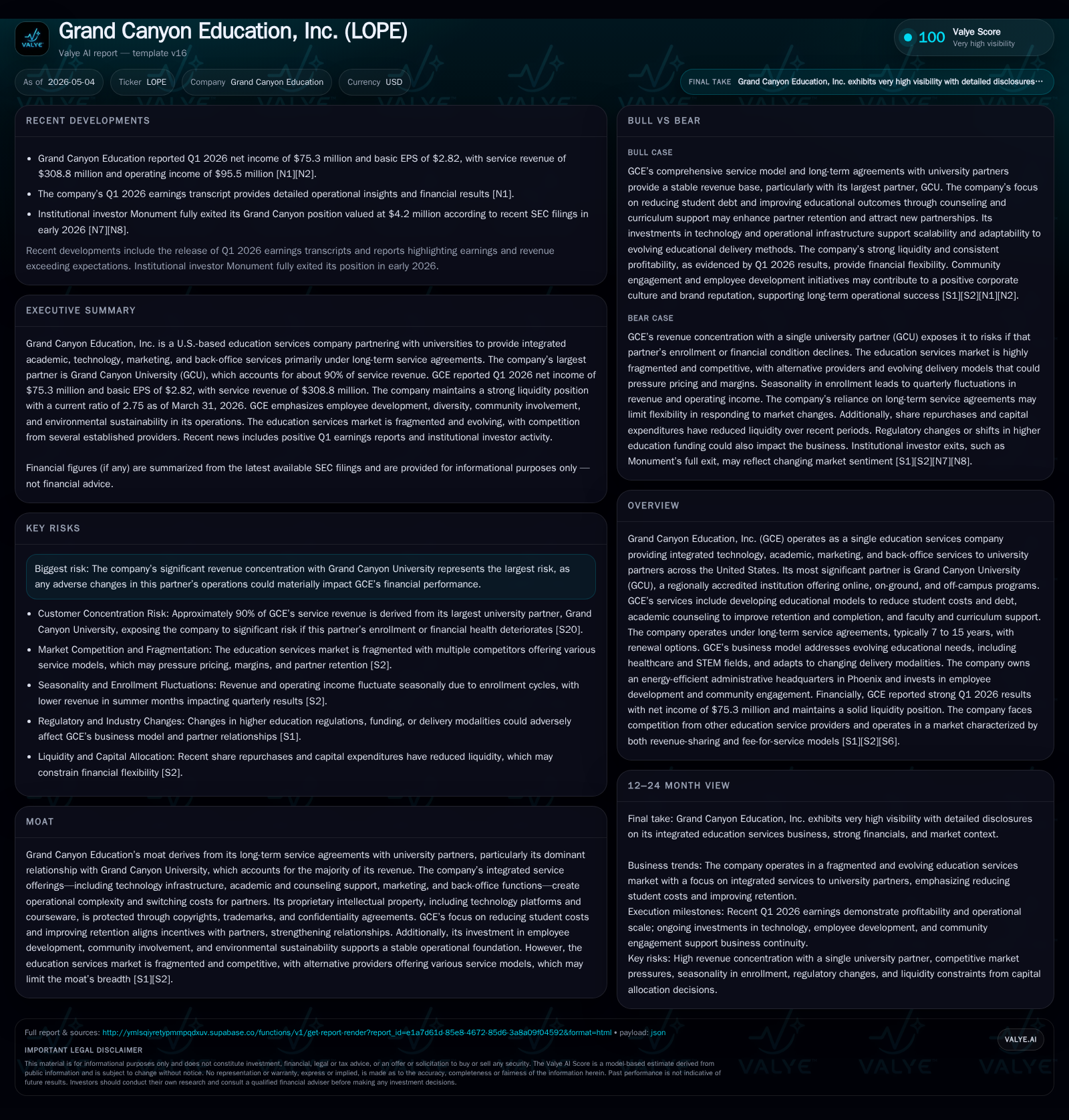
Grand Canyon Education, Inc. (LOPE) delivered solid operational performance in Q1 2026, underscoring the resilience of its education services model. The company’s core revenue derives from long-term service agreements with university partners, primarily Grand Canyon University (GCU), creating a moat through integrated academic, marketing, and technology offerings. Recent disclosures highlight stable net income growth and robust cash flow generation, albeit concentrated revenue and regulatory exposure remain key risks. Looking forward, LOPE’s growth drivers include expanding STEM and healthcare educational programs aligned with labor market needs, continued innovation in online delivery platforms, and potential new university partnerships. Execution milestones will hinge on partner enrollment trends and regulatory compliance adherence.
Recent Operating Update: Q1 2026 Highlights
Grand Canyon Education reported its first-quarter results for the period ending March 31, 2026 ([S2], [S3]). The quarter featured a net income of $75.3 million, slightly up from $71.6 million in the prior year quarter, signaling consistent profitability. Operating activities continue to generate strong cash flow with disciplined cost management across technology, academic services, marketing communications, and general administration segments. The company maintains a solid current ratio of approximately 2.75 and holds nearly $96 million in cash equivalents as of quarter-end, underpinning financial flexibility [F1], [S2].
Revenue recognition remains centered on longstanding Service Agreements with university partners that generally span 7 to 15 years. These agreements encompass a bundle of integrated services delivered continuously throughout the period rather than discrete transactions. The company applies practical expedients in financial reporting due to the single performance obligation nature of these contracts [S2], which emphasize sustained partnership economics over time.
Business Model
Grand Canyon Education operates as an education services company delivering integrated technology infrastructure, academic support services including counseling aimed at retention and completion improvement, extensive marketing campaigns targeted at prospective students via digital channels and brand strategy, alongside back-office functions like enrollment management and billing processing ([S1], [S2]).
The primary customer is Grand Canyon University (GCU), a regionally accredited institution that offers a diversified portfolio of online, on-ground campus-based programs across undergraduate and graduate levels. GCE's revenue is largely a percentage share of tuition fees generated by these university partners per their service agreements ([S1], [S22]).
Key strategic strengths emerge from this tightly coupled partnership model where GCE's vertically integrated platform generates operational complexity that deters partner switching due to intertwined IT systems, bespoke academic programming support teams, proprietary courseware development protected under copyrights and trademarks ([S1]). Additionally, GCE offers programs that enable universities to reduce overall student debt load through developing accelerated pathways such as dual-credit arrangements with high schools or online prerequisite courses that shorten time to degree completion ([S1]). This alignment helps universities maintain enrollment amid demographic pressures.
Customer incentives are aligned since increasing student retention directly translates into higher tuition-derived revenue streams shared with GCE. The extended contract durations provide visibility into future revenues while guarding against competitive encroachment. However, substantial single-customer revenue concentration inherently introduces volatility risk if partner dynamics deteriorate.
Industry Structure & Competitive Position
The outsourced education services industry includes competitors such as EmbanetCompass (historically linked to Pearson) and Wiley Education Services who offer varying degrees of online program management solutions ([S1]) but often lack the integrative scope or contract length enjoyed by GCE's partnership with GCU. Universities also increasingly consider insourcing administrative or instructional functions potentially constraining third-party provider growth.
Regulation plays a crucial role: third-party servicers must comply with guidelines under the Higher Education Act Title IV provisions including regular compliance audits mandated by the U.S. Department of Education ([S10]). Adherence to these regulations is critical since breaches might trigger liability both for GCE and its university partners.
GCE's moat primarily stems from:
- Long-term contractual lock-ins typically ranging from 7-15 years providing durable revenue streams.
- Integrated mix of exclusive software platforms supporting customized educational delivery.
- Intellectual property protection for curriculum design.
- Dedicated academic counseling services improving retention outcomes.
- Multi-channel marketing expertise attracting potential students across national markets.
- Investments in employee learning & development programs aiding service quality ([S1]).
Growth Drivers
The path forward involves multiple avenues:
- Programmatic Expansion: Aligning new offerings towards labor market shortages notably healthcare fields (e.g., nursing), science/technology/engineering/math (STEM), and teacher education helps address growing demand segments ([S1]).
- Online Modality Innovation: Continued enhancement of proprietary online platforms aims to boost student engagement metrics translating into higher retention rates.
- Partnership Development: While GCU dominates current revenues, scaling to additional accredited institutions could diversify client mix cautiously without diluting service quality.
- Dual Credit & Prerequisite Courses: Partnering with K–12 systems nationally expands student pipelines enabling earlier college-level course completions reducing overall educational cost burdens.
- Retention & Completion Services: Specialized counseling boosts degree attainment impacting revenue-sharing positively.
These elements will provide indications about revenue momentum sustainability and margin trajectory over the current fiscal year cycle.
Financial Profile Summary
Latest financial snapshot
| Metric | Value | Period |
|---|---|---|
| Cash & equivalents | $96mm | |
| 2026-03-31 | ||
| Current assets | $380mm | |
| 2026-03-31 | ||
| Current liabilities | $138mm | |
| 2026-03-31 | ||
| Current ratio | 2.75x | |
| 2026-03-31 |
Source: SEC companyfacts cache [F1].
As of March 31, 2026 the balance sheet shows $96.15 million in cash and equivalents against current liabilities of $138.4 million yielding a strong current ratio near 2.75 ensuring ample short-term liquidity for operations ([F1], [S2]). Q1 operating income continues delivering profitability reflective of scalable cost structure embedded within technology-enabled service delivery ([S2]). Share repurchases continue as part of capital return strategy funded primarily from free cash flow highlighting management confidence in underlying business fundamentals ([S13], [S26]).
Operating margins experience typical seasonal variability given academic calendar dynamics but remain within stable ranges consistent with prior years ([S14]). Investment emphasis prioritizes maintaining proprietary content development along with employee skill upgrades supporting service differentiation.[F1]
This analysis synthesizes publicly available SEC filings through Q1 2026 alongside sector-context assessments without constituting investment advice or recommendations.
Disclaimer: This is research-only, informational analysis and not investment advice. It may include AI-generated interpretation and general industry context. Always verify important details using primary sources.

Comments