
Atmos Energy's Q2 2026 Results Highlight Regulatory Asset Recovery and Infrastructure Investments
Regulatory asset capitalization and steady gas distribution underpin Atmos Energy's operational stability and growth in Q2 2026.
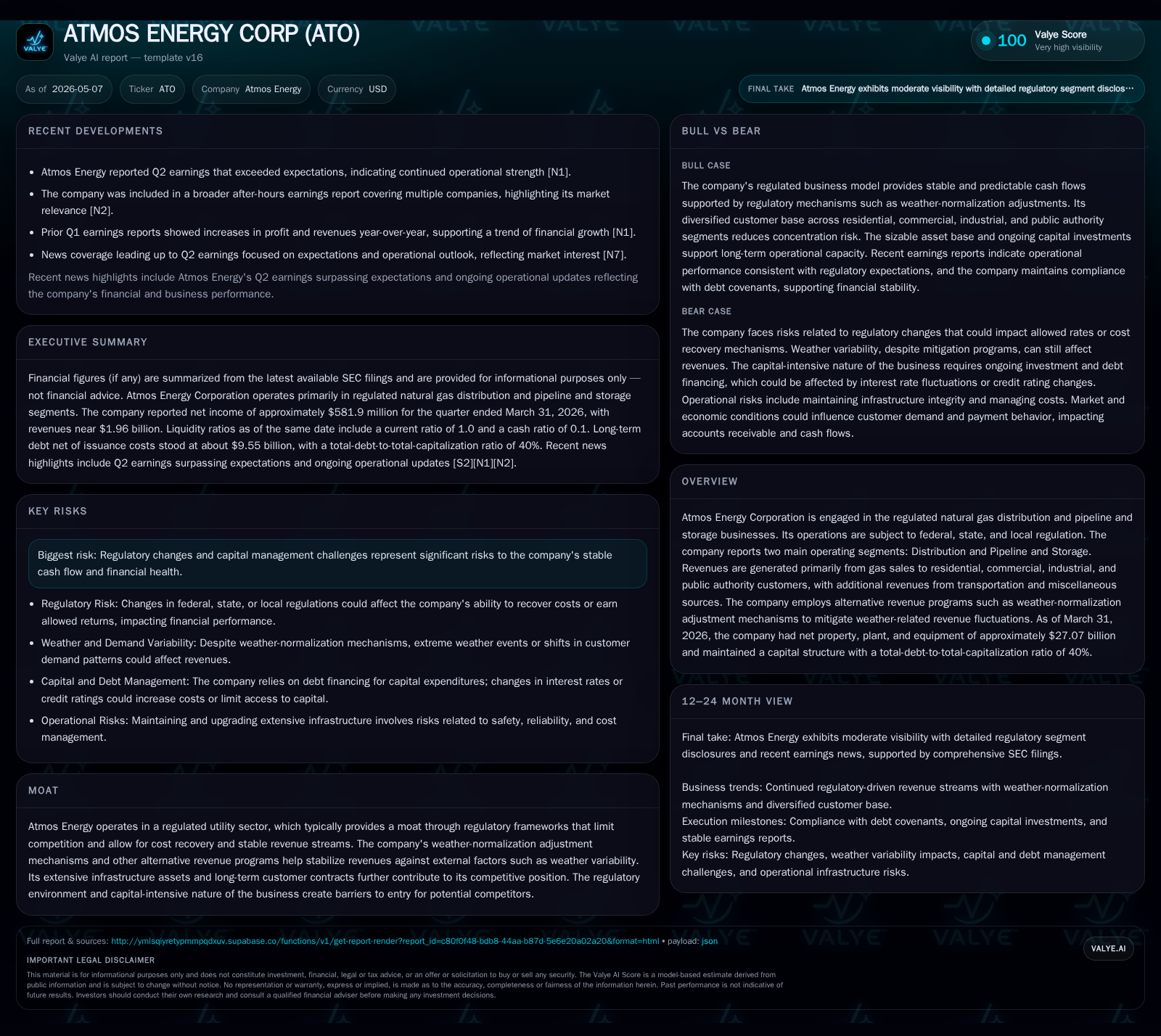
In its Q2 2026 filing, Atmos Energy Corporation disclosed the continued capitalization of costs as regulatory assets supporting stable earnings and infrastructure investments. Gas sales revenues remained consistent across key residential and commercial sectors, while the company extended maturities on major credit facilities to bolster financial flexibility. Operating within a highly regulated framework, Atmos leverages alternative revenue mechanisms like weather normalization to mitigate volatility and fund capital-intensive growth paths. Maintaining a 40% total-debt-to-capitalization ratio, Atmos balances robust infrastructure expansion with a stable regulatory moat, although it faces risks from regulatory changes and high leverage.
Q2 2026 Operating Update: Capitalized Costs and Revenue Stability
Atmos Energy’s latest quarterly filing dated May 6, 2026 [S2] underscores the continuation of expense capitalization practices wherein certain costs are recorded as regulatory assets when recovery through future customer rates is deemed probable. This regulatory accounting treatment supports earnings stability by deferring costs rather than immediate expensing. Regulatory liabilities are similarly recorded when expected revenues will be credited back to customers through ratemaking processes. Substantially, these regulatory assets and liabilities are presented in current asset and liability sections respectively.
In the six months ended March 31, 2026, gas sales revenues in the Distribution segment remained resilient with $2.0 billion from residential customers largely unchanged compared to prior period $2.0 billion [S2]. Commercial gas sales increased modestly from $746 million to $785 million reflecting steady demand growth while industrial sales also rose from $65 million to $77 million [S2]. Public authority revenues declined slightly but remain a minor component overall.
Transportation revenues grew notably in Pipeline and Storage segment (approximately $636 million vs $533 million prior YTD), indicating enhanced pipeline usage or contract expansions supporting firm transportation services [S2]. Despite available commercial paper programs totaling billions in capacity, no borrowings were outstanding at quarter end [S2], illustrating prudent liquidity management amid capital-intensive operations.
Furthermore, the company announced an extension of its $1.5 billion senior unsecured credit facility maturity from March 2028 to March 2029 as well as an increase opportunity on committed loans to $1.75 billion providing added financial flexibility [S2]. These moves enhance the stability of its capital structure amidst ongoing infrastructure investment requirements.
Business Model and Product Portfolio: Gas Distribution and Pipeline Segments
Atmos Energy operates principally through two regulated segments: Distribution and Pipeline & Storage [S1]. The Distribution segment serves roughly 3.4 million residential, commercial, public authority, and industrial customers distributed across six regulated divisions spanning eight states [S1][S24]. Revenues here stem primarily from natural gas sales under long-term rate-regulated contracts where prices reflect cost-based tariffs approved by state regulators.
The Pipeline & Storage segment includes interstate transmission pipelines transporting gas primarily into its Texas and Louisiana distribution systems along with underground storage facilities that ensure supply reliability [S1][S24].
Revenue mechanics focus on billings based on volumes consumed or transported multiplied by rates set via formal state or federal proceedings—thereby integrating volume-driven usage with pricing power constrained within regulatory guidelines. Importantly, alternative revenue programs such as weather-normalization adjustment mechanisms help smooth out volatility due to seasonal climate fluctuations that otherwise would affect gas consumption patterns materially [S1][S2].
Regulatory Environment: Moat and Rate Recovery Mechanisms
Atmos Energy benefits from entrenched regulatory protections typical in utility sectors that limit competition through franchise territories across its eight states of operations [S1]. The company’s extensive property plant & equipment base valued at approximately $27 billion supports these franchise rights while anchoring long-lived assets eligible for rate recovery [F1].[S1]
Cost recovery adheres to rate cases allowing Atmos to file for tariff adjustments that reflect prudently incurred expenses plus reasonable returns on invested capital. Weather-normalization adjustments embedded in several jurisdictions offset revenue variability linked to abnormal heating-degree days thereby delivering revenue consistency despite external environmental factors.
Encumbrances such as accrued regulatory assets (reflecting deferred costs awaiting recovery) and liabilities (representing over-collected revenues credited back) are systematically tracked on the balance sheet reflecting the ratemaking process’s influence on timing versus recognition mismatch [S2][F1]. These attributes collectively comprise a durable economic moat by constraining new entrants given capital intensity, regulatory approvals needed for market entry, and established customer bases reliant on reliable gas delivery.
Competition and Industry Positioning: Regulatory Barriers and Market Dynamics
The natural gas utility space in which Atmos operates presents minimal direct competition within its franchise territories due to regulated monopoly statuses sanctioned by local/state authorities [S1]. Competitive pressures mainly arise indirectly via alternative energy sources or efficiency gains reducing gas consumption.
Market dynamics favor incumbents like Atmos with deep existing infrastructure networks enabling economies of scale in maintenance, safety compliance, system upgrades, and resilience investments. Construction of new pipeline capacity is both capital intensive and subject to stringent permitting regulations limiting supply-side expansions outside incumbent operators.
Pricing power remains governed by prudential regulators requiring transparent cost justification but simultaneously provides stable cash flow streams absent commodity price exposure seen in unregulated businesses.
Customer switching costs are practically prohibitive given lack of viable alternatives for utility natural gas supply within regulated service areas enhancing retention prospects.
Growth Drivers: Infrastructure Expansion and Regulatory Programs
Growth catalysts center on ongoing infrastructure capital investment programs designed to modernize pipeline systems enhancing safety/integrity standards mandated by federal/state regulators [S1][S2]. Capital expenditure allocation accelerates operational capacity increases alongside replacing aging pipelines vulnerable to failures or leaks.
Rate mechanisms such as infrastructure riders permit timely recovery of prudently incurred capital expenditures between formal rate cases reducing lag risks on investment returns [S1]. This accelerates return cash flows incentivizing continuous network expansion.
Incremental transportation contracts under the pipeline/storage business also contribute revenues potentially leveraging incremental fixed-cost absorption improving segment margins [S2].
Expanding population bases serviced alongside higher penetration into commercial sectors can incrementally elevate demand volumes particularly where electrification lags transformation trends.
The effectiveness of weather-normalization adjustments reduces earnings unpredictability keeping underlying economics insulated against erratic climatic impacts maintaining cash flow stability.
Risks and Constraints: Regulatory Changes and Capital Intensity
Despite structural advantages, key risks persist including possible adverse regulatory decisions limiting allowed returns or disallowing certain cost recoveries which would materially affect profitability metrics [S1][F1]. Regulatory policy shifts especially toward decarbonization may also alter long-term demand patterns challenging the natural gas utility model.
Weather fluctuations remain an unavoidable fundamental risk even if partially mitigated via normalization programs; extreme events could disrupt supply chains or cause unexpected maintenance expense spikes.
High leverage associated with a nearly $9.5 billion debt stockpile necessitates vigilant capital management; recent maturity extensions aid liquidity but require ongoing free cash flow generation sufficiently exceeding service obligations [F1][S17][S19]. Interest rate exposure tied to variable-rate borrowings or refinancing needs underlines financial risk amid volatile credit markets.
Capital intensity means substantial upfront investments are mandatory before revenue recognition causing working capital strains if rate recoveries lag spending pace.
Upcoming Catalysts and Monitoring Points
Key milestones for market monitoring include upcoming state-level rate case filings or decisions that can recalibrate authorized tariffs affecting near-to-mid-term earning power [N11]. The company's capital expenditure guidance updates will provide visibility into infrastructure pacing impacting asset base growth.
Execution progress in pipeline integrity programs combined with any expansions in transportation contracts may shift segment profit contributions warranting close tracking during quarterly calls/webcasts scheduled post-Q2 earnings announcement May 7th [N1][N11][S3].
Atmos’s at-the-market equity sales program with remaining availability upwards of $827 million offers optionality for balanced capital structure management enhancing funding capacity without increasing leverage unduly [S27][F1]. Equity issuance cadence through this program should be assessed for dilution impact versus liquidity enhancement.
Finally, attentiveness toward any material changes in federal or state energy policy impacting natural gas long-term use trends is advisable given inherent sector reliance on regulated volumes.
Latest Financial Snapshot
Latest financial snapshot
| Metric | Value | Period |
|---|---|---|
| Cash & equivalents | $126mm | |
| 2026-03-31 | ||
| Total debt | $9.5bn | |
| 2026-03-31 | ||
| Net debt | $9.4bn | |
| 2026-03-31 | ||
| Current assets | $1262mm | |
| 2026-03-31 | ||
| Current liabilities | $1258mm | |
| 2026-03-31 | ||
| Current ratio | 1x | |
| 2026-03-31 |
Source: SEC companyfacts cache [F1].
This snapshot reflects a leveraged but manageable balance sheet aligned with regulated utility industry norms supported by positive net income generation year-to-date validating operational profitability underpinned by regulated tariff structures.
Disclaimer: This analysis is intended solely for informational purposes reflecting publicly available filings as of early May 2026 without providing investment advice or recommendations.
Disclaimer: This is research-only, informational analysis and not investment advice. It may include AI-generated interpretation and general industry context. Always verify important details using primary sources.

Comments