
Zevra Therapeutics Reports Strong Q1 2026 Performance Backed by MIPLYFFA Sales and Strategic Portfolio Refinement
Zevra’s latest quarterly filing highlights robust operational momentum driven by its orphan drug franchise and significant corporate restructuring.
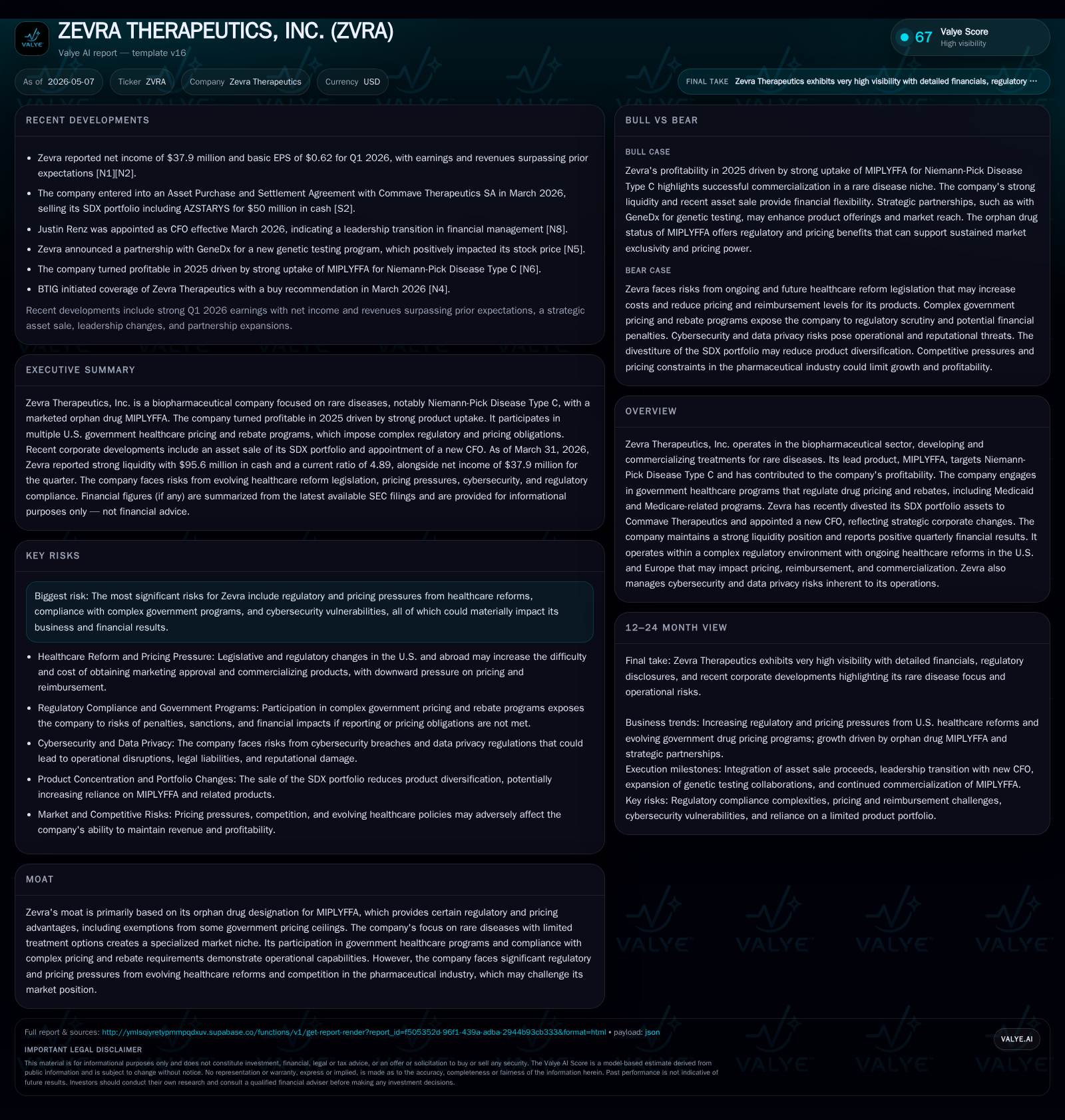
Zevra Therapeutics, Inc. delivered positive financial results in Q1 2026, underpinned by its lead orphan drug MIPLYFFA targeting Niemann-Pick Disease Type C. The company has streamlined its asset base through divestiture of the SDX portfolio to focus on core rare disease therapies, while appointing a new CFO to drive financial strategy. Operating within a challenging regulatory environment characterized by healthcare reforms in the U.S. and Europe, Zevra leverages orphan drug exclusivity to maintain pricing power and market niche leadership. Risks from evolving government reimbursement policies and cybersecurity remain key watchpoints as Zevra advances growth via commercialization expansion and regulatory compliance.
Recent Operating Update
In its latest quarterly filing dated May 6, 2026 [S2], Zevra Therapeutics reported solid operating performance primarily driven by its flagship product, MIPLYFFA, a therapy indicated for Niemann-Pick Disease Type C (NP-C). The first quarter results underscore effective commercialization progress in this ultra-rare disease segment, contributing favorably to the company’s profitability. Alongside financial disclosures, the company finalized the divestiture of its SDX asset portfolio to Commave Therapeutics [S3], signaling a strategic pivot toward concentrating resources on rare disease franchises where it possesses competitive advantages.
A significant corporate development was the appointment of Justin Renz as Chief Financial Officer in March 2026 [S6], enhancing the executive team’s capability to manage financial operations amid an evolving pharmaceutical landscape shaped by complex reimbursement frameworks.
Business Model
Zevra’s revenue generation centers around its biopharmaceutical pipeline targeted at rare diseases, with MIPLYFFA representing the cornerstone product. Sales stem from supply contracts with healthcare providers and payors who reimburse based on regulatory approvals and negotiated pricing frameworks. Key revenue drivers include volume dictated by patient diagnosis rates and contract fulfillment alongside pricing influenced heavily by orphan drug status coupled with government program regulations.
Importantly, Zevra participates in U.S. government healthcare programs such as Medicaid Drug Rebate Program (MDRP), Medicare Part B/D rebate obligations per the Inflation Reduction Act (IRA), and other federal discount programs (e.g., Tricare Retail Pharmacy). This participation entails stringent monthly and quarterly price reporting requirements to CMS, mandating transparency around metrics like Average Manufacturer Price (AMP) and Best Price calculations [S1]. Such involvement influences net realizable prices through rebate obligations affecting margins but is balanced by statutory benefits accorded to orphan drugs.
The recent divestment of non-core SDX assets allows Zevra to sharpen capital allocation on proprietary assets with higher barriers to entry due to limited treatment alternatives. These strategic moves aim to enhance operational focus, streamline development priorities, and optimize commercialization pathways.
Industry Structure and Competitive Position
Zevra operates within the biopharmaceutical sub-sector specialized in ultra-orphan drug development. This niche is characterized by high research intensity, substantial regulatory oversight, small but stable patient populations, and exogenous reimbursement variability tied to public healthcare policies.
MIPLYFFA benefits from an orphan drug designation that confers exclusivity periods protecting it from direct generic competition while enabling premium pricing reflective of unmet medical needs. This status underpins a moat that requires continuous investment in compliance amid evolving Medicaid/Medicare regulations designed to curb pharmaceutical cost inflation.
Competitors within this space range from other specialty pharma firms developing therapies for lysosomal storage disorders to larger biopharma entities diversifying portfolios into rare genetic conditions. Entry barriers are significant due to costly clinical trials required for rare diseases coupled with intricate payer negotiations post-launch.
Growth Drivers
- Expansion of Patient Access: As diagnostic capabilities improve for NP-C globally, patient identification is expected to rise incrementally supporting demand growth for MIPLYFFA.
- Regulatory Milestones: Approval of supplemental indications or geographic extensions can broaden clinical application scope.
- Government Program Inclusion: Successful negotiation within Medicare Part D price negotiations under IRA could influence reimbursement ceilings but also increase market volume if coverage expands.
- Streamlined Operations: Divesting non-strategic assets increases focus on core markets enhancing commercial efficiency.
- Pipeline Development: Progression of late-stage candidates targeting analogous rare diseases may deliver new revenue streams.
These drivers align with key KPIs such as prescription uptake rates, formulary inclusions across Medicaid/Medicare channels, renewal rates under government contracts, and regulatory submission timelines.
Risks / Watchpoints / Growth Constraints
- Regulatory Pricing Pressure: Recent healthcare reforms impose inflation-based rebates penalizing price increases outpacing inflation rate calculations [S26]. These mechanisms inject uncertainty into long-term pricing models.
- Compliance Complexity: Failure or delays in accurate rebate reporting risk penalties including fines or exclusion from crucial coverage programs [S1]. This mandates investment in advanced compliance systems.
- Legislative Changes Abroad: European Commission proposals aiming at revising data protection durations and expedited approval pathways could erode established protections for orphan products post-2028 [S29].
- Market Access Limitations: State-level drug affordability boards focusing on upper payment caps could restrict achievable prices in key U.S. markets [S29].
- Cybersecurity Risks: Increasing cyber threats endanger data integrity critical for regulatory compliance and corporate operations; breaches could result in legal liabilities or reputational harm [S1][S27].
Monitoring these evolving external variables remains essential to maintain sustainable growth trajectories.
What to Watch Next
Investors and stakeholders should monitor:
- Quarterly sales updates particularly growth trends in MIPLYFFA prescriptions within Medicaid/Medicare-covered populations.
- Updates on IRA-driven Medicare price negotiations outcomes which will frame upcoming pricing ceilings.
- Progress on pipeline clinical trials or new regulatory submissions expanding indication breadth or geographic reach.
- Evolving state-level pharmaceutical pricing legislation that may impact net reimbursement levels.
- Integration effectiveness of new CFO Justin Renz’s financial strategy execution including cost controls or potential capital raises.
- Cybersecurity audits outcomes ensuring robustness against data privacy breach risks inherent in healthcare data management.
Financial Profile Summary
Latest financial snapshot
As of March 31, 2026, Zevra holds approximately $95.6 million in cash and equivalents supported by total current assets of about $230.0 million against current liabilities nearing $47.0 million—a strong current ratio of roughly 4.89 supports operational liquidity [F1]. The company's best-estimate total debt stood at approximately $63.6 million as of December 31, 2025, rendering an estimated net debt position negative at nearly -$32.0 million after adjusting for cash holdings [F1]. This net cash position provides a solid foundation for funding ongoing development activities while cushioning against cyclical industry pressures.
Operating income remains negative historically; however, reported net income reversal indicates unusual factors likely related to one-time gains or accounting adjustments rather than sustained profitability [F1]. Zevra’s ability to drive positive cash flow depends heavily on successful commercialization scale-up alongside controlled investment in pipeline advancement while navigating regulatory headwinds.
Disclaimer: This analysis is based solely on publicly available SEC filings dated through May 6, 2026, company-released information, and known industry context as of June 2026 without incorporating speculative or forward-looking estimates beyond stated regulatory guidance. It does not constitute investment advice or recommendations regarding securities of Zevra Therapeutics, Inc.
Disclaimer: This is research-only, informational analysis and not investment advice. It may include AI-generated interpretation and general industry context. Always verify important details using primary sources.

Comments