
SS&C Technologies Expands Global Footprint with High-Retention SaaS and Automation Amid Debt Leverage
Latest quarterly results highlight strong client retention and operational scale in financial and healthcare software services.
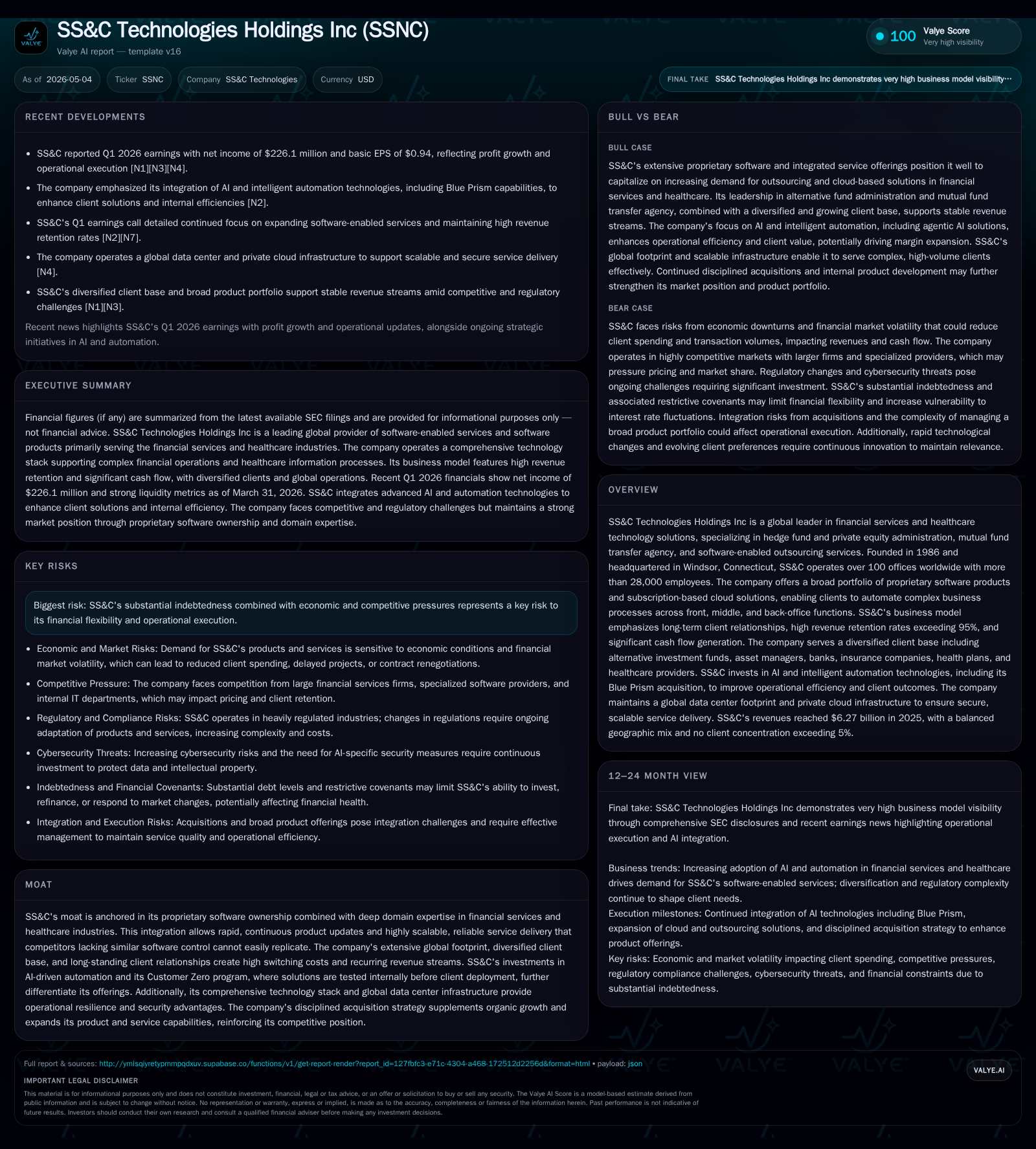
In its latest quarter ended March 31, 2026, SS&C Technologies Holdings Inc continued to demonstrate the resilience of its software-enabled services business, supported by long customer contracts and high retention rates. The company’s core offerings span hedge fund administration, mutual fund transfer agency, and healthcare IT solutions, leveraging proprietary software combined with intelligent automation capabilities. SS&C’s competitive moat stems from deep domain expertise coupled with a disciplined acquisition strategy that broadens product offerings and client reach globally. However, substantial indebtedness remains a watchpoint amid interest cost pressures. Sustained growth hinges on expanding international sales, driving margin expansion through automation, and cross-selling within an extensive installed base.
Recent Operating Update
SS&C Technologies' latest quarterly filing for Q1 ended March 31, 2026 [S2] confirms continuity in its established operating model without material changes to previously disclosed risks. The company issued a disclosure on April 23, 2026 [S3] emphasizing strong first-quarter earnings that beat revenue estimates driven by sustained demand across its diversified business segments. Management highlighted strategic progress in deploying AI-driven automation and expanding international footprint particularly in Asia Pacific markets.
While this most recent quarterly report focuses on steady-state performance metrics rather than significant new initiatives or restructuring actions, it underscores confidence in the recurring revenue base stemming from multi-year client contracts that include automatic renewals — a source of stable cash flow generation central to SS&C's operating profile.
Business Model
SS&C operates primarily as an integrated software provider coupled with software-enabled outsourcing services tailored to the financial services and healthcare sectors [S8][S15]. It combines proprietary technology assets across securities accounting, back-office operations, risk analytics alongside healthcare information processing into a cohesive end-to-end offering designed for complex operational environments.
Revenue is driven mainly by:
- Software-enabled services: These represent the largest portion of revenue via contracts ranging from one to five years with monthly or quarterly billing cycles plus automatic annual renewals that foster consistently high retention rates exceeding 95% over five years.
- Software licensing: Both perpetual and term licenses generate upfront license fees plus maintenance fees typically renewed annually.
Pricing models in the software-enabled services segment scale largely according to clients’ AUM (assets under management), transaction volumes, account complexity across asset classes for financial clients or claims volume for healthcare payers.[S4] This usage- and complexity-based pricing provides operational leverage opportunity as client volumes increase without commensurate increases in costs.
Clients can deploy solutions via multiple modalities—on-premises installations for sensitive clients preferring local control; cloud-hosted platforms operated by SS&C; multi-tenant or dedicated application configurations—to meet diverse compliance and operational requirements. This deployment flexibility strengthens customer lock-in by matching various IT governance policies found internationally [S10][S15].
Industry Structure and Competitive Position
SS&C's competitive moat rests on its:
- Ownership of the full technology stack: Unlike many competitors who resell third-party software or provide only point solutions,
- Deep vertical specialization: The company tailors products for alternative funds (hedge funds/private equity), asset managers, banks/brokerage firms as well as healthcare payers,
- Customer Zero program: Innovations are thoroughly tested internally before client release ensuring robust reliability,
- Scale and integration capabilities: Over 28,000 employees globally supporting more than 23,000 clients,
- Comprehensive support infrastructure: Extensive training programs (including online platforms) maintain high client engagement and adoption rates.
Primary competitors vary by segment: custodian banks such as State Street and BNY Mellon compete largely in fund administration while specialized vendors like eFront (Blackrock) or Datasite contest investor portal/virtual data room (VDR) markets [S11][S16]. On trading software front Bloomberg rivals SS&C partially but defendants could use proprietary internal tools. Competition spans both large integrated providers with expansive resources plus smaller niche innovators offering specialized functionality.
Despite competitive fragmentation, switching costs remain significant due to the mission-critical nature of the products involved—migration involves data security risks, regulatory hurdles including GDPR/CCPA compliance internationally—and lengthy onboarding phases. SS&C's multi-decade relationships with top-tier financial institutions buttress its market position [S18].
Growth Drivers
Structural Demand from Regulatory Complexity
Enhanced regulatory frameworks worldwide continue elevating IT spend among financial intermediaries and healthcare entities aiming to comply efficiently through automation [S19]. Upcoming rules including ESG disclosures for asset managers and evolving health plan reporting standards sustain demand for agile compliance platforms.
Expansion into High-Growth Geographies
International sales comprise about one-third of revenue currently with Asia Pacific noted as key growth vector where revenues increased nearly 23% CAGR over two years through acquisitions and organic expansion initiatives [S5][S9]. Continual global rollout of existing product suites adapted locally should drive incremental uptake.
Portfolio Diversification Through Acquisitions
Since inception SS&C has acquired ~70 businesses targeting complementary niches allowing rapid access to proven technologies while cross-selling into established accounts reduces marketing expense ratios [S23][S26]. Examples include Blue Prism robotic process automation integrating AI techniques industry-wide enabling margin improvement prospects.
Client Base Expansion & Cross-Selling Potential
Existing clients often deploy SS&C technologies for limited product lines initially leaving untapped potential within broader portfolios. Persistent innovation cycles evidenced by major releases yearly reinforce opportunities for enhanced wallet share capture through blended solution bundles combining software plus services [S17].
Risks / Watchpoints / Growth Constraints
Financial leverage: While current debt specifics are limited post Q1 disclosures ([F1]), historical filings indicate ~$7.47 billion indebtedness with associated $427 million annualized interest expenses imposing cash flow strain limiting flexibility for opportunistic investments or aggressive growth maneuvers [S6][S20]. Interest rate sensitivity poses cyclic risk if tightening persists.
Regulatory complexity: Although driving demand structurally also raises compliance risk if SS&C fails to keep pace effectively potentially eroding reputation or encouraging customer churn especially amidst tightening global data privacy laws such as Europe's GDPR evolution or California Consumer Privacy Act enforcement nuances [S7][S14][S22].
Competitive dynamics: Fragmented market attracts entrants innovating rapidly especially in AI/automation layers—maintaining cutting-edge tech requires sustained R&D spend around $500 million annually [$507m spend FY2025] threatening margin pressure if commercial uptake falters [S10][N2].
Dependence on large clients: Top ten customers accounted for ~15% revenues (with no single client >5%), so loss of any key account although not imminent could dent near-term top line implying careful client management essential [S25].
What to Watch Next
- Q2 earnings updates focusing on renewal rates especially among largest contracts reflecting organic revenue base resilience.
- New product launches or upgrades leveraging AI/automation capabilities validating path toward margin expansion and service quality improvements.[N2]
- Acquisition announcements signaling continued inorganic growth pipeline execution at attractive valuations.[S26]
- International sales progression notably contribution percentage shifts indicating further APAC penetration success.[N1]
- Debt refinancing activity or covenant amendments providing relief or constraints impacting liquidity.[F1]
- Regulatory shifts impacting client industries potentially altering demand profiles requiring agile adaptation from SS&C teams.
Disclaimer
This analysis is based solely on publicly available documents filed with the U.S. Securities Exchange Commission through April 30, 2026, supplemented by market news sources referenced herein. It does not constitute investment advice nor reflect non-public information. Readers should consider multiple sources before forming any valuation or investment conclusions.
Latest financial snapshot
| Metric | Value | Period |
|---|---|---|
| Cash & equivalents | $421mm | |
| 2026-03-31 | ||
| Current assets | $5.3bn | |
| 2026-03-31 | ||
| Current liabilities | $4.9bn | |
| 2026-03-31 | ||
| Current ratio | 1.1x | |
| 2026-03-31 |
Source: SEC companyfacts cache [F1].
Disclaimer: This is research-only, informational analysis and not investment advice. It may include AI-generated interpretation and general industry context. Always verify important details using primary sources.

Comments