
Cabot Corporation’s Portfolio Expansion Drives Niche Market Penetration Amid Regulatory Headwinds
Cabot’s recent acquisition and operational updates spotlight strategic growth in specialty chemicals despite ongoing legal and regulatory challenges.
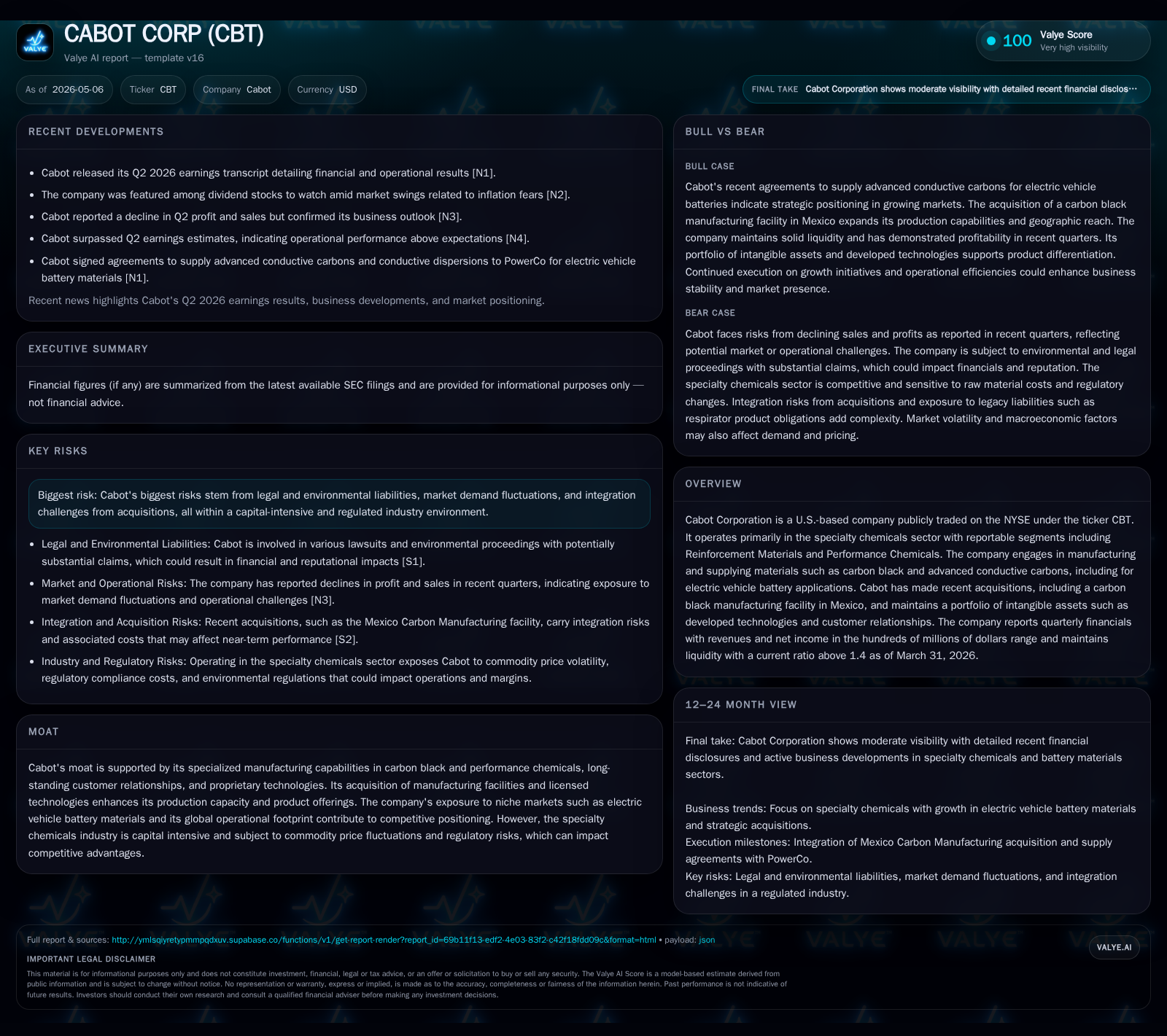
In its Q2 2026 filing, Cabot Corporation disclosed the acquisition of a carbon black manufacturing facility in Mexico, expanding capacity within its Reinforcement Materials segment. The company also acknowledged ongoing respirator-related liabilities stemming from legacy acquisitions, underscoring regulatory and legal risk exposure. Cabot’s business model centers on specialized carbon black and performance chemicals with a strong global footprint and proprietary technologies that support premium pricing. Growth drivers include rising demand for conductive carbons in electric vehicle batteries and synergies from recent capacity expansions. However, the capital-intensive nature of specialty chemicals combined with environmental litigation risks and commodity cost volatility temper growth visibility. Financially, Cabot maintains solid liquidity and a balanced leverage profile supporting continued investment.
Latest Quarterly Operating Highlights: Growth and Liability Update
In the quarterly report ending March 31, 2026, Cabot Corporation highlighted key operational developments shaping its near-term trajectory. Foremost is the January 31 acquisition of Mexico Carbon Manufacturing (MXCB), a dedicated carbon black production facility in Tamaulipas, Mexico. Acquired for a purchase price of $68 million (cash component included), this addition integrated approximately $12 million in revenue into the Reinforcement Materials segment during Q2 2026 [S2][S10]. This move strategically expands Cabot’s manufacturing footprint to meet rising demand particularly for advanced conductive carbons used increasingly in electric vehicle (EV) battery applications.
Simultaneously, the company disclosed continuing exposure to contingent liabilities arising from respirator products sourced from American Optical Corporation (AO), whose respiratory safety product business it acquired in 1990 but divested in 1995 [S2]. This liability stems from allocated shares of legal fees and settlement payments related to AO respiratory products used before the subsidiary's takeover. While current estimates cover probable costs accrued through the reporting date, inherent uncertainty remains over future claims driven by evolving legal developments and insurance recoverability [S22]. These contingent liabilities highlight ongoing regulatory and environmental risk vectors that could materialize into significant cash outflows.
Further accounting policy modifications were noted as Cabot integrates recently issued FASB standards updating internal-use software capitalization criteria. The January-September quarterly periods reflect early adoption considerations influencing intangible asset recognition practices that may improve clarity on R&D investment tracking [S14].
Business Model and Product Differentiation
Cabot operates principally through two reportable segments: Reinforcement Materials (primarily carbon black) and Performance Chemicals [S1]. Carbon black manufacturing, a capital-intensive process requiring sophisticated technological inputs, constitutes the backbone of its reinforcement materials unit. Cabot’s products serve diverse applications including tires, automotive components, plastics reinforcement, inks, pigments, and notably conductive carbons essential for EV battery electrodes—a rapidly growing niche demanding high-purity materials with precise electrical properties.
The Performance Chemicals segment supplements with proprietary chemical formulations utilized across industries such as coatings, adhesives, sealants, elastomers, and specialty polymers. This segment leverages licensed technologies allied with developed patents to sustain product differentiation [S1].
A critical element of Cabot’s business model rests on proprietary technological assets encompassing trademarks, developed technologies (e.g., battery materials innovations), customer relationships built over decades leading to sticky end-market positioning [F1][S1]. High switching costs arise from stringent quality requirements in specialty inputs where performance deviations can materially affect customers’ final product tolerances—this dynamic confers premium pricing power even under general commodity price pressures.
Moreover, global production sites including expanded facilities acquired recently augment flexibility in supply chains and logistics efficiencies crucial amid volatile raw material sourcing landscapes.
Industry Dynamics and Competitive Landscape
Specialty chemicals represent a structurally challenging industry characterized by high capital intensity due to complex manufacturing processes involving continuous reactors or thermal processes as in carbon black synthesis. Regulatory oversight is stringent given environmental externalities inherent in production (e.g., emissions controls), while commodity feedstock volatility—like crude oil derivatives feeding carbon black feedstocks—introduces margin unpredictability [S1].
Within this context, Cabot faces competition from multinational incumbents such as Birla Carbon (Aditya Birla Group), Philip Morris International’s OM Group division (historically), and emerging Asian producers exploiting lower-cost positions but often lacking advanced proprietary technology or customer integration found at Cabot.
Market trends show increasing customer preference shifting towards higher-performance intermediate materials tailored for EV batteries—favoring suppliers like Cabot with developed conductive carbon technology [N1][N2]. Additionally, supply chain disruptions have intermittently constrained availability globally; Cabot’s acquisition of MXCB enhances supply chain resilience by localizing production closer to key customers in Americas.
Growth Catalysts: Acquisitions, Innovation, and Market Demand
Cabot’s pursuit of growth aligns with key secular demand drivers centered on electrification trends accelerating adoption of EVs requiring state-of-the-art battery materials. The MXCB acquisition provides incremental capacity to address this growing demand within Reinforcement Materials [S10]. Early financial impact includes $12 million contribution in Q2 revenues supporting top-line growth.
Innovation-driven differentiation aids performance chemicals offerings where investment in internal-use software modules tracked under new capitalization accounting further supports R&D efficiency improvements [S14]. These advancements potentially speed time-to-market for novel chemistries critical in fast-evolving applications such as specialty coatings or polymer additives.
Additional pipeline expansion derives from cross-selling opportunities between segments leveraging existing customer intimacy.
Risks and Constraints: Regulatory Exposure and Integration Challenges
Environmental legacy exposures remain a considerable risk factor notably related to respirator liabilities inherited from AO prior operations [S2][S22]. Given the unpredictable nature of litigation outcomes or changes in allocation among liable parties—including insurance coverage uncertainties—Cabot faces potential financial impacts disrupting forecasted free cash flow.
Integration risks tied to MXCB encompass operational harmonization challenges typical post-acquisition including aligning health-safety-environment protocols and realizing anticipated cost synergies amidst competitive raw material inflation [S10].
Commodity input price fluctuations especially crude oil derivatives pose margin compression hazards under less favorable pass-through pricing scenarios impacting profitability.temporal cyclicality tied to automotive OEM production schedules could induce short-term volume variability within core reinforcement markets.
Key Upcoming Milestones and Monitorables
Investor focus should remain attuned to subsequent quarterly earnings releases disclosing further results post-MXCB acquisition integration efforts including margin trajectory evolution [N1]. Monitoring FASB internal-use software standard adoption impact will clarify R&D capitalization effectiveness potentially influencing forward earnings consistency.
Market penetration advancement in EV battery conductive carbon applications evidenced via order backlog or expanded customer contracts will validate growth hypotheses.
Environmental liability developments including legal case resolutions or settlement disclosures should be tracked closely given materiality potential [S22].
Current Financial Health Snapshot
Latest financial snapshot
| Metric | Value | Period |
|---|---|---|
| Cash & equivalents | $252mm | |
| 2026-03-31 | ||
| Current assets | $1547mm | |
| 2026-03-31 | ||
| Current liabilities | $1068mm | |
| 2026-03-31 | ||
| Current ratio | 1.45x | |
| 2026-03-31 |
Source: SEC companyfacts cache [F1].
Cabot exhibits a robust liquidity position at March 31, 2026 highlighted by cash & equivalents totalling $252 million alongside current assets amounting to $1.547 billion versus current liabilities of $1.068 billion yielding a current ratio of approximately 1.45 [F1][S2]. Estimated net debt stands near $786 million reflecting prudent leverage consistent with capital expenditure commitments toward capacity enhancements.
Interest expenses remain manageable within operating income margins supported by steady revenue streams across diversified segments allowing sustainable reinvestment capability without excessive balance sheet strain.
*Estimated net debt = Total debt - cash (latest available data) **Operating income latest reported quarter prior to current snapshot [F1]
This analysis synthesizes Cabot Corporation’s recent disclosures elucidating operational advances juxtaposed against enduring legal risks within a specialty chemical landscape demanding capital commitment amid evolving market dynamics. Continued observation of integration efficacy alongside regulatory developments remains imperative for assessing the company’s sustainable competitive positioning.
Disclaimer: This report is for informational purposes only and does not constitute investment advice or an offer to buy or sell securities.
Disclaimer: This is research-only, informational analysis and not investment advice. It may include AI-generated interpretation and general industry context. Always verify important details using primary sources.

Comments