
Texas Pacific Land’s Expansive Permian Footprint Accelerates Diverse Growth Trajectory
TPL's latest quarter highlights strategic acquisitions and water service expansion fueling long-term revenue diversification and market dominance.
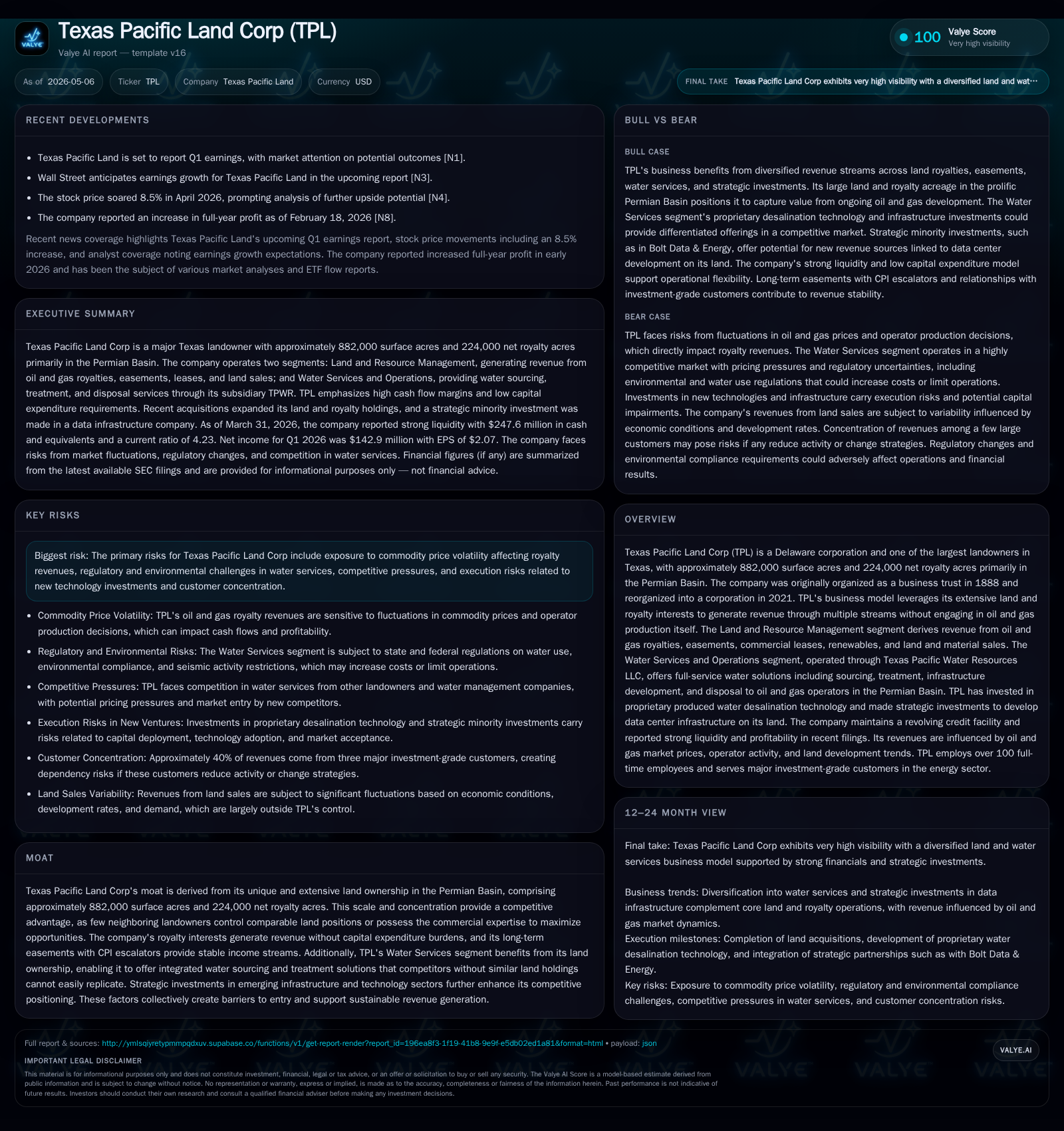
In Q1 2026, Texas Pacific Land Corp (TPL) reported advancing profits supported by continued investments in Permian Basin land assets and a minority stake in Bolt Data & Energy, marking its strategic pivot to infrastructure and technology applications on its acreage. TPL sustains a unique business model that monetizes its vast land and royalty holdings through multiple revenue streams including royalties, easements, commercial leases, water services, and material sales. Its competitive moat is anchored in its unmatched scale in the Permian Basin and integrated water services—which leverage extensive surface ownership. Growth drivers include expanding water operations amid tightening regional water supply conditions, ongoing land acquisitions, and emerging commercial infrastructure developments. Key risks involve commodity price sensitivity, regulatory scrutiny on water services, and execution challenges with new ventures. Investors should closely monitor operational metrics tied to water volume growth, lease renewals with CPI escalators, production activity on royalty lands, and progress of the Bolt partnership.
Q1 2026 Operating Highlights and Strategic Moves
Texas Pacific Land Corporation reported a robust first quarter ending March 31, 2026 [S2], showcasing an operating profit uplift fueled by its core royalty streams alongside recent asset acquisitions in the Permian Basin. Notably, TPL expanded its footprint via multiple 2025 acquisitions including approximately 17,306 net royalty acres (NRA) primarily throughout the Midland Basin counties such as Martin and Midland for around $450.7 million in cash [S7]. Additionally, the company bolstered surface holdings with an 8,147-acre purchase in Martin County for $31.4 million. Overlaying these physical asset expansions is TPL’s December 2025 $50 million strategic minority investment in Bolt Data & Energy—an infrastructure company developing large-scale data center campuses on TPL-owned lands [S7]. This move diversifies revenue potential beyond traditional oil & gas royalties toward emerging technology infrastructure aligned with commercial land use evolution.
These developments collectively reinforce TPL's growth trajectory by cementing its dominant Permian Basin presence while broadening commercial avenues beyond hydrocarbon extraction. The company’s ability to monetize through multiple channels—including newly formed partnerships—creates a complex but resilient operating profile supported by deep local knowledge and integrated asset control. This quarter’s profitability progression underlines execution success amid evolving energy market dynamics [N4].
Business Model: Monetizing Texas’ Largest Land and Royalty Holdings
TPL's business model is deeply rooted in leveraging its unparalleled ownership of nearly 882,000 surface acres plus about 224,000 NRA primarily concentrated within the prolific Permian Basin [S1]. The company is unique insofar as it does not engage directly in oil or gas production but instead generates revenue from perpetual nonparticipating oil and gas royalty interests that require no capital expenditure for well development or production operations.
The Land and Resource Management segment drives majority revenues from oil & gas royalties modulated by commodity prices and operator capital spending decisions. Complementing this are fee-based revenues generated from long-term easements—primarily pipelines transporting hydrocarbons—and commercial leases for processing facilities or midstream infrastructure. These easements generally extend over multiple decades with renewals subject to consumer price index (CPI) escalators tying future cash flows to inflation trends [S14]. Other surface revenues include sales of materials like caliche used in infrastructure buildout as well as land sales.
Crucially, the Water Services segment operated through Texas Pacific Water Resources LLC offers integrated water sourcing, treatment, infrastructure development, and disposal services tailored for oilfield operators within TPL’s extensive acreage [S1]. This segment benefits structurally from owning surface rights enabling more efficient control of supply chains versus competitors dependent on third-party land access or less integrated assets [S17]. The low capital intensity combined with recurring contractual cash flows highlights durable margin attributes typical of TPL’s business model.
Industry Positioning: Unmatched Scale in Permian Basin with Diverse Revenue Streams
TPL occupies a singular position as one of Texas’ largest private surface landowners concentrated strategically across the Permian Basin—a region among the world’s most prolific hydrocarbon producing basins. Few nearby entities can match TPL's acreage breadth nor possess the requisite expertise to fully exploit commercial leasing or complex easement agreements that often factor inflationary adjustments into long-term contracts.
Further fortifying its moat is the diversity of income sources: perpetual oil/gas royalties insulated from operational costs; easement agreements providing CPI-indexed stable revenues; expansive water infrastructure coupled with disposal facilities; plus nascent investments targeting renewable energy projects and cutting-edge data infrastructure [S14,S7]. This multifaceted portfolio spreads operational risk while enhancing upside optionality tied to evolving energy transition themes.
Particularly notable is how Water Services binds together physical land control with high barriers to entry for competitors who lack comparable acreage access. Its integrated treatment capabilities paired with infrastructure ownership constitute a natural moat difficult for water supply or treatment-only firms to replicate at scale [S17].
Growth Catalysts: Expanding Water Services, Asset Acquisitions, and New Infrastructure Ventures
TPL’s growth outlook is powered by several interconnected drivers:
- Water Services Expansion: Amid growing regional constraints on freshwater availability coupled with heightened regulation of produced water handling in the Permian Basin, demand for TPWR's full-service water offerings stands poised to increase [S9]. Electrification initiatives within water assets are further reducing operational costs while aligning with ESG preferences [S24].
- Asset Acquisitions: Throughout 2025 TPL pursued opportunistic purchases adding
177 NRA in Midland Basin ($3.5M), Midland surface acres ($4.5M), Martin County ($31M), culminating in a substantial ~17k NRA purchase for $450M enhancing its acreage base linked directly to producing plays [S7]. Such accretive deals improve future royalty streams while expanding fee-based opportunities. - Bolt Data & Energy Partnership: The $50 million minority stake acquired allows TPL exposure into scalable data center campuses leveraging underutilized portions of its landholdings complemented by rights to supply water resources—marrying digital infrastructure trends with legacy real estate assets at a time when hyperscale cloud providers seek new locales strategically proximate to power grids [S7].
Macro tailwinds supporting these catalysts include rising electricity demands in edge-data sectors complementing energy transition initiatives fostering renewables on company lands; stringent regulatory ecosystems incentivizing reuse/recycling of produced water; plus increased drilling activity driving volumes underpinning royalties – albeit with some cyclicality tied to commodity prices.
Risks and Challenges: Commodity Exposure, Regulatory Factors, and Execution Risks
Despite strengths, TPL faces multiple risk vectors:
- Commodity Price Sensitivity: As all oil & gas royalty revenues intrinsically depend on fluctuating commodity prices subject to volatile global factors—from OPEC decisions to geopolitical conflicts—declines may dampen revenue visibility irrespective of TPL’s non-producing status. Operator decisions can impact well development cadence causing variability unrelated directly to market prices.
- Regulatory Scrutiny on Water Operations: The Water Services business entails expanding oversight concerning environmental compliance including discharge permits and produced-water handling regulation which may add costs or limit operational flexibility. Increasing local/state regulation could tighten compliance requirements increasing operational complexities for TPWR [S9].
- Customer Concentration: Approximately 40% of revenues stem from only three major investment-grade customers deeply engaged within the Permian Basin territory [S17]. This concentration exposes TPL to spending shifts or relationship risks although customers are large reliable operators.
- Execution Complexity: Diversifying into technology infrastructure segments like data centers via Bolt involves uncertain commercialization timing and requires navigating new markets beyond historical competencies potentially exposing the firm to integration challenges.
Investor Focus: Key Milestones, Guidance, and Near-Term Drivers to Watch
Key indicators investors should monitor include:
- Capital deployment efficacy evidenced by pace of incremental acreage acquisition balanced against return metrics.
- Lease renewal activity particularly easement payments indexed to CPI that help sustain real-dollar cash flows over multiyear horizons.
- Trends in well permits pending drilling/completion—as measured by royalty acreage permit counts—as proxies for near-term production growth potential [S16].
- Service volumes achieved by TPWR signaling traction amid regional water scarcity pressures including progress towards electrification goals lowering operating costs.
- Commercial development wins derived from Bolt Data & Energy partnership reflecting successful attraction of anchor tenants onto TPL land positions.
- Dividend consistency reflecting cash flow strength amid commodity cyclicality given Board discretion influences dividend policy [S5].
- Any governance changes related to recent Board Representative Agreement suggest evolving shareholder activism engagement [S3].
Q2 earnings announcements will provide updated guidance on these fronts along with management commentary clarifying macro impact expectations thereby shaping medium-term outlook clarity [N3,N4].
Financial Overview: Current Liquidity and Profitability Snapshot
Latest financial snapshot
| Metric | Value | Period |
|---|---|---|
| Cash & equivalents | $248mm | |
| 2026-03-31 | ||
| Current assets | $435mm | |
| 2026-03-31 | ||
| Current liabilities | $103mm | |
| 2026-03-31 | ||
| Current ratio | 4.23x | |
| 2026-03-31 |
Source: SEC companyfacts cache [F1].
As of March 31, 2026, Texas Pacific Land maintains strong liquidity evidenced by $247.57 million cash & equivalents alongside total current assets of approximately $435 million versus current liabilities near $102.93 million—a current ratio of 4.23 reflecting robust short-term financial flexibility supportive of ongoing capital investments or opportunistic acquisitions [F1,S2].
While trailing twelve-month operating income stood at $592 million through December 31, 2025 reflecting solid profitability underpinned by diverse revenue streams complemented by prudent capital allocation policies including measured stock repurchases initiated mid-cycle [F1,S5], TPL continues emphasizing high-margin cash flow generation over aggressive capital expenditure deployment consistent with long-term stewardship ethos noted repeatedly throughout filings [S1,S14].
This analysis is based solely on publicly filed SEC disclosures including Texas Pacific Land Corporation's latest quarterly filing dated May 6, 2026 (Form 10-Q) among other referenced documents without offering investment advice or price targets.
Disclaimer: This is research-only, informational analysis and not investment advice. It may include AI-generated interpretation and general industry context. Always verify important details using primary sources.

Comments