
DoorDash Expands Contribution Profit Amid Revenue Growth and Platform Investment
DoorDash reported a significant increase in contribution profit for Q1 2026, driven by robust order and revenue growth alongside strategic investments in its technology and marketplace expansion.
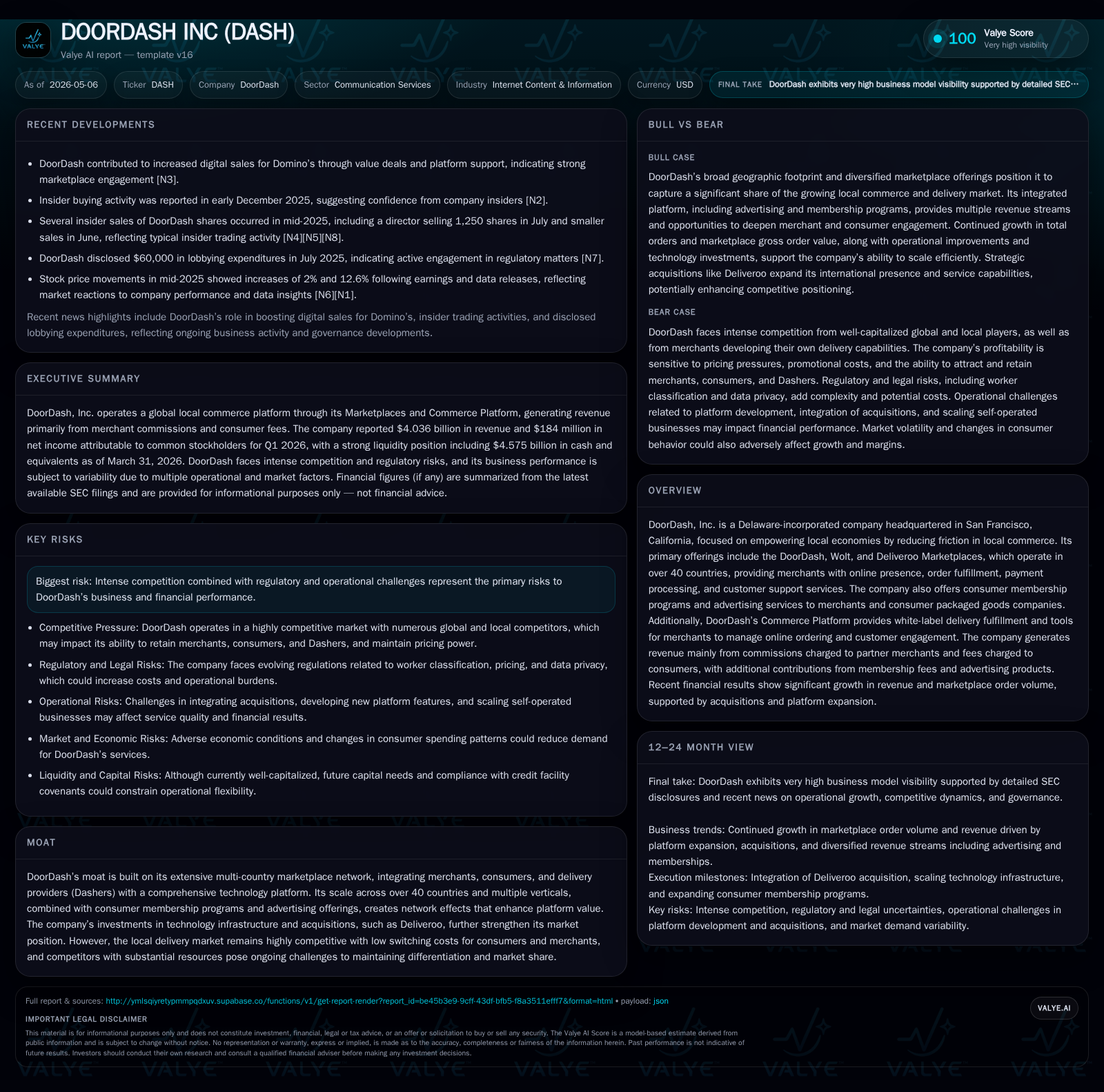
In the first quarter of 2026, DoorDash demonstrated operational momentum with contribution profit rising to $1.4 billion, supported by a 33% year-over-year revenue increase and a 27% increase in total orders. The company’s multifaceted platform, leveraging its DoorDash, Wolt, and Deliveroo Marketplaces across over 40 countries, continues to scale with augmented consumer membership programs and advertising services. Despite intensifying competition and regulatory complexities in the gig economy delivery sector, DoorDash’s broad geographic footprint and integrated commerce platform position it well for sustained growth. However, ongoing risks include margin pressures from cost inflation and compliance constraints tied to credit facility covenants.
Latest Quarterly Operating Performance and Its Significance
DoorDash’s quarterly filing dated May 6, 2026 ([S2]) reveals the company’s contribution profit—a key metric reflecting core operating profitability net of direct order fulfillment expenses—increased sharply to $1.4 billion in Q1 2026 from $1.0 billion a year earlier. This roughly 35% uplift was chiefly driven by a strong revenue increase of 33% to $4.036 billion alongside a 27% rise in total orders to 933 million across its marketplaces ([S2], [S11]). Despite increases in cost of revenue and sales & marketing expenses reflecting investments in capacity expansion and technology infrastructure supporting longer-distance deliveries, contribution margin held steady at about 34.2%. Adjusted EBITDA improved materially to $754 million from $590 million in Q1 2025 ([S10], [S11]), demonstrating enhanced operating leverage at scale.
This dynamic underscores DoorDash’s ability to grow volume robustly while partially absorbing incremental costs through efficiency gains within its integrated technology platform that connects consumers, merchants, and Dashers—the gig economy delivery workforce. The company’s focus on contribution profit rather than GAAP net income affords clearer visibility into order economics absent non-core costs like stock-based compensation or depreciation ([S10]). Such an approach is particularly prudent for gig platforms where capital expenditures underpinning scale are substantial.
Core Business Model and Product Quality Driving Marketplace Leadership
DoorDash's business model centers on orchestrating local commerce through its Marketplaces—DoorDash itself plus Wolt and Deliveroo acquired recently ([S1]). Together they span over 40 countries providing merchants services from online presence creation to demand generation via advertising tools tailored to consumer packaged goods firms ([S2]). The platform offers consumer memberships (DashPass/Wolt+/Deliveroo Plus) that lower delivery fees aiming to deepen retention by reducing transaction friction ([S2]). Revenue streams are diversified across merchant commissions on order volumes, consumer fees including membership charges, advertising income from enhanced merchant promotions, and Commerce Platform services.
The Commerce Platform complements the consumer-facing marketplaces by offering merchants white-label delivery fulfilment (“Drive”), custom mobile app development, restaurant reservation systems (via SevenRooms acquisition), tableside payments, CRM tools, and customer support suites ([S1]). This dual-marketplace & commerce approach extends DoorDash’s addressable market beyond standard last-mile delivery into enabling merchants’ own direct channels—an increasingly strategic aspect amid rising local commerce digitization.
Product quality factors such as reliability of Dashers network coverage, continuously optimized dispatch algorithms supporting longer-range deliveries without degrading service times or costs,[S2] coupled with comprehensive merchant onboarding/retention support drive DoorDash’s positioning as a preferred partner across segments. Moreover, integrated technology infrastructure that harmonizes ordering/payment/delivery workflows reinforces seamless user experience that is critical given low switching costs common in food delivery verticals.
Competitive Dynamics and Industry Position Across Over 40 Countries
DoorDash leverages scale-density advantages accruing from operating multiple Marketplaces internationally; cross-border synergies allow shared investment in logistics tech infrastructure spanning more than four dozen countries ([S1], [S2]). The company benefits from network effects where increased consumer usage attracts more merchants offering wider selection boosting convenience—a virtuous cycle aimed at locking-in participants despite competitive pressure.
However analysis acknowledges that last-mile food delivery markets suffer elevated churn risk among consumers due to low loyalty sensitivity and abundant alternatives including Uber Eats or Just Eat Takeaway. Competitors with comparable financial resources regularly apply aggressive pricing actions while battling local regulatory regimes pertaining to worker classification jeopardize cost structures for gig-based Dashers ([S20]). Acquisitions like Deliveroo accelerate geographic footprint but integration complexity remains non-trivial involving harmonizing product offerings while maintaining service consistency.
Supply chain capacity constraints inherent in last-mile logistics manifest when scaling higher effort (longer distance) orders which elevate unit costs. DoorDash attempts technological differentiation via investment in route optimization software while balancing dispatch incentives aligned with Dasher availability ensuring market responsiveness.[S2]
Growth Drivers Fueling Demand, Membership Uptake, and Platform Scale
Near-term measurable drivers include expanding order volumes which surged to nearly one billion completed orders in Q1 ([S2]). Global expansion fueled by recent acquisitions unlocks new country markets progressively increasing Marketplace GOV ($31.6B growing +37% Y/Y) providing scale tailwinds ([S2]). Consumer membership programs continue broadening subscriber bases motivated by fee reductions incentivizing repeat ordering behavior enhancing lifetime value ("+membership long-term retention" ). Meanwhile advertising services gain traction unlocking incremental merchant revenues enabling cross-sell opportunities.
The Commerce Platform grows as merchants increasingly prioritize omnichannel strategies desiring turnkey solutions not reliant solely on third-party marketplaces but also managing owned digital storefronts with integrated logistics-backed fulfillment. This diversification mitigates some dependency risks intrinsic to marketplace-only models.
Continual upgrades to platform tech including expanded Drive capacity aim to accommodate longer-distance deliveries critical in less dense suburbs or international markets where delivery unit economics are challenging.[S2]
Key Risks, Regulatory Headwinds, and Operational Constraints to Monitor
Principal risks identified comprise fierce rivalry driving pricing pressure threatening margin sustainability alongside escalating costs tied to personnel compensation inflation—both for Dashers and corporate teams managing compliance/legal affairs ([S20], [S14]). Labor-related regulations regarding classification of gig workers persistently shape the economics of DoorDash’s “Dasher” model creating operational uncertainty potentially raising labor costs markedly if stringent rules prevail or court rulings overturn legislative exemptions like Proposition 22.
Technology risks include cybersecurity vulnerabilities potentially disrupting platform availability or data privacy undermining consumer trust ([S20]). Furthermore legal contingencies related to alleged misrepresentation around Dasher pay or working conditions can yield litigation costs impacting earnings volatility.
Financial policy-wise the company operates under revolving credit facility covenants limiting indebtedness levels restricting strategic flexibility on financing acquisitions or share repurchases ([S4], [S5], [S21]). Failure to comply could trigger significant repayment demands constraining liquidity.
Milestones and Catalysts in 2H 2026: What To Watch Next
Investors should closely track management disclosures related to:
- Membership program renewal rates revealing consumer satisfaction/deadweight churn levels.
- Continued geographic expansion metrics post-Deliveroo integration notably GMV contributions outside North America.
- Marketing spend efficiency signals tied to incremental user acquisition costs versus lifetime value improvements.
- Capital investments paced towards increasing Drive fleet capacity particularly for high-effort longer routes addressing unit economics challenges.
- Regulatory developments impacting labor rules potentially requiring adaptative cost restructuring decisions.
- Launch of new verticals encompassing non-food local commerce categories infectious leveraging existing infrastructure.[S3]
CEO Tony Xu’s commentary referenced in the latest event filing underscores prioritization of tech innovation alongside expanding marketplaces profitably while navigating macroeconomic uncertainties ([S3]).
Current Financial Profile and Liquidity Standing
Latest financial snapshot
| Metric | Value | Period |
|---|---|---|
| Cash & equivalents | $4.6bn | |
| 2026-03-31 | ||
| Current assets | $8.6bn | |
| 2026-03-31 | ||
| Current liabilities | $6.0bn | |
| 2026-03-31 | ||
| Current ratio | 1.43x | |
| 2026-03-31 |
Source: SEC companyfacts cache [F1].
As of March 31, 2026 per latest SEC disclosures,[F1][S2][S4], DoorDash maintained a healthy liquidity position with cash & equivalents totaling approximately $4.575 billion complemented by total current assets of $8.592 billion against current liabilities of $6.026 billion yielding a current ratio near 1.43—indicative of solid short-term solvency.
Net income attributable to common stockholders was about $184 million for Q1 supporting positive operating cash flow generation despite elevated reinvestment spending. The company achieved free cash flow of $420 million though this declined slightly versus prior year primarily due to working capital timing differences ([S9], [S10]).
Overall financial health enables strategic investments sustaining marketplace growth initiatives even amid volatile earnings profiles characteristic of growth-stage internet platform operators.
Disclaimer: This analysis is based solely on publicly available data through SEC filings dated May 6, 2026 ([S1]-[S29]) and companyfacts snapshot dated March 31, 2026 [F1]. It does not constitute investment advice or recommendations regarding securities ownership.
Disclaimer: This is research-only, informational analysis and not investment advice. It may include AI-generated interpretation and general industry context. Always verify important details using primary sources.

Comments