
DLH Holdings Faces Growth Challenges as Small Business Contract Transitions Reshape Revenue
DLH Holdings reports revenue pressure from federal contract set-asides to small businesses, prompting a reassessment of growth strategies amid an evolving procurement landscape.
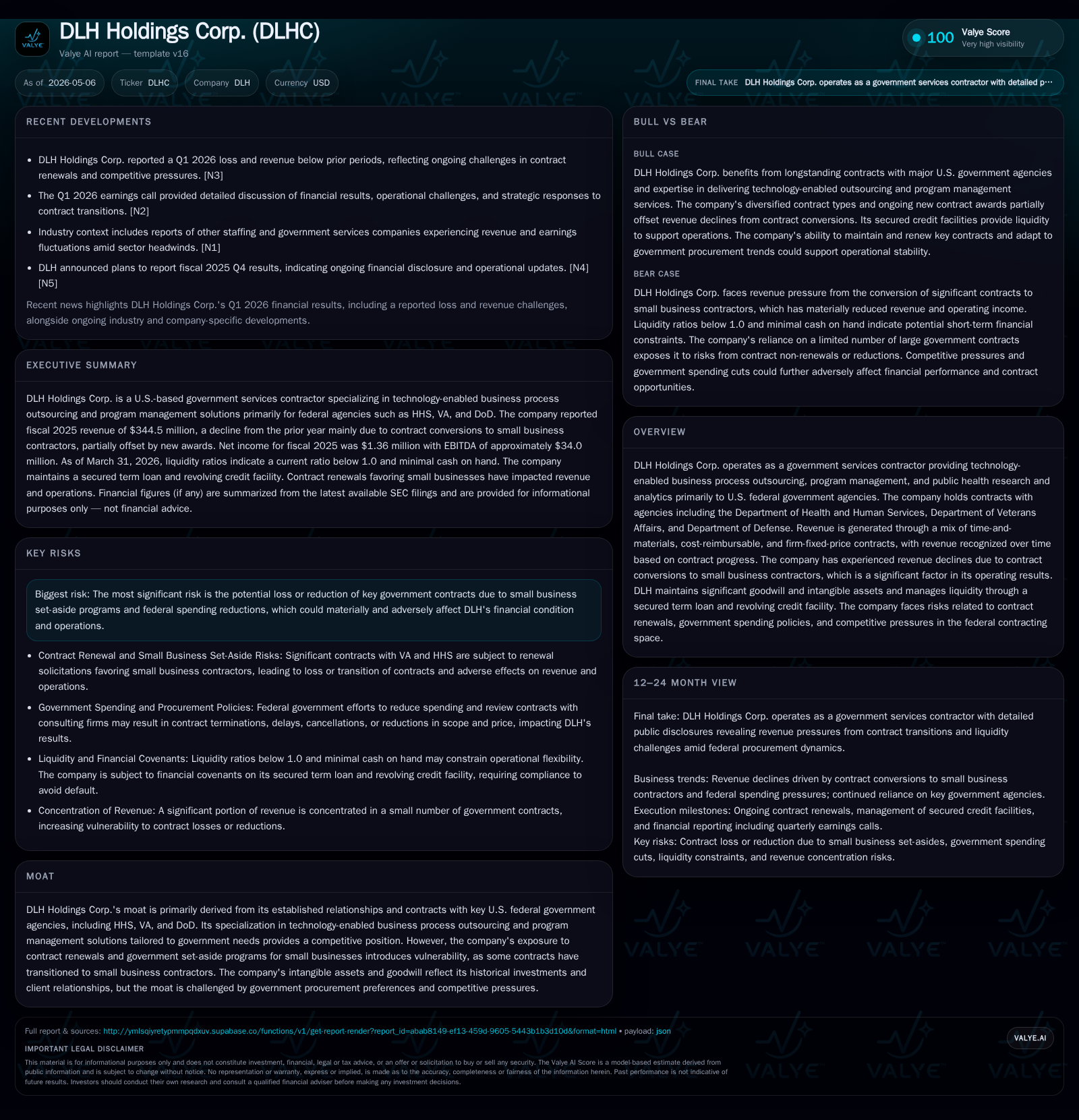
In its latest quarterly filing ending March 31, 2026, DLH Holdings Corp. highlighted continuing revenue declines driven by substantial contract transitions to small business prime contractors within key federal customers like the Department of Veterans Affairs (VA) and the Department of Health and Human Services (HHS). The firm remains primarily reliant on government contracts that are increasingly subject to Small Business Administration (SBA) set-asides, reshaping its revenue profile and competitive positioning. Despite these headwinds, DLH’s entrenched federal relationships and tailored technology-enabled services provide some resilience, although liquidity constraints and leverage remain notable. Monitoring contract recompete outcomes and margin trends will be critical for assessing stabilization prospects going forward.
Latest Quarterly Performance Highlights and Operational Update
DLH Holdings' second quarter fiscal 2026 10-Q filing dated May 6, 2026 reveals sustained operating challenges stemming from key contract conversions to small business primes mandated by federal procurement regulations [S2][S3]. The Department of Veterans Affairs has actively transitioned several Consolidated Mail Outpatient Pharmacy (CMOP) task orders under Service-Disabled Veteran Owned Small Business (SDVOSB) set-asides, with DLH participating via revised SDVOSB partnership proposals. However, three task orders have been awarded to unaffiliated SDVOSBs during this period while DLH continues serving remaining CMOP locations as prime contractor [S1]. Simultaneously, a significant Head Start program contract supporting the Department of Health and Human Services concluded in late fiscal 2025 with services handed over to a new small business prime contractor outside DLH's affiliation [S1]. These developments materially reshaped DLH's revenue base.
Notably, the company confirms no material changes to risk factors affecting operating performance since its last annual filing but double down on revenue contraction risk linked directly to the evolving federal set-aside landscape [S2]. Operating expense structures remain stable though adjusted proportionally to shrinking contract volumes. This transition underscores an urgent need for DLH to adapt operationally as prime contracting opportunities shrink under SBA programs [S2].
DLH Holdings’ Business Model and Service Offering Profile
DLH Holdings operates as a specialized government services contractor focused on technology-enabled business process outsourcing (BPO), program management consulting, and public health research analytics targeted primarily at U.S. federal agencies including VA, HHS, and Department of Defense (DoD) [S1]. The company earns revenue through a mix of contract arrangements: time-and-materials contracts providing billing based on labor-hours or direct costs; cost-reimbursable contracts where expenses plus fee are recovered; and firm-fixed-price engagements with predefined deliverables for fixed fees [S1][F1].
Revenue recognition principally proceeds over time aligned with contract progress milestones—a method well-suited for prolonged multi-year government projects requiring regulatory compliance adherence. DLH leverages its deep sector expertise particularly in healthcare-related government functions such as pharmacy operations for veterans (CMOP) and program evaluation analytics in public health domains.
The firm's solution suite enhances traditional BPO services with tech enablement tailored for complex federal requirements encompassing data security standards, audit readiness capabilities, and continuous process improvement methodologies. Such specialization supports relatively high client retention but also ties the firm's fate closely to governmental budget allocations and contracting cycles within health services domains [S1].
Competitive Positioning and Industry Structure in Federal Contracting
The federal services contracting landscape is characterized by intense competition intensified by regulatory small business set-aside mandates designed to channel business towards certified smaller entities like SDVOSBs or Economically Disadvantaged Women-Owned Small Businesses (EDWOSBs). This regime limits large incumbent primes’ footprint on select procurements or task orders—a growing constraint for firms like DLH which traditionally function as prime contractors across their portfolio.
DLH contends with competitors ranging from pure-play small specialized businesses aggressively targeting SBA-designated procurements to consolidated large contractors competing in broader service categories. Procurement cycles follow highly regimented recompete schedules governed by General Services Administration (GSA) oversight with regular pricing pressure embedded as budgets tighten under administration spending reductions implemented since 2025 [S1].
Labor supply chain dynamics present additional challenges: the requirement for suitably cleared IT specialists or domain experts elevates wage pressure amid a constrained labor market within federal outsourcing services. The combined impact compresses margins while necessitating ongoing investments in workforce development to maintain qualifying credentials needed for contract bids.
Growth Drivers and Opportunities Despite Set-Aside Pressures
Despite encroaching challenges from SBA set-asides transforming traditional contract ownership models, DLH retains potential growth vectors anchored in its incumbent footprint enabling strategic partnerships with SDVOSBs — demonstrated by its revised joint proposals submitted during VA CMOP rebid cycles [S1][S2]. Such partnerships not only allow continued service delivery but position DLH as valuable support subcontractors offering scale advantages.
The company also identifies opportunities expanding into underserved agency segments beyond healthcare—leveraging modular technology-enabled outsourcing solutions adaptable across various compliance-critical government functions. Additionally, DLH aims to win work via multiple contract vehicles extending beyond its core portfolio potentially mitigating customer concentration risks from VA or HHS loss exposures.
Internal efforts focus on enhancing proposal competitiveness by embedding innovative analytics capabilities leveraging data science alongside cost efficiency improvements in operational delivery. These investments reflect a proactive stance responding structurally rather than relying solely on legacy client relationships vulnerable under set-aside pressures.
Risks and Constraints from Federal Procurement Trends
The foremost risk facing DLH comes from anticipated ongoing erosion in prime contracting roles due to SBA mandated set-asides consistently favoring smaller businesses outside its direct control—a pattern already materialized with significant VA CMOP task orders passing away from DLH primeship or complete contract closures such as HHS Head Start programs transitioning third parties [S1].
Compounding this are broader federal spending restraint initiatives instituted after 2024 leading to increased possibility of terminations, scope reductions or delays impacting full revenue realization across existing contracts [S1][S2]. Financially stringent covenants under DLH’s credit agreement necessitate maintaining leverage ratios within defined thresholds while managing weakening working capital metrics evidenced by the sub-1 current ratio measured at 0.87 at Q2 FY2026 quarter-end [F1].
Liquidity constraints emerge given minimal cash balances (~$131K) juxtaposed against sizable total debt approximating $132.7 million predominantly from secured term loans maturing in late 2027—highlighting dependency on stable cash flow generation from remaining contracts plus revolver availability capped near $8M at last reported interval [F1]. Further margin compression risks slow deleveraging progress.
Strategic Watchpoints and Upcoming Milestones
Key indicators to track include forthcoming award decisions across VA CMOP recompetes where DLH’s success or failure intimately affects near-term top-line trajectories given multi-million-dollar task order sizes involved [S1][S2]. Observing whether partnerships with SDVOSB entities deepen providing new prime contracting footprints will also evidence adaptive resilience.
Additionally critical will be monitoring new contract wins outside traditional health-centric agencies signaling diversification progress plus margin trends reflecting operational discipline amid shrinking volumes.
Management commentary embedded within successive quarterly disclosures will serve as barometers regarding execution efficacy against structural headwinds created by persistent government procurement reforms favoring small businesses.
Current Financial Position and Liquidity Snapshot
As of March 31, 2026—the close of Q2 fiscal year 2026—DLH Holdings reported cash reserves totaling around $131 thousand juxtaposed against total debt approximating $132.7 million translating into net debt near $132.56 million indicative of high leverage exposure confined within secured financing agreements carrying amortization obligations through December 2027 [F1]. Current assets stood at approximately $36.8 million compared against current liabilities of $42.3 million resulting in a current ratio of roughly 0.87 [F1].
While long-standing federal relationships furnish a foundation enabling partnership-driven continuity and niche expansion possibilities within technology-enabled government service delivery models, the immediate outlook remains challenged by revenue contraction risk tied directly to procurement dynamics shifting prime contract ownership away from legacy incumbents like DLH. Careful observation of upcoming recompete outcomes together with prudent financial stewardship will be essential for validating any emerging growth trajectory or signaling deeper structural headwinds ahead.
This memo is intended solely for informational purposes reflecting publicly available disclosures as of May 2026 without investment recommendations or forecasts.
Disclaimer: This is research-only, informational analysis and not investment advice. It may include AI-generated interpretation and general industry context. Always verify important details using primary sources.

Comments