
Ensign Group Accelerates Growth Through Localized Operations and Portfolio Expansion
Recent quarterly results underscore Ensign's localized leadership and strategic acquisitions as keys to sustained quality improvement and operational growth.
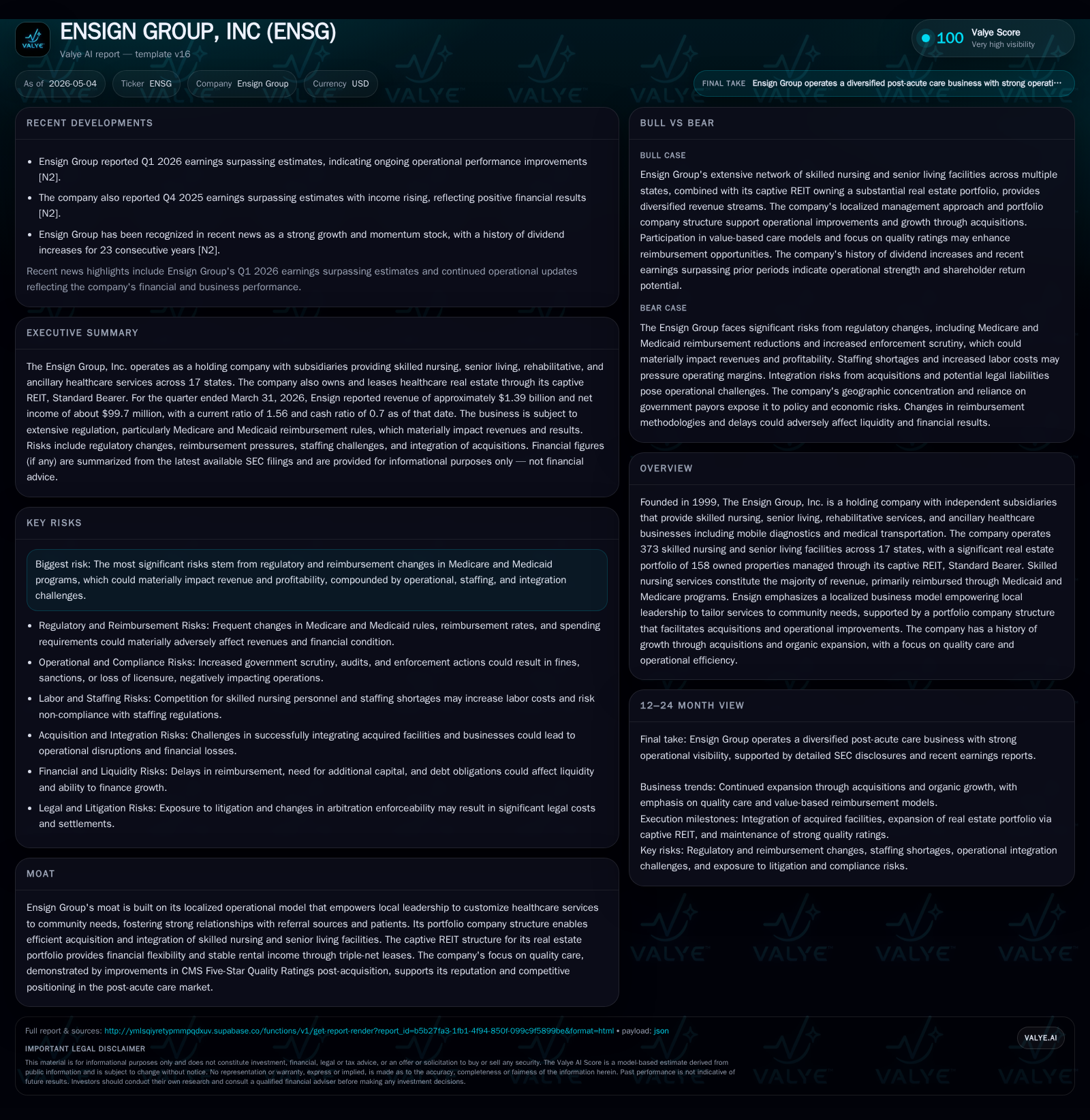
In Q1 2026, The Ensign Group demonstrated continued momentum driven by its unique localized operational model and a consistent acquisition pipeline expanding its skilled nursing and senior living footprint. Leveraging a portfolio company structure combined with a captive REIT for real estate holdings, Ensign balances operational agility with financial stability. The company's focus on improving CMS Five-Star Quality Ratings and expanding ancillary services underpins robust demand despite ongoing reimbursement and regulatory risks. Upcoming quarters will test management’s ability to sustain quality gains and navigate evolving Medicare and Medicaid frameworks.
Q1 2026 Operational Results: Key Takeaways from Latest Filing
The Ensign Group’s first quarter 2026 filing (10-Q) reveals strong operational performance anchored by further expansion in its skilled nursing facility count and improved profitability metrics. The company reported revenue increases primarily driven by growing utilization in its skilled nursing services segment—accounting for over 95% of total revenue—and positive pricing/mix effects within the post-acute care continuum [S2][N2]. Adjusted EBITDA outpaced consensus expectations, supported by operational efficiencies realized from continued maturation of acquired facilities and enhanced reimbursement management practices. Additionally, the accompanying April 30th 8-K confirms broader strategic initiatives including ancillary service line expansion and maintenance of robust cash flow generation capabilities bolstered by its captive REIT model [S3][S5].
These near-term quarterly results illustrate execution consistency in Ensign’s fundamental growth levers: localized operational control alongside systematic portfolio optimization through accretive acquisitions.
Business Model and Localized Service Delivery Framework
Founded as a holding entity overseeing independent subsidiaries delivering skilled nursing, senior living, rehabilitative care, plus ancillary offerings such as mobile diagnostics and medical transportation across 17 states, Ensign relies heavily on reimbursements from government programs. Approximately 95.6% of its revenue stems from skilled nursing services funded predominantly through Medicaid and Medicare channels [S1][S21].
A distinguishing characteristic is Ensign’s emphasis on local leadership empowerment. Each subsidiary retains decision-making authority enabling tailored service delivery that aligns closely with specific community health needs. This localized approach drives stronger engagement with referral sources such as hospitals and physicians—critical for patient intake volume—and enables adaptation to state or county regulatory environments swiftly.
Supporting this operating autonomy is Ensign’s portfolio company structure wherein independent subsidiaries operate semi-autonomously but benefit from centralized data sharing platforms that disseminate clinical benchmarks and best practices across the network. This infrastructure underpins accelerated quality improvements while maintaining accountability at the local facility level [S1][S21].
Complementing healthcare operations is Standard Bearer, Ensign’s captive REIT managing a portfolio of 158 properties comprising both owned-operated facilities and third-party leased locations. These triple-net leases generate stable rental income underpinning recurring cash flows that finance operational investments without compromising balance-sheet flexibility [S1][S6].
Industry Structure and Ensign’s Competitive Moat
The U.S. post-acute care sector remains highly fragmented with numerous regional operators competing largely on quality outcomes driven by CMS Five-Star Quality Ratings—a key referral incentive mechanism affecting payer contracts and patient choice [S1][S21]. Ensign’s moat lies in leveraging localized operational empowerment combined with scale benefits derived from its portfolio company format.
Quality ratings serve as critical differentiation: improved CMS Five-Star scores correlate strongly with higher admission volumes from acute care hospitals seeking reliable discharge partners. Despite absorbing acquired facilities often rated lower (1 or 2 stars), by end-2025 Ensign elevated a significant number—153 facilities—with above-average (4 or 5 star) ratings surpassing national benchmarks by wide margins (6.8% higher overall star rating; 18.2% higher quality measure rating) [S1].
Financially, the captive REIT ownership ensures cost-control advantages over operators leasing externally at market rates. The long-term nature of lease agreements combined with rent escalations indexed to CPI caps exposure to inflationary pressures while enabling stable funds from operations (FFO) generation supportive of expansion capital budgets [S1][S6].
Growth Drivers: Acquisition Strategy, Quality Improvement, and Real Estate Portfolio
Ensign has aggressively grown through acquisitions coupled with organic expansion measured by increasing bed counts (from ~25k beds in 2021 to nearly 38k by end-2025) along with senior living units similarly scaled upward [S22]. Its strategy focuses on acquiring underperforming facilities near existing markets then applying its clinical protocols, leadership development programs, and operational tools to rapidly upgrade care standards.
Facility count rose from 327 to 373 over five years alongside steady improvement in average star ratings—validating integration success contributing both top-line growth via higher occupancy/mix shifts toward higher acuity patients as well as margin expansion through efficiency gains [S1][N2].
Ancillary business lines such as mobile diagnostics not only diversify revenues but strengthen referral networks by offering comprehensive post-acute service bundles beyond routine skilled nursing care.
The Standard Bearer real estate portfolio additionally provides financial flexibility allowing opportunistic acquisition financing internally without extensive reliance on external capital markets amid competitive funding conditions [F1][S6]. This shields certain capital allocation decisions from market volatility.
Risks and Constraints: Regulatory Environment and Reimbursement Pressures
The core risk domain centers on ongoing Medicare/Medicaid program evolutions that could materially compress reimbursement rates or alter payment models adversely impacting revenue trajectories [S8][S9][S14]. Changes including spending caps, documentation mandates, or audit intensifications increase compliance burdens.
State-specific direct spending requirements constitute additional hurdles varying widely thereby complicating standardized cost structures across states.
The addition of facilities into CMS’s Special Focus Facility (SFF) program heightens risk for penalties or loss of licensure; recent program expansions with longer look-back periods impose retroactive liability exposure even after apparent improvements [S12][S13].
Furthermore, labor market tightness producing nurse shortages escalates wage costs while penalizing substandard staffing levels creating financial strain especially if rate adjustments lag cost inflation.
Potential cybersecurity breaches present emerging risks given increasing digitization of records; while mitigated through formal frameworks aligned with NIST standards endorsed by experienced security staff overseen directly by the Audit Committee expert member, residual risk remains non-trivial [S8].
Finally, integration complexity associated with acquisition scaling requires sustained management focus to avoid dilution of operational standards or unexpected regulatory noncompliance episodes.
Upcoming Catalysts and What Investors Should Watch
Key monitors include second quarter guidance updates reflecting any early impact from reimbursement changes announced federally or at state levels following the imminent November 2026 midterm elections which may reshape healthcare oversight regimes [N14][S2].
Clinical care improvements tracked via CMS rating upgrades remain paramount; watch for pace targeting continued increases beyond the current tally of over 150 highly rated facilities.
Integration progress on recently acquired markets will be indicative of pipeline health versus past growth cadence.
Lease escalations under master triples-net leases with CareTrust pose moderate rent cost pressure; observing how these affect adjusted EBITDAR in upcoming quarters will be relevant.
Operational KPIs such as occupancy stabilization amidst labor cost inflation will be critical signals for sustainable margin recovery.
Lastly, capital expenditure decisions respecting ancillary expansions and potential refinancing timelines related to the $600 million credit facility maturing April 2027 warrant attention for potential shifts in leverage dynamics.
Latest Financial Snapshot Supporting Operational Analysis
Latest financial snapshot
| Metric | Value | Period |
|---|---|---|
| Cash & equivalents | $539mm | |
| 2026-03-31 | ||
| Current assets | $1320mm | |
| 2026-03-31 | ||
| Current liabilities | $848mm | |
| 2026-03-31 | ||
| Current ratio | 1.56x | |
| 2026-03-31 |
Source: SEC companyfacts cache [F1].
| Metric | Value |
|---|---|
| Cash & Equivalents | $539.5M |
| Current Assets | $1.32B |
| Current Liabilities | $848.0M |
| Current Ratio | 1.56 |
As of March 31, 2026, Ensign held substantial liquidity evidenced by $539.5 million in cash equivalents paired with a current ratio of 1.56 signaling healthy short-term coverage capacity supporting day-to-day operations and capex activities [F1]. Despite total long-term debt around $144 million at end-2025 primarily comprising HUD-insured loans bearing fixed low-interest rates circa ~3%, net debt position remains effectively negative when factoring cash reserves highlighting conservative leverage posture compatible with cyclical uncertainties facing the sector [S1][F1]. The revolving $600 million Truist credit facility further supplements capital availability until April 2027 facilitating continued strategic initiatives without immediate refinancing urgency [S6].
This analysis offers detailed insight into The Ensign Group's business nuances following recent SEC filings up to Q1 2026 without recommending any investment action. Readers should consider all material disclosures within official filings alongside evolving sector developments before forming independent conclusions.
Disclaimer: This is research-only, informational analysis and not investment advice. It may include AI-generated interpretation and general industry context. Always verify important details using primary sources.

Comments