
NCS Multistage’s Q1 2026 Update Highlights Pinpoint Stimulation Adoption and Operational Challenges
The company reported a Q1 loss and missed revenue estimates, underscoring mixed near-term dynamics in fracturing system demand and cost management.
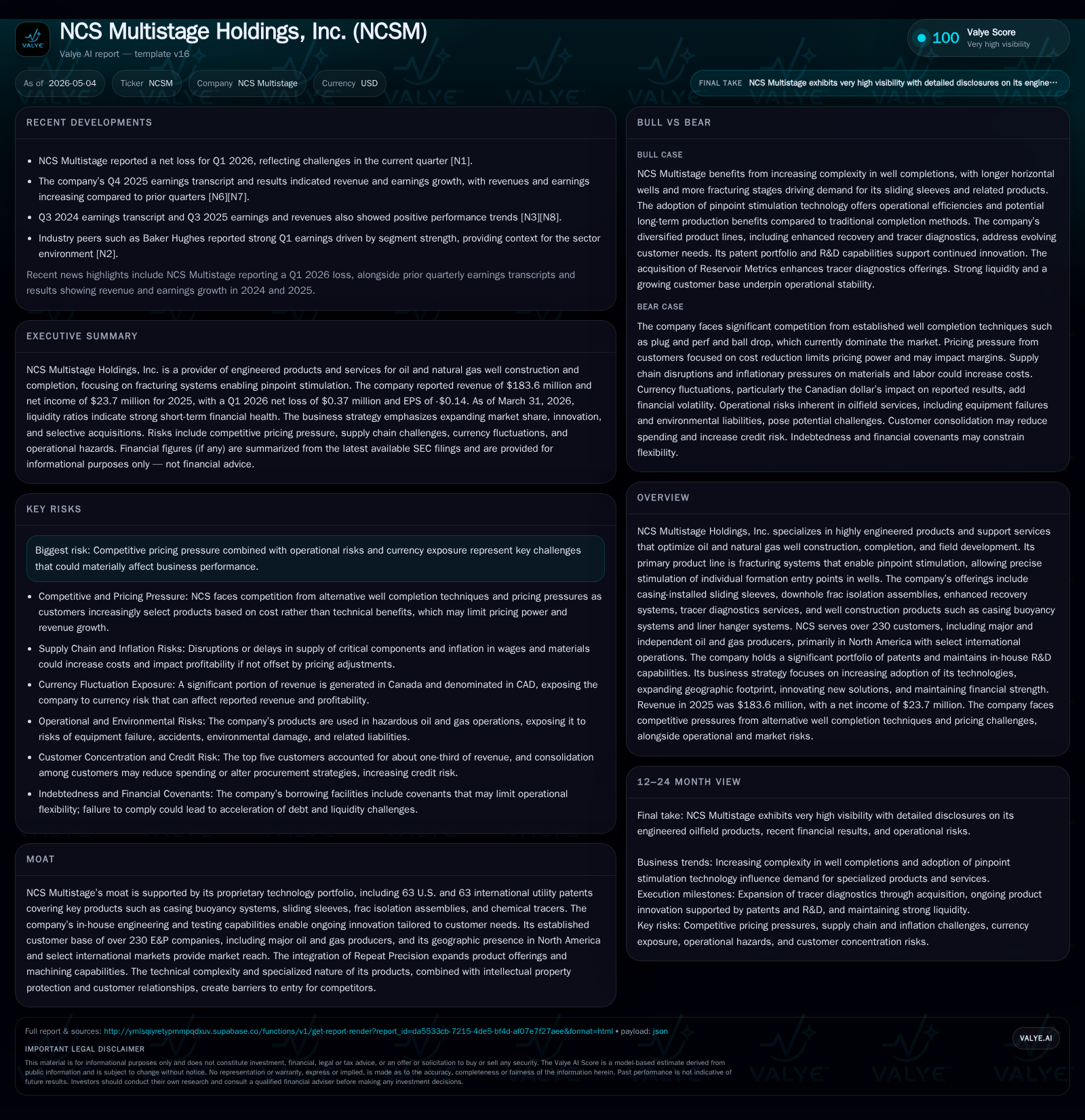
NCS Multistage’s latest quarterly filing reveals ongoing progress in the adoption of its pinpoint stimulation fracturing systems despite facing revenue headwinds and operational challenges. The firm continues to capitalize on trends toward longer, more complex horizontal wells requiring multiple stimulation stages. Its proprietary patented technology and close customer relationships underpin a strong competitive moat. However, cyclicality in oil and gas spending, pricing pressures, and integration risks pose material constraints to growth. Near-term growth depends on broader industry activity as well as increasing penetration of innovative completion solutions.
Recent Operating Update
NCS Multistage Holdings, Inc. disclosed its Q1 2026 results on April 29, 2026, via an SEC Form 10-Q and an 8-K filing [S2][S3]. The company reported a quarterly loss while falling short of consensus revenue estimates according to market reports [N1]. This marks a near-term operational challenge amid a backdrop of steady but cautious spending in North America's oilfield services sector. Despite this softness, NCS emphasized ongoing progress in customer adoption of its pinpoint stimulation products designed for increasingly complex horizontal wells.
The strategic importance of this quarter lies in gauging how quickly customers are transitioning to multistage fracturing methods that drive incremental product volume per well drilled. Precision stimulation aims to efficiently treat each formation entry point via casing-installed sliding sleeves or downhole isolation assemblies, aligning well with longer laterals drilled industry-wide [S1]. However, the company must navigate cyclical E&P capital expenditure pressures that influence completion activity levels.
Business Model
NCS's revenues primarily derive from selling engineered consumable equipment—most notably casing-installed sliding sleeves—and providing technical services including supervision of downhole frac isolation assemblies during completions. These products support their flagship offering: pinpoint stimulation technology enabling discrete, repeatable fracturing treatments at individual perforation clusters within horizontal laterals.
The business model hinges on E&P operators' well completion choices; more complex wells with multiple frac stages incrementally increase units sold per well. Pricing is driven by product mix (consumables vs services), contract terms, and prevailing aftermarket demand for completions. Services leverage NCS's specialized engineering expertise, adding differentiation beyond pure hardware sales.
Value creation is reinforced by extensive R&D capabilities developing next-generation technologies—a key competitive advantage given the technical complexity involved. The company's ownership stake in Repeat Precision expands access to complementary frac plugs and perforating equipment while consolidating machining capacity.
Industry Structure and Competitive Position
Operating primarily across North America with select international operations such as the North Sea and Middle East, NCS competes against established plug-and-perf and ball-drop well completion methods dominating unconventional plays today. Pinpoint stimulation technologies represent a niche but growing segment predicated on delivering enhanced completion efficiency and reservoir performance gains.
NCS maintains a robust patent portfolio with over 120 patents globally covering key innovations like buoyancy systems for casing string installation, sliding sleeves enabling precise access control during fracturing, and chemical tracers for reservoir diagnostics [S1]. This intellectual property network generates licensing income and erects substantial barriers against commoditized competition.
With more than 230 customers—including majors and independents—the company balances concentration risk with broad market penetration.
Guidance disclosures remain limited but any shifts will be material to refining demand outlooks given the underlying project timelines associated with well completions spanning months.
Financial Profile Context
Latest financial snapshot
| Metric | Value | Period |
|---|---|---|
| Cash & equivalents | $34mm | |
| 2026-03-31 | ||
| Current assets | $117mm | |
| 2026-03-31 | ||
| Current liabilities | $22mm | |
| 2026-03-31 | ||
| Current ratio | 5.35x | |
| 2026-03-31 |
Source: SEC companyfacts cache [F1].
As of March 31, 2026, NCS demonstrated solid liquidity positioning with cash & equivalents totaling approximately $34.5 million alongside current assets near $117 million versus $21.9 million current liabilities yielding a stout current ratio around 5.35—reflective of ample working capital coverage [F1][S2].
Operating income for year ending December 31, 2025 reached $10.5 million with net income at $23.7 million reflecting solid profitability before this quarter’s reported loss, signaling recent margin pressures perhaps linked to cost inflation or lower volumes [F1]. Future quarters will reveal whether management can stabilize operating margins through efficiency initiatives alongside revenue growth acceleration.
This analysis is based solely on publicly available SEC filings up to April 30, 2026 ([S1], [S2], [S3]) combined with verified companyfacts data ([F1]) and market reporting ([N1]). No proprietary insight has been incorporated. This report does not constitute investment advice but intends to provide an informed evaluation of NCS Multistage Holdings’ operating context, competitive dynamics, growth prospects, risk factors, and relevant financial position as of early 2026.
Disclaimer: This is research-only, informational analysis and not investment advice. It may include AI-generated interpretation and general industry context. Always verify important details using primary sources.

Comments