
New York Times Co. Surpasses Q1 Expectations with Subscription Gains and Digital Ad Innovation
The New York Times reported strong Q1 2026 results driven by accelerating digital subscriptions and an enhanced advertising product suite.
In its latest quarterly filing, New York Times Co. demonstrated robust subscription growth, crossing new milestones in its digital bundle adoption while innovating its advertising offerings with proprietary first-party data insights. The company’s diversified revenue streams and technology investments underpin resilience amid a competitive and evolving media landscape. Looking forward, the focus remains on expanding subscriber scale, improving user engagement through AI-driven personalization, and navigating risks from digital ad pricing pressures and sector disruption.
Latest Quarterly Results: Laying the Groundwork for Growth in 2026
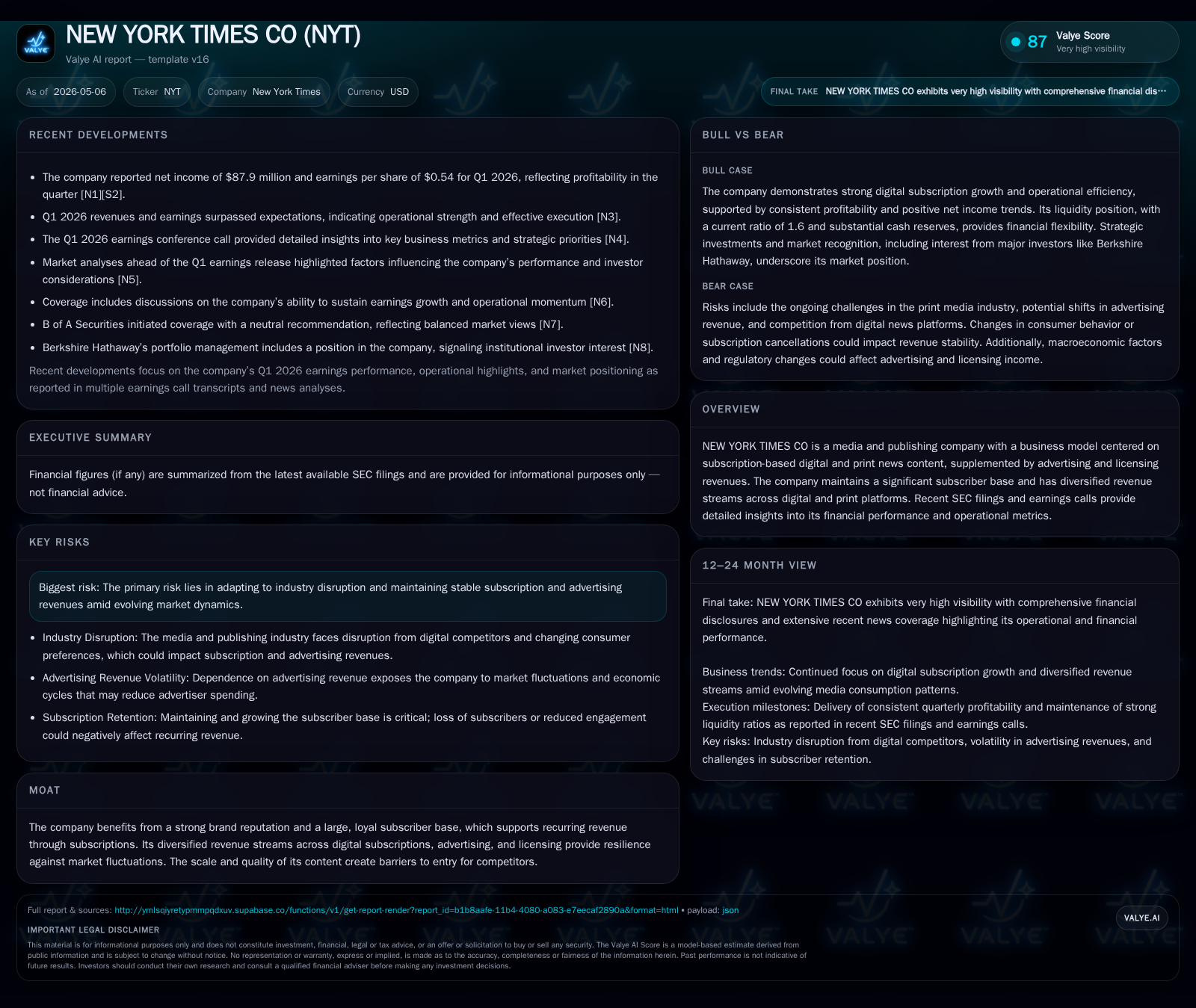
The New York Times Company (NYSE: NYT) reported solid operational results in its Q1 2026 filing dated May 6, 2026 [S2], corroborated by an accompanying 8-K press release [S3] and reflected in multiple analyst summaries [N1][N2][N3]. Total subscribers climbed beyond 13 million during this period, reflecting continued success of the company's interconnected digital subscription bundles that combine core news access with niche products like The Athletic (sports), Cooking, Games, Audio, and Wirecutter. This bundling strategy fosters stronger user habituation and reduces churn by offering multiple entry points to diverse content.
Concurrently, the advertising segment showed signs of rejuvenation as NYT expanded its premium digital offerings. Leveraging proprietary first-party data assets enabled more precise targeting at higher digital CPMs compared to standard programmatic ads [S1][S4]. These innovations contributed to advertising revenue outperformance relative to consensus estimates [N2][N3]. Print circulation remains a meaningful but declining component of overall revenues; however, print operations continue to produce positive operating margins bolstered by disciplined cost management [S1].
Overall revenue gains in Q1 were driven primarily by subscription volume increases combined with gradual improvement in advertising yield metrics. The growing importance of recurring subscription-based revenues over volatile advertising income continues to anchor sustainable financial performance.
Business Model Focus: Subscription Bundles and Advertising Innovations
NYT’s business model is predominantly anchored on delivering high-quality journalism via a subscription framework supplemented by targeted advertising sales and licensing revenues [S4][S11]. Consumers pay for stand-alone or multi-product digital subscriptions granting varying degrees of access to news content plus specialty products. Pricing models are calibrated dynamically according to customer willingness-to-pay insights derived from extensive data analytics.
The company's multiproduct bundle serves both as a demand-driver and retention mechanism by providing daily engagement opportunities across interests - such as general news, sports coverage (The Athletic), cooking recipes, audio storytelling, puzzle games, and trusted product reviews (Wirecutter) [S4][S11]. This strategy leverages cross-promotion within the ecosystem increasing the share-of-wallet per subscriber while mitigating churn risk.
On the advertising side, NYT offers a comprehensive mix including display ads across digital platforms (web & apps), video ads within multimedia content, email newsletters sponsorships, plus event-based marketing [S1]. Its competitive edge here centers on integrating proprietary first-party audience data to fuel predictive marketing analytics—delivering advertisers more measurable impact through contextual relevance without compromising user experience [S4]. This capability provides pricing power in premium segments less susceptible to commoditization pressures from broad programmatic marketplaces.
Print newspapers remain a profitable albeit shrinking segment involving physical distribution mainly in the U.S. metropolitan regions supplemented by international editions distributed globally via third-party agreements. Print subscribers receive bundled digital access which supports cross-platform monetization and protects some print subscriber loyalty despite secular declines in physical news consumption.
Competitive Ecosystem: Navigating Media Industry Challenges and Opponents
NYT operates amidst fierce competition not just from traditional news publishers but increasingly from dynamic platforms reshaping content discovery and consumption [S1]. Key competitive forces include large search engines (Google), social media platforms (Meta, Twitter), aggregated news outlets (Apple News Plus), streaming services with news components (Netflix News), and emergent AI-driven content creators potentially disrupting established editorial models.
Despite this challenge, NYT boasts a strong moat rooted in brand prestige backed by award-winning investigative journalism recognized globally [S26]. Its ability to produce original high-quality content at scale remains unmatched among many new entrants focused on aggregation or algorithmically generated material.
However, industry-wide pricing pressure exists especially in the advertising market where competitors vie aggressively for advertiser budgets leading to potential reductions in CPMs. Consumer behavior also poses challenges with rising expectations for integrated multimedia experiences alongside low tolerance for intrusive ads or paywall friction.
Therefore, NYT’s strategic pathway includes deepening product differentiation through editorial excellence coupled with sophisticated technology tools designed to heighten engagement and reduce subscriber churn [S15][S22].
Growth Drivers: Technology Investments and Audience Engagement Metrics
NYT continues prioritizing investments in data infrastructure modernization alongside advanced machine-learning tools applied across content recommendation engines, subscription conversion funnels, personalized marketing campaigns, and fraud detection systems [S4][N1]. These technical capabilities enhance user experience by tailoring articles/newsfeeds according to individual preferences while optimizing promotional strategies using real-time subscriber behavior insights.
Notably, NYT's deployment of AI enhances live briefing updates within its mobile app ecosystem ensuring subscribers remain instantly informed during unfolding events—a feature critical for habituation gains tied directly to daily active user growth metrics [N1]. Its email newsletter suite drives consistent engagement rates measured across millions of inboxes globally facilitating upstream conversion from casual readers into paying subscribers.
The combination of technology-enabled richer content formats (video/audio), attractive multiproduct bundle economics, plus iterative experimentation around pricing models creates multiple levers accelerating sustainable subscriber base expansion 3 Key performance indicators monitored include net new subscribers added each quarter, monthly recurring revenue growth from bundled products versus stand-alone subs (reflecting up-sell success), average revenue per user (ARPU), churn rates following price adjustments or feature launches, plus digital ad yield trajectories based on evolving targeting sophistication.
Risks and Constraints: Market Dynamics and Disruption Threats
Highlighted risks include the potential plateauing of subscription growth once market saturation approaches among English-language general interest news consumers [S2][S1]. Should significant churn accelerate due to intensified competition or changes in consumer media consumption habits—such as increased preference for zero-cost aggregator models—the revenue impact could be material.
Moreover, the digital advertising environment remains uncertain given macroeconomic cycles affecting advertiser spending patterns coupled with emerging pressures on pricing power from automated exchanges.
Further threats arise from innovative AI content producers potentially lowering barriers for new entrants armed with generative technologies capable of rapid content creation undermining established editorial credentials if not addressed adequately.
Regulatory risks around privacy laws impacting data collection practices critical for targeted advertising are also present.
Capital intensive nature of continued technology upgrades necessitates maintaining balanced investment versus profitability focus while protecting journalistic standards essential for subscriber trust.
What Investors Should Monitor Next: Milestones and KPIs to Watch
Upcoming quarters will be instructive regarding NYT’s ability to sustain subscriber acquisition momentum amidst intensifying market noise. Key metrics to watch closely include:
- Retention rates post price changes or feature enhancements indicating durability of value perception;
- Digital advertising CPMs especially within premium segments harnessing first-party data insights;
- Adoption rates of newly launched app capabilities like enhanced briefing alerts or integrated audio/video programming;
- Progress on AI integrations yielding measurable improvements in personalization effectiveness or operational efficiency;
- Revenue mix shifts between print vs. digital subscription sales providing insight into transformation pace;
- Churn related trends signaling elasticity against competitor offerings or free alternatives;
- Any updates on capital expenditure priorities which may affect near-term earnings leverage;
- Regulatory developments particularly concerning consumer privacy compliance influencing ad targeting strategies. These markers collectively represent execution points signaling whether NYT can maintain profitable growth trajectories amid evolving industry dynamics [N5][N7][S2].
Financial Overview and Current Balance Sheet Snapshot
Latest financial snapshot
| Metric | Value | Period |
|---|---|---|
| Cash & equivalents | $187mm | |
| 2026-03-31 | ||
| Current assets | $927mm | |
| 2026-03-31 | ||
| Current liabilities | $578mm | |
| 2026-03-31 | ||
| Current ratio | 1.6x | |
| 2026-03-31 |
Source: SEC companyfacts cache [F1].
New York Times maintains a robust liquidity position supportive of ongoing strategic investments. As of March 31, 2026:
| Metric | Amount (USD) |
|---|---|
| Cash & Equivalents | 186,733,000 |
| Current Assets | 927,211,000 |
| Current Liabilities | 577,882,000 |
| Current Ratio | 1.6 |
Although publicly disclosed total debt figures lag historical reporting dates ([F1]), net debt approximates $63 million reflecting conservative leverage levels. This financial flexibility enables NYT to fund technology advancements crucial for defending its competitive moat without immediate refinancing pressure [F1][S2]. Operating income results reported for full year 2025 affirm profitability stability underpinning reinvestment capacity [F1].
This analysis synthesizes New York Times’ recent quarterly disclosures combined with annual filings enriched by secondary investor commentary sources. The company appears poised on a trajectory balancing growing subscription monetization complemented by progressive advertising innovations underpinned by robust technology infrastructure upgrades amid sectoral challenges. Continued monitoring of structural KPIs related to subscriptions scaling and ad yield revitalization will be essential signals in an increasingly fluid media ecosystem.
Disclaimer: This report is for informational purposes only reflecting public filings as cited; it does not constitute investment advice or recommendations.
Disclaimer: This is research-only, informational analysis and not investment advice. It may include AI-generated interpretation and general industry context. Always verify important details using primary sources.

Comments