
BlackRock Amid Market Volatility: Latest Quarterly Insights and Strategic Outlook
Q1 2026 results reveal nuanced asset flow dynamics and emphasize BlackRock’s technology-driven differentiation amidst evolving industry risks.
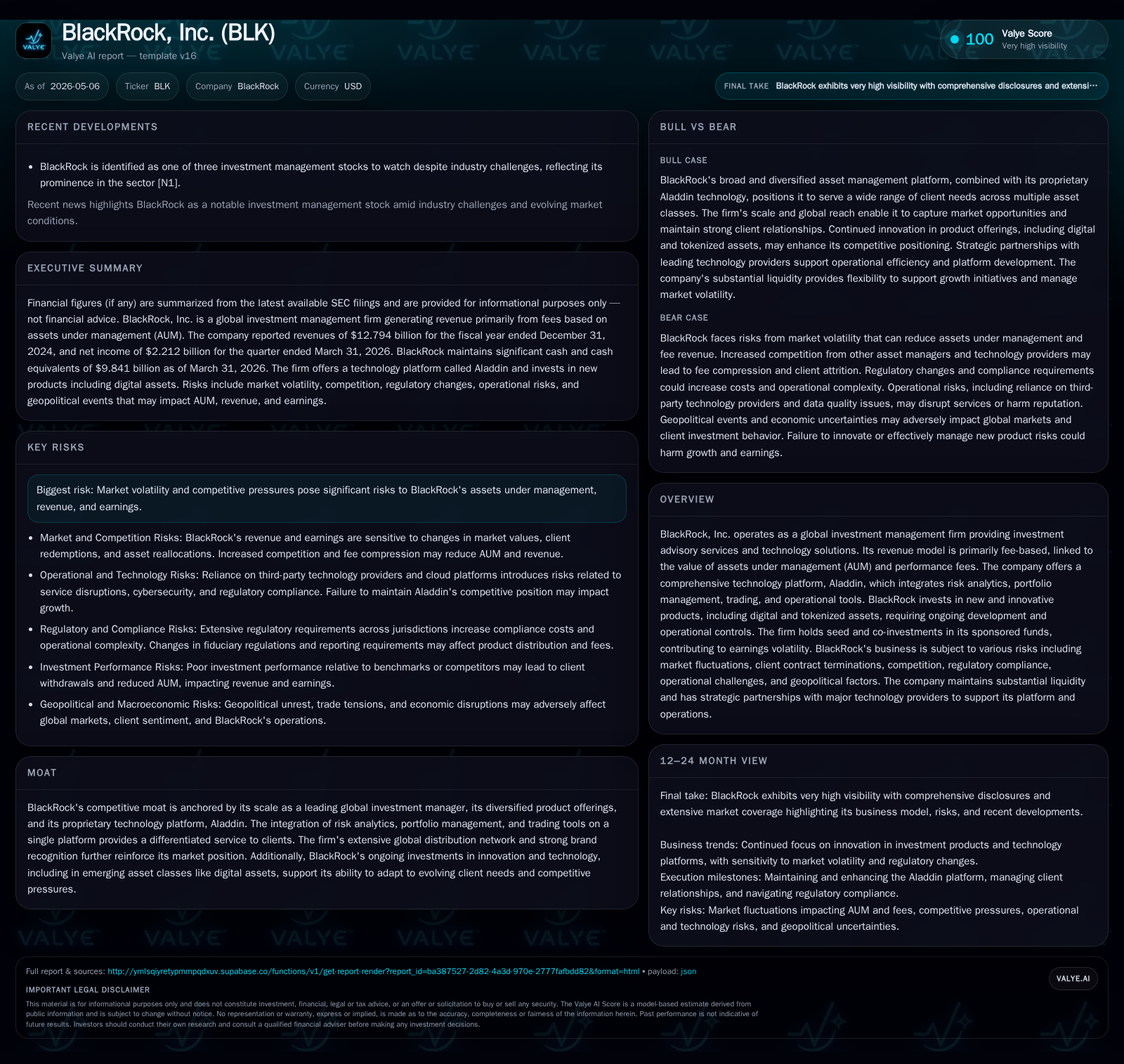
BlackRock's Q1 2026 disclosures highlight moderate pressure from market volatility impacting assets under management, with selective outflows in active strategies offset by continued strength in index and alternative products. The Aladdin platform remains a critical competitive moat, underpinning client retention and cross-selling amid fee pressures. Growth prospects hinge on technology enhancements, digital asset integration, and expanding ESG-aligned offerings, while regulatory scrutiny and market volatility pose ongoing challenges. The firm's robust liquidity and manageable leverage position it well to navigate these headwinds.
Latest Q1 2026 Operating Update and What It Means Now
BlackRock's first quarter of 2026 provided a mixed but insightful operating snapshot emphasizing the ongoing impact of market volatility on assets under management (AUM) and fee revenue streams. According to the Q1 10-Q filing dated May 6, 2026 [S2], the firm experienced modest net outflows in active investment strategies as some clients rebalanced amidst uncertain equity and fixed income markets. These redemptions were partly offset by persistent inflows into passive index products including ETFs and alternative asset classes such as private equity and real assets. This bifurcation accords with broader industry trends seen in contemporaneous filings from peers like Apollo Global and Federated Hermes who reported variable inflows but overarching sensitivity to macroeconomic shifts [N1,N3].
The blend of inflows into diversified products helps sustain BlackRock's advisory fee base despite downward pressure on average effective fees driven by product mix changes. Notably, performance fees linked to seed capital investments in sponsored funds introduced earnings volatility this quarter due to uneven returns across those holdings. The April 14 earnings release detailed these dynamics further outlining revenue fluctuations connected directly to AUM valuations across BlackRock's global business units [S3]. In sum, Q1 reflects typical cyclical noise layered onto structural forces reshaping asset allocation patterns worldwide.
Business Model Breakdown: Fee Structure, Product Offerings, and Technology Integration
BlackRock operates primarily through an AUM-linked fee model supplemented by performance-related incentives from select vehicles [S1]. Clients—including institutional investors, sovereign wealth funds, intermediaries, and retail segments—pay advisory fees based on a percentage of their portfolio size under management as well as potential additional fees deriving from fund performance exceeding benchmarks.
Central to BlackRock’s business model is its proprietary Aladdin platform which integrates sophisticated risk analytics with portfolio management, trading execution algorithms, and comprehensive operational tools. This unified technology ecosystem enables clients to gain real-time insights into exposures while benefiting from streamlined decision support that potentially reduces implementation frictions [S17]. This platform not only enhances client retention through higher switching costs but also broadens cross-selling capabilities for complementary services spanning equities, fixed income, multi-asset solutions, alternatives and now digital assets.
Moreover, BlackRock has ramped development efforts around digital/tokenized asset offerings reflecting strategic foresight into emergent financial technologies. These ventures necessitate continuous investment in operational controls given regulatory complexities around AI deployment and data privacy compliance [S21]. Additionally, seed investments within the firm's own sponsored private funds represent a source of both capital gains but also earnings volatility that can amplify reported results quarter-to-quarter.
Competitive Dynamics and Industry Position: Scale, Innovation, and Distribution Power
As the world’s largest asset manager by AUM with extensive geographic reach via a global distribution network spanning major financial centers across Americas, EMEA and APAC regions [S1], BlackRock’s scale forms a core pillar of its moat. Its brand recognition coupled with technological leadership via Aladdin creates a formidable barrier to entry.
Market share retention benefits from multiple switching costs embedded in Aladdin’s integrated user experience alongside contractual advisory relationships often renewed annually but subject to board approvals that maintain disciplined fee governance [S17]. Competitors ranging from large private equity firms like Apollo vying aggressively for institutional mandates to boutique managers compete heavily on bespoke solutions or price concessions but typically lack comparable technology ecosystems or distribution breadth.
Regulatory environment is tightening with uncertainties surrounding potential Systemically Important Financial Institution (SIFI) designation elevating compliance costs while antitrust scrutiny post-Hart-Scott-Rodino amendments threatens transaction pace particularly in inorganic growth areas. However, BlackRock's proactive investments in technology modernization and governance frameworks have bolstered resilience against these systemic pressures [S4,S13].
Growth Drivers: Technology Expansion, Emerging Asset Classes, and Global Penetration
Looking forward, BlackRock emphasizes several clear avenues fueling future growth trajectories:
Aladdin Platform Enhancements: Persistent upgrades to increase automation capabilities using AI/ML techniques enhance value propositions for institutional clients facilitating deeper analytics-driven portfolio construction.
Digital and Tokenized Assets Development: Strategic product launches targeting blockchain-enabled securities demand specialized expertise accelerating adoption among tech-savvy investors.
Emerging Markets Expansion: Accelerating penetration into higher-growth markets taps rising wealth pools amid evolving pension systems especially in Asia Pacific where regulatory landscapes are progressively maturing.
ESG/Sustainable Investing Innovations: Expanding suite of sustainable strategies aligns with increasing client mandates for responsible investing under evolving regulatory frameworks globally stimulating newer flows.
These drivers are accompanied by measurable KPIs such as incremental net new AUM from targeted launch funds or regions plus expansion of client agreements incorporating technology service provisions beyond pure advisory functions [S1].
Risks and Constraints: Market Volatility, Regulatory Developments, and Client Retention Challenges
Despite growth prospects there remain significant constraints:
Market Sensitivity: Fluctuations in market values drive direct variability in fee revenues given dependency on AUM levels; sustained downturns could trigger accelerated redemptions or contract renegotiations impacting margins seriously [S8,S21].
Contract Renewal Risks: Advisory contracts can be terminated or not renewed at fund boards’ discretion annually posing consistent retention risks especially in competitive active management segment where fee compression is acute [S1].
Regulatory Uncertainty: Potential SIFI designation would impose higher capital buffers along with direct Federal Reserve supervision escalating operational complexity; additionally evolving antitrust rules inject deal timing unpredictability impairing inorganic growth options [S4,S29].
Operational Control Complexity: Increasing reliance on AI-powered investment tools coupled with nascent digital asset exposures require robust controls; failure could result in regulatory fines or client loss damaging reputation materially [S21].
Legal/Litigation Exposure: Ongoing regulatory investigations plus heightened scrutiny around ESG claims increase risk of contingent liabilities affecting discretionary budgets if protracted or unfavorable outcomes occur [S8,S29].
Overall these risks shape the cadence of earnings cycles creating episodic volatilities distinct from underlying long-term secular trends.
Key Upcoming Catalysts and Monitoring Points for Execution and Demand Signals
Investors monitoring BlackRock should focus near term on:
- Quarterly earnings updates emphasizing organic net new money trends across product types providing early signs of client demand shifts post-Q1 turbulence.
- Progress reports on Aladdin platform AI integration upgrades slated for phased introduction potentially unlocking new revenue streams via enhanced licensing models.
- Regulatory developments regarding FSOC reviews of SIFI designations particularly any pronouncements impacting capital/liquidity requirements.
- Management commentary around margin trajectory reflecting cost management versus investment intensity balance post recent acquisitions or technological initiatives.
- Fund-level inflow/outflow data for flagship ETFs or alternatives highlighting whether BlackRock can sustain scale advantages relative to competitors noted for volatile fund flows recently [N11,S3].
Successful navigation through these milestones will materially influence firm valuation perspectives over medium term.
Current Financial Profile: Liquidity, Debt Position, and Profitability Snapshot
Latest financial snapshot
| Metric | Value | Period |
|---|---|---|
| Cash & equivalents | $9.8bn | |
| 2026-03-31 | ||
| Total debt | $12.7bn | |
| 2026-03-31 | ||
| Net debt | $2.9bn | |
| 2026-03-31 |
Source: SEC companyfacts cache [F1].
At March 31, 2026 quarter-end according to companyfacts data [F1], BlackRock held $9.84 billion in cash and equivalents against total debt approximating $12.75 billion yielding a net debt position close to $2.9 billion.
Disclaimer: This is research-only, informational analysis and not investment advice. It may include AI-generated interpretation and general industry context. Always verify important details using primary sources.

Comments