
Parke Bancorp Advances Core Deposit Strategy to Support Regional Lending Growth
Parke Bancorp’s latest 10-Q highlights a strategic refinement in funding sources with increased reliance on core deposits and selective brokered deposits, underpinning loan portfolio expansion in New Jersey and Pennsylvania.
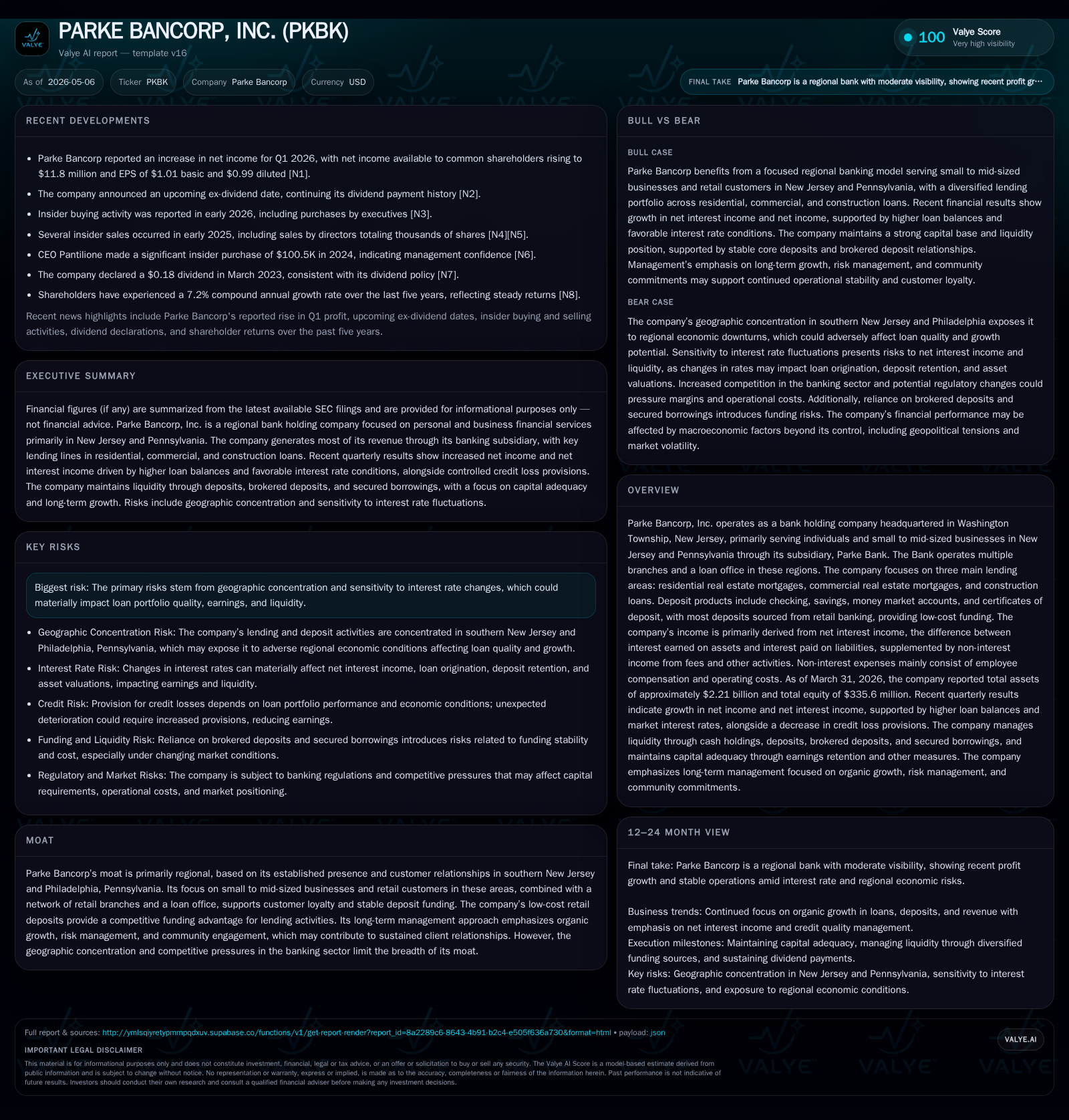
In the first quarter of 2026, Parke Bancorp reinforced its funding base by deepening core deposit relationships while supplementing liquidity through established brokered deposits and the IntraFi Financial Network. The company’s business model centers on serving small to mid-sized businesses and retail customers through focused lending in residential, commercial, and construction loans, supported by a stable retail deposit franchise. Its regional foothold in southern New Jersey and Philadelphia underpins a modest moat, but geographic concentration and interest rate fluctuations remain notable risks. Looking forward, monitoring deposit cost trends, loan growth momentum, and local economic conditions will be critical to assessing Parke Bancorp’s trajectory.
Latest Quarterly Operating Update: Shifts in Funding and Liquidity
Parke Bancorp's most recent quarterly filing dated May 6, 2026 ([S2]) delivers a clear picture of how the company is actively managing its funding mix to underpin continued lending growth in its regional markets. The company reiterated deposits as its primary funding source but explicitly highlighted an increased reliance on brokered deposits totaling approximately $156.6 million from longstanding relationships with Wells Fargo, Piper Sandler, and Stonecastle. This external liquidity complements around $35 million sourced via the IntraFi Financial Network through its CDARS ® settlement process and ICS ® money market products. This nuanced combination enhances the bank's ability to maintain stable funding while preserving balance sheet flexibility.
Liquidity management also includes maintaining a substantial cash position of roughly $110.9 million as of March 31, 2026 ([S2]). These funds primarily reside in interest-bearing accounts at the Federal Reserve, reflecting prudent asset-liability management that ensures operational resilience amid potential volatility. Overall, this funding evolution balances the bank’s traditional emphasis on low-cost core deposits with strategic utilization of brokered sources to support incremental loan growth.
Business Model and Product Mix: Lending Focus and Fee Income
Parke Bancorp operates principally as a bank holding company serving individuals and small to mid-sized businesses within southern New Jersey and Philadelphia metropolitan areas ([S1],[S2]). The offering comprises three main lending products: residential real estate mortgages, commercial real estate mortgages, and construction loans. These categories reflect a deliberate focus aligned with regional demand patterns where property development cycles often stimulate borrowing needs.
Revenue generation hinges predominantly on net interest income — the differential between interest earned on loan assets and interest paid on liabilities — supplemented by non-interest income streams such as fees from deposit services ([S2]). Core deposit products include checking accounts, savings accounts, money market accounts, and certificates of deposit primarily sourced from retail customers; this supports a low-cost funding structure vital for margin stability. The company distributes these offerings mostly via branch locations dispersed across its service areas along with a dedicated loan office for commercial engagement.
This business model emphasizes tight integration with community clientele enabling tailored credit underwriting while maintaining strong deposit capture through direct banking relationships. The focus on organic growth combined with disciplined risk controls frames Parke Bancorp’s approach to sustaining earnings quality over economic cycles.
Regional Banking Landscape: Competitive Position and Moat Analysis
Parke Bancorp occupies a distinctive regional niche within a saturated competitive banking environment reaching into southern New Jersey and adjacent Pennsylvania territories ([S1]). Its moat derives from entrenched customer relationships cultivated through an extensive retail branch network paired with personalized service targeting small-to-mid sized enterprises (SMEs) and individual consumers.
This localized presence fosters customer loyalty translating into stable core deposits which provide an economically advantageous funding base relative to wholesale alternatives. Furthermore, geographic familiarity allows for specialized expertise in underwriting area-specific real estate loans where nuanced market knowledge offers competitive edge.
However, this regional dependency introduces constraints limiting scalability beyond proximate markets. Competition from larger national banks and fintech entrants also places pressure on pricing power particularly in deposits retail segments. Consequently, Parke Bancorp’s moat is more accurately characterized as moderate — solid locally but vulnerable without broader diversification or technological innovation initiatives.
Growth Drivers: Core Deposits, Loan Portfolio Expansion, and Regional Economy
Key growth vectors spotlight expanding core deposit balances as the foundation supporting loan portfolio buildout especially focused on commercial real estate and construction lending ([S1],[S2],[N1]). Management’s commitment to prudent risk management combined with prolonged relationships aids asset quality maintenance enhancing capacity for measured credit extension.
Evolving macroeconomic factors within its footprint further bolster prospects; localized economic activity including real estate development cycles in New Jersey and Pennsylvania fuel demand for financing solutions essential for corporate clients’ capital projects. Additionally, sustained consumer engagement ensures dependable retail deposit inflows providing stable liability costs which underpin net interest margin preservation.
Recent news reports indicate improvement in first-quarter profitability ([N1]), signaling operational momentum possibly driven by refined expense management or effective deployment of new loans fueling interest income expansion. Nevertheless, growth is contingent upon continued success in managing deposit pricing amid rising market rates alongside capacity to capitalize on targeted lending niches without compromising asset quality.
Risks and Constraints: Geographic Concentration and Interest Rate Sensitivity
Parke Bancorp’s concentrated operations within southern New Jersey and Philadelphia create exposure to localized economic downturns which could impair credit performance materially ([S1]). Real estate markets’ cyclicality poses inherent risk particularly if adverse conditions lead to diminished collateral values or borrower defaults impacting loan loss provisions.
Moreover, earnings are acutely sensitive to changes in interest rates governed largely by Federal Reserve policy shifts ([S1]). Fluctuations impact net interest margin dynamics since increased market rates can elevate funding costs faster than yields on existing loans adjust downwardly affecting profitability temporarily. Elevated rate environments may also suppress loan demand adversely affecting future revenue trajectories.
Regulatory changes or evolving competitive pressures represent additional watchpoints that could constrain operational flexibility or increase compliance burdens.
Key Near-Term Developments to Watch
Investors should track Parke Bancorp’s upcoming quarterly disclosures for insights into Q2 deposit account pricing trends which directly influence net interest margins ([S2],[N1]). Loan production volumes reflecting momentum in commercial real estate and construction sectors will provide tangible evidence regarding execution against stated growth strategies.
Adjustments in proportional reliance on brokered deposits versus organic core fund generation will signal management’s confidence level in underlying franchise stability under shifting market conditions. Any updates related to regulatory environment adaptations or shareholder voting outcomes might also illuminate evolving corporate governance or strategic priorities ([S3]).
Finally, broader macroeconomic indicators affecting southern New Jersey and Philadelphia economies remain critical barometers for the bank’s operating context given their outsized influence on credit quality patterns.
Financial Profile Snapshot (Brief Contextual Discussion)
The firm reported net income of approximately $37.8 million for full year 2025 highlighting ongoing profitability though specifics beyond that period remain subject to forthcoming releases ([F1]). Capital adequacy metrics were not reconfirmed explicitly in this quarterly filing but historical filings indicate soundness consistent with peer group norms.
Overall balance sheet composition suggests conservative leverage posture suitable for regional banking dynamics with strategic emphasis placed on balancing growth imperatives against credit risk prudence amid evolving market conditions.
This analysis synthesizes Parke Bancorp’s recent SEC disclosures emphasizing operational updates anchored by its May 2026 quarterly report alongside contextual business model insights drawn from its March 2026 annual filing complemented by public news reports up to April 2026. It refrains from investment recommendations or price forecasting conforming strictly to Valye News policy directives.
Disclaimer: This is research-only, informational analysis and not investment advice. It may include AI-generated interpretation and general industry context. Always verify important details using primary sources.

Comments