
XPO, Inc. Delivers AI-Fueled Growth and Margin Leverage in North American LTL
Q1 2026 results showcase XPO's operational efficiency gains propelled by AI-driven innovations and strategic scale in Less-Than-Truckload services.
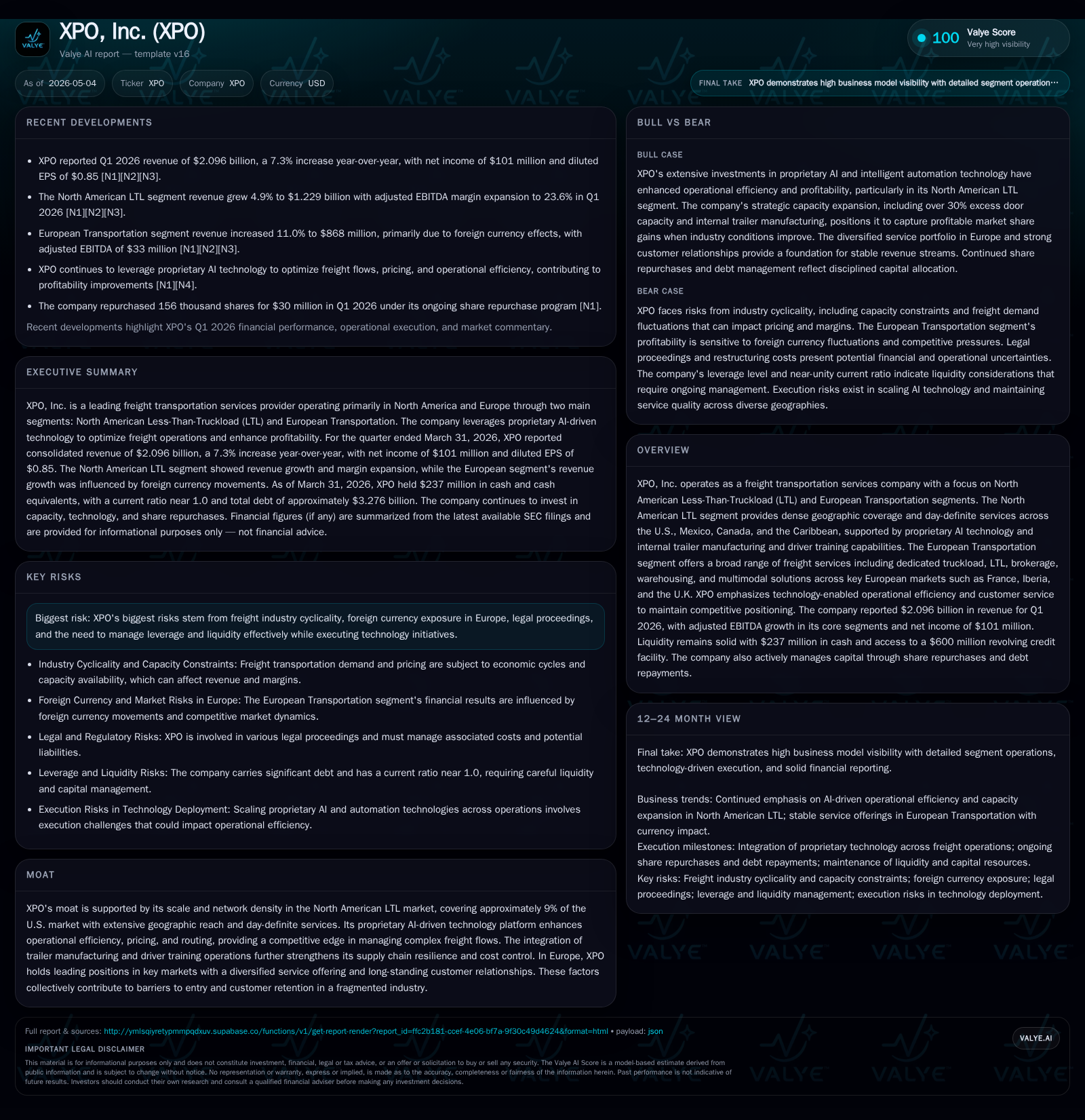
In Q1 2026, XPO, Inc. reported a 7.3% revenue increase driven by robust performance in its North American Less-Than-Truckload (LTL) segment and sustained operations in Europe. The company leveraged proprietary AI technologies to boost shipments per day and yield, resulting in a 16% adjusted EBITDA growth within its LTL business. Despite challenges including wage inflation and fuel cost pressures, XPO’s disciplined execution and network density underpin its competitive positioning. The firm continues to manage leverage proactively while expanding cross-border freight operations and enhancing productivity with real-time labor analytics.
Q1 2026 Operating Performance: Reinforcing Core Strengths
XPO's first quarter of 2026 delivered strong operating momentum highlighted by a consolidated revenue uptick of 7.3%, reaching $2.096 billion compared to the prior year period [S2]. This growth was predominantly fueled by its North American Less-Than-Truckload (LTL) segment whose revenues climbed nearly 5%, driven by increased shipments per day and improved pricing yields excluding fuel surcharges [S12]. Specifically, shipments per day rose by 3% while average weight per shipment declined marginally (-2.8%), signaling a focus on higher frequency smaller loads conducive to optimized utilization from AI-driven route planning [S12]. Adjusted EBITDA for the LTL segment expanded robustly by 16%, reaching $290 million due to enhanced operational efficiencies including lower purchased transportation spend and reduced vehicle insurance costs despite headwinds from wage inflation and elevated fuel prices [S2], [S12].
Meanwhile, the European Transportation business reported an 11% revenue increase primarily reflecting favorable foreign exchange movements (~10.9 percentage points); however, on a constant currency basis revenue remained largely flat year-over-year at roughly $868 million [S7]. Adjusted EBITDA held steady at $33 million despite macroeconomic pressures across key markets like France, Iberia, and the U.K., showcasing stability in a diverse freight service portfolio encompassing dedicated truckload, brokerage, warehousing, multimodal logistics solutions along with long-established customer relationships [S7], [S11]. The corporate segment absorbed costs related to restructuring actions aimed at streamlining European operations.
XPO’s Business Model: Network Density Meets AI Integration
XPO’s business model capitalizes on operating one of North America's largest LTL networks encompassing approximately 37,000 shippers with critical geographic density servicing almost every U.S. ZIP code (99%) as well as comprehensive cross-border routes covering Mexico, Canada, and Caribbean territories [S11]. This network density facilitates day-definite delivery commitments crucial for customer stickiness in time-sensitive supply chains.
Central to its competitive advantage is XPO’s significant investment in proprietary technology employing artificial intelligence (AI). Since late 2021, the company has scaled its AI-enabled linehaul models that optimize freight flow efficiency by reducing empty miles and maximizing trailer load factors based on extensive data inputs—volume patterns, capacity constraints, dimensional attributes—resulting in smarter routing decisions that support margin enhancement [S11], [S15]. Furthermore, real-time labor analytics deployed at service centers foster improved workforce productivity aligned with demand fluctuations.
Complementing technological investments are vertically integrated assets such as an internal trailer manufacturing facility and connected commercial driver training programs which insulate XPO from external equipment shortages and driver scarcity challenges prevalent across the logistics sector post-pandemic [S11]. These capabilities reduce supply chain reliance on third parties thereby controlling costs while facilitating rapid network capacity adjustments when market conditions improve.
XPO’s dual-segment strategy balances mature yet growth-oriented North American LTL operations against a diversified portfolio of European freight services ranging from full truckload brokerage to last mile delivery and multimodal transport catered via digital platforms—allowing tailored solutions across varying customer sectors including consumer goods and industrial markets [S6], [S11].
Competitive Dynamics: Scaling Advantages in a Fragmented Industry
The less-than-truckload industry is characteristically fragmented but heavily reliant on scale economies for comprehensive regional coverage combined with technology adoption that enables complex network orchestration. Within this context, XPO leverages its ~9% U.S. market share advantage to yield differentiated pricing power through superior service consistency backed by day-definite delivery guarantees covering almost all urban and rural geographies [S11]. This network effect creates entry barriers for smaller competitors lacking critical mass or advanced digital infrastructures.
In Europe’s market landscape marked by regulatory complexity and heterogeneous modal preferences among countries such as France (where XPO ranks #1 in pallet networks), Iberia (#1 full truckload broker), and the U.K., XPO maintains leadership positions supported by longstanding customer contracts infused with managed transportation solutions enabling deeper collaboration beyond pure freight haulage roles [S11]. The broadened product mix incorporating warehousing intermeshed with value-added logistics positions XPO reasonably well amid competitive pressures though it remains exposed to currency volatility risks intrinsic to multinational operations.
Industry fragmentation also presents opportunities for consolidation particularly where technological investment creates differentiation; XPO’s AI-enabled decision platforms represent an emerging moat enhancing operational agility amid capacity constraints currently below pre-pandemic thresholds in North America’s LTL sector [S22].
Growth Drivers: Technology Innovation and Cross-Border Expansion
Primary growth drivers stem from deepening implementation of AI-powered tooling across linehaul routing algorithms that incrementally improve load optimization metrics reducing empty runs alongside pickup-and-delivery route innovation piloted through real-time monitoring systems [S2], [S15]. These tools not only push marginal cost down but enhance yield capture through precision pricing models adapting dynamically to shipment characteristics.
Cross-border expansion plays a strategic role as XPO capitalizes on NAFTA/USMCA trade corridors linking the United States with Mexico and Canada extending to Caribbean markets leveraging integrated day-definite service contracts reinforced through proprietary technology platforms facilitating complex customs clearance protocols seamlessly—a key client demand vector supporting sustained volume growth amidst evolving supply chain security requirements [S2], [N3].
European growth prospects lie in broadening multimodal logistics offerings combining trucking with rail or maritime segments via digital brokerage systems providing customers holistic freight solutions that meet environmental sustainability trends increasingly prioritized in EU regulatory frameworks [N3], [S6]. This diversification also helps offset some cyclicality inherent in traditional truckload or LTL modes.
Measured KPIs indicating these growth trajectories include shipment counts per day rising at low single digit percentage rates paired with yield increases measured via gross revenue per hundredweight excluding fuel surcharges showing mid-single-digit gains reflecting successful pricing strategies amidst competitive end-market dynamics [S12].
Risks and Constraints: Cyclicality, Currency Exposure, and Leverage Monitoring
XPO’s financial performance faces cyclical headwinds linked directly to overall freight demand variability correlated with macroeconomic cycles affecting industrial output and retail activity volumes; downturns depress utilization rates pressuring margins given the fixed-cost nature of asset-heavy LTL networks although internal excess door capacity offers flexibility during lulls mitigating downside risk somewhat [S26], [S11], [S22].
Foreign currency exposure remains material as European revenues denominated mainly in euros translate back into dollars impacting reported top-line figures; while hedging programs are employed periodically their imperfect nature subjects earnings consistency to FX swings which can be aggravated during geopolitical uncertainties or Eurozone disruptions [S26], [F1].
The legacy litigation environment primarily involving insurance contribution claims related to historical Con-way acquisitions generates recurring legal expense risks though presently not considered materially adverse by management; nevertheless pending outcomes warrant ongoing watchfulness given potential settlement cost magnitudes versus operating cash flows [S26].
Rising personnel costs due to wage inflation combined with increasing fuel prices continue exerting upward pressure on operating expenses necessitating sustained productivity improvement efforts via technology adoption else margin dilution could ensue over time especially if freight rate escalations lag input cost trends creating margin squeeze scenarios [S26], [S12].
Leverage metrics remain under active management with total debt approximating $3.4 billion fair value but net debt around $4 billion when factoring cash position; during Q1 2026 alone total term loan principal repayments exceeded $100 million comprising both scheduled amortizations plus opportunistic prepayments indicating deliberate balance sheet strengthening aimed at easing covenant restrictions while preserving liquidity reserves exceeding $800 million inclusive of revolving credit availability—all supportive of maintaining financial flexibility for capex or M&A activities [F1], [S4], [S5], [S8].
Investor Watchlist: Upcoming Catalysts and Execution Milestones
Key milestones for market participants include tracking subsequent quarterly earnings releases expected to update guidance incorporating volume trajectories per shipment counts alongside yield movements chiefly influenced by pricing initiatives efficacy against inflationary backdrops [S2], [N1]. Monitoring implementation progress for expanding AI-driven linehaul scheduling tools across new or under-optimized hubs remains critical as successful rollouts correlate strongly with margin progression timelines.
Resolution timing on European payment cycle delays tied to structural reorganization refunds estimated at approximately $6 million expected either this year or next will serve as an indicator of settled operational risk exposures alleviating working capital pressures moderately within that segment’s P&L flow dynamics[S2], [N1].
Legal settlement developments particularly around legacy insurance claims warrant periodic review due their asymmetrical risk profile though current accruals suggest manageable exposure absent unforeseen material adverse rulings[S26]; likewise any strategic disposal announcements concerning European Transportation operations could materially reconfigure capital deployment focus subject to board authorization yet remain uncertain currently[S22].
Financial Profile Snapshot: Liquidity, Debt Structure, and Capital Strategy
Latest financial snapshot
| Metric | Value | Period |
|---|---|---|
| Cash & equivalents | $237mm | |
| 2026-03-31 | ||
| Current assets | $1675mm | |
| 2026-03-31 | ||
| Current liabilities | $1691mm | |
| 2026-03-31 | ||
| Current ratio | 0.99x | |
| 2026-03-31 |
Source: SEC companyfacts cache [F1].
As of March-end 2026 balance sheet strength is underscored by liquidity nearing $837 million when aggregating cash lines plus undrawn revolver capacity net of letters of credit outstanding primarily related to operational guarantees embedded within commercial contracts respectively totaling roughly $132 million under uncommitted secured letter of credit facilities[S4], [F1].
Debt amortization activities concentrate on senior secured term loans maturing between 2028–2031 averaging weighted interest around mid-5% range manageable through proactive refinancing approaches observed via recent extinguishments totaling approximately $100 million during early 2026 reflecting prudent deleveraging steps aligned with medium-term capital strategy goals[S8], S27]. Interest expense declined modestly year-over-year benefiting from lower average debt balances offset partially by persistent variable rate components hedged via near-term interest swap instruments expiring Q4 2026 constituted as cash flow hedges stabilizing expense volatility accordingly[S20].
Operating cash flows benefitted from net income gains consistent with volume yield expansions complemented by disciplined working capital management evidenced in receivables securitization facilities aiding liquidity optimization especially within European operations facing extended payment terms cycles[S25]. Capital expenditures prioritize IT infrastructure advancing AI platforms while maintaining trailer fleet upgrades crucial for service quality preservation allowing emerging margin expansion potential befitting incremental delivery reliability enhancements[S2, S11].
This analysis is based exclusively on information publicly available up to May 4th, 2026 from official SEC filings including Form 10-Q dated April 30th, 2026 ([S2]) supplemented by other regulatory documents ([S1],[S3]) along with corroborating secondary sources ([N1],[N3]). Financial figures are cited precisely from referenced disclosures without extrapolations or forecasts beyond stated evidence. This discussion aims solely at providing an in-depth operational overview devoid of investment recommendations or subjective valuation judgements.
Disclaimer: This is research-only, informational analysis and not investment advice. It may include AI-generated interpretation and general industry context. Always verify important details using primary sources.

Comments