
Tiptree Inc. Consolidates Strategy Post-Dispositions, Focuses on Scalable Private Investments
Following recent divestitures, Tiptree is shrinking its asset base but sharpening its investment focus on patient capital opportunities in small and middle market firms.
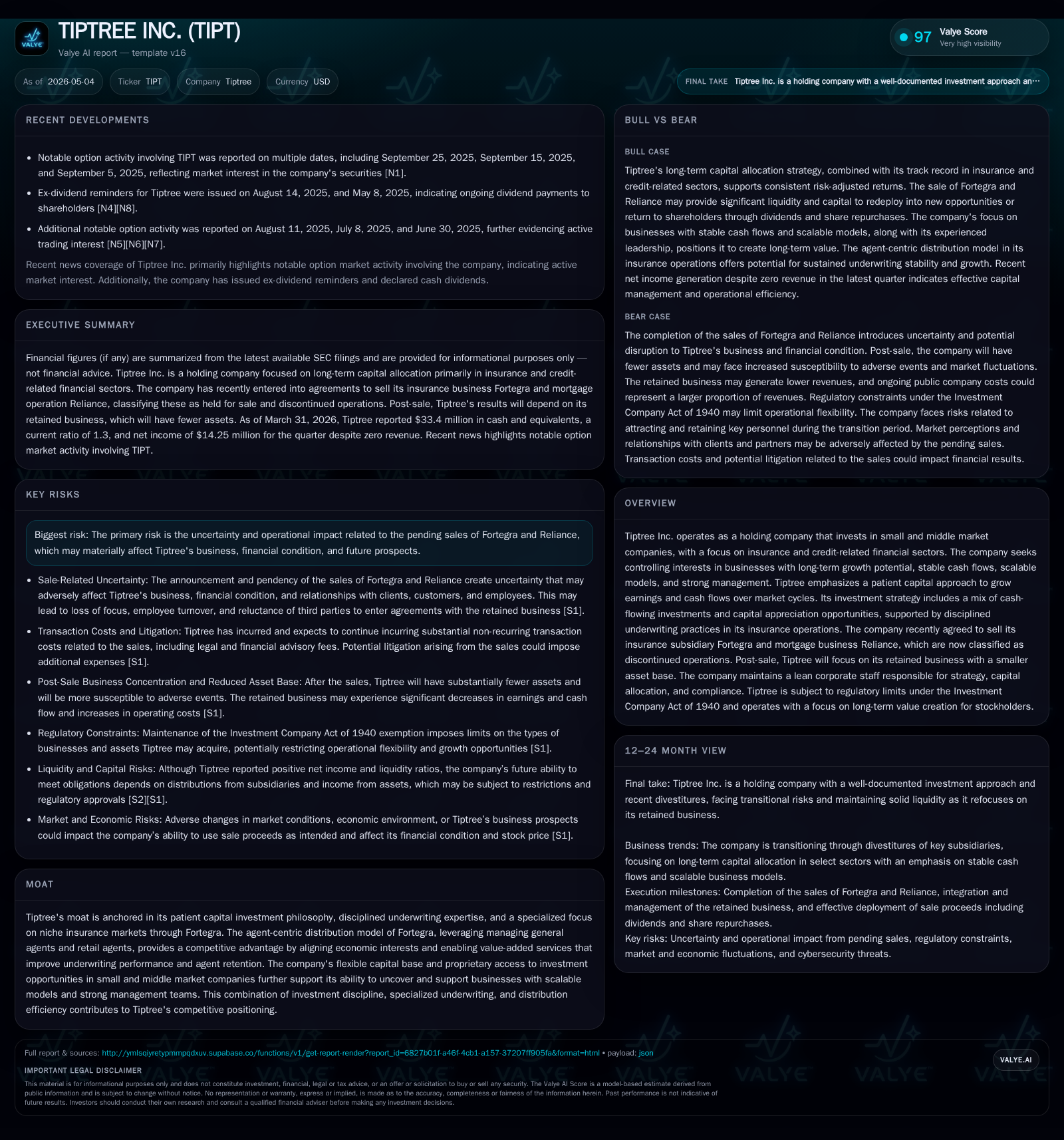
In its latest quarter ending March 2026, Tiptree Inc. materially progressed the sale of its insurance subsidiary Fortegra and mortgage business Reliance, now classified as discontinued operations, reducing the company’s asset footprint to concentrate on retained businesses. Its core model centers on acquiring controlling interests in niche insurance and credit-related sectors with an emphasis on long-term growth potential and scalable operations supported by disciplined underwriting. While divestiture-related uncertainties pose risks, Tiptree’s moat lies in its patient capital approach, strong underwriting expertise, and agent-centric MGA distribution model. The company faces notable operational scale-down and heightened expense ratios in a post-sale environment but retains a lean corporate team steering strategic capital deployment across targeted private market investments.
Recent Operating Update
Tiptree Inc.’s latest quarterly filing dated April 30, 2026 ([S2]) reveals pivotal developments reshaping the company’s operational landscape. The firm has officially reclassified its two largest businesses—Fortegra insurance subsidiary and Reliance mortgage unit—as discontinued operations following sale agreements initiated in late 2025 ([S1], [S3]). The $1.65 billion cash consideration for Fortegra closed or nearing close marks a material de-risking event that simultaneously shrinks Tiptree’s asset base and refocuses its strategy around retained investments.
This transition to a leaner enterprise means Tiptree will no longer have an equity stake or earn future income from Fortegra. Similarly, Reliance’s disposition effectively exits the mortgage origination and servicing market ([S1]). In the immediate term, this wind-down drives a sharp contraction in top-line revenue and operating volume given the prior scale of these subsidiaries relative to the whole company.
Management emphasizes patience amid these structural changes ([S3]), intending to deploy freed-up capital into small and middle market companies characterized by scalability and stable cash flow profiles—a shift away from large-scale insurance underwriting toward more selective private equity-styled investments ([S18]).
Business Model
Tiptree operates fundamentally as an investment holding company with a differentiated focus on middle-market enterprises primarily within the insurance and credit-related financial industries. Its approach is rooted in acquiring controlling interests where it can actively influence governance and operational outcomes ([S18]). Key tenets of their model include:
- Patient Capital Philosophy: Emphasis on long-term earning growth rather than quick flips underpins capital allocation decisions. This outlook aims for earnings stability through economic cycles.
- Disciplined Underwriting: Particularly relevant when operating insurance subsidiaries (now divested), underwriting rigor is critical for sustained profitability; Tiptree stresses pricing discipline, claims management, and risk selection ([S18]).
- Scalable Business Models: Focused on companies with scalable platforms which embed optionality for expansion or margin improvement over time.
- Strong Management Partnership: Efforts hinge on partnering with robust executive teams capable of executing growth strategies amid regulatory frameworks.
Revenue mechanics historically included premium income from Fortegra’s specialty casualty insurance products distributed through a network of managing general agents (MGAs)—a model aligning agent incentives with underwriting quality—alongside mortgage fee income from Reliance originating FHA/VA loans sold largely into agency pools ([S21]). Post-disposition, revenue sources will be predominantly derived from returns on private investments alongside any recurring income generated by retained entities or assets.
Cost structures had been scaled for larger operational footprints with nearly 1,500 employees before divestments; now corporate overhead resides with approximately fourteen staff members responsible for strategy, compliance, and public company functions—a significant dilution of previous scale economies ([S1]).
Industry Structure and Competitive Position
In its legacy insurance operations via Fortegra, Tiptree competed within specialty excess & surplus (E&S) markets distinguished by higher underwriting complexity but commensurately better margin potential when disciplined ([S1]). Fortegra’s agent-centric MGA distribution was a moat element providing differentiated access to niche product segments underserved by standard insurers.
The company also operated within credit-financial sectors evidenced by mortgage origination and servicing aligned with government-sponsored enterprise standards—highly cyclical yet structurally dependent on regulatory frameworks like FHA/VA programs ([S21]).
The holding company strategy positions Tiptree uniquely against pure-play insurers or mortgage lenders by combining investment skills across industries with selective controlling ownership. This horizontal integration facilitates value creation through capital allocation agility but depends heavily on management's ability to identify promising niche opportunities outside mainstream financial institutions ([S18]).
Growth Drivers
Post-Fortegra/Reliance sales, growth initiatives pivot unmistakably toward:
- Private Market Acquisitions: Pursuing controlling stakes in well-managed companies exhibiting stable cash flow profiles that can be unlocked via strategic oversight or growth capital infusion ([S18]).
- Operational Improvements: Applying underwriting discipline lessons to any remaining or newly acquired financial services businesses can drive margin enhancements.
- Selective Capital Deployment: With a lean corporate structure facilitating nimble decision-making, Tiptree aims to opportunistically invest proceeds from prior divestitures into high-quality platforms poised for expansion.
Structural tailwinds include continued demand for specialty insurance products fueled by E&S market cycles—though no longer via Fortegra—and credit/financial services niches increasingly underserved by large incumbents due to regulatory burdens (5). Nevertheless, immediate internal growth drivers must compensate for shrinkage resulting from exited subsidiaries.
Risks / Watchpoints / Growth Constraints
Several risks emerge prominently:
- Execution Risk Around Sale Proceeds Deployment: Though certain transactions have closed, broad discretion over proceeds use introduces uncertainty about how efficiently new investments will generate value compared to legacy operating cash flows ([S1]).
- Smaller Asset Base Sensitivity: A reduced scale makes profitability more sensitive to fixed costs and external shocks; increased proportionate expenses are expected as public company costs remain relatively fixed ([S1]).
- Concentration Risk: With fewer holdings post-sale, idiosyncratic risks tied to remaining investments might increase volatility in results ([S1]).
- Regulatory Risks: Though no longer an insurer operator directly post-Fortegra sale, regulatory compliance requirements continue for retained entities; anti-corruption and cybersecurity regulations remain pertinent risk categories ([S7], [S12]).
- Market Cyclicality: Specialty insurance markets traditionally show cyclicality depending on broader economic conditions affecting pricing adequacy; similarly, mortgage markets expose past operations to volatility driven by interest rates and credit availability (now exited segments) ([S1]).
Monitoring execution pace of new acquisitions or organic initiatives will be essential alongside prudent balance sheet stewardship given leverage levels.
What to Watch Next
Key upcoming indicators include:
- Completion Dates and Final Terms on Divestitures: Confirmation that all proceeds are realized as planned per announced deals affords clarity for reinvestment budgets ([S3]).
- Capital Deployment Activity: Announcements related to new controlling acquisitions or scaling of retained investments provide directional signals about growth trajectories.
- Operating Cost Trends: Tracking expense ratios will reveal how effectively overhead absorption improves post-spin-off ([S2]).
- Dividend Policy Developments: Changes may reflect evolving confidence levels in cash generation stability moving forward ([N14] implied).
Financial Profile Snapshot (Latest Available)
| Metric | Value | Period |
|---|---|---|
| Cash & equivalents | $33mm | |
| 2026-03-31 | ||
| Current assets | $36mm | |
| 2026-03-31 | ||
| Current liabilities | $28mm | |
| 2026-03-31 | ||
| Current ratio | 1.3x | |
| 2026-03-31 |
Source: SEC companyfacts cache [F1].
| Metric | Value | Period End |
|---|---|---|
| Cash & Equivalents | $33.4 million | |
| 2026-03-31 | ||
| Total Debt | $524.1 million | |
| 2025-09-30 | ||
| Current Assets | $36.3 million | |
| 2026-03-31 | ||
| Current Liabilities | $27.9 million | |
| 2026-03-31 | ||
| Current Ratio | ~1.3 | Computed |
| Net Debt (approx.) | $490.7 million | Computed |
Liquidity remains adequate with a current ratio above one supporting short-term solvency. Leverage remains substantial relative to the remaining asset scale, underscoring the importance of disciplined capital management as outlined in filings ([F1], [S2]).
Profitability metrics reflect prior overhead absorption for businesses now divested; going forward reported earnings will need reevaluation according to retained business composition.
This analysis is based solely on disclosed SEC filings up through April 30, 2026 and publicly available company information as of May 4, 2026. It does not constitute investment advice but aims to provide an informed perspective grounded in operating facts.
Disclaimer: This is research-only, informational analysis and not investment advice. It may include AI-generated interpretation and general industry context. Always verify important details using primary sources.

Comments