
TPG Mortgage Investment Trust Signals Growth Potential Amid Interest Rate Sensitivities
MITT’s latest quarter highlights resilience through integration and portfolio breadth amid market volatility.
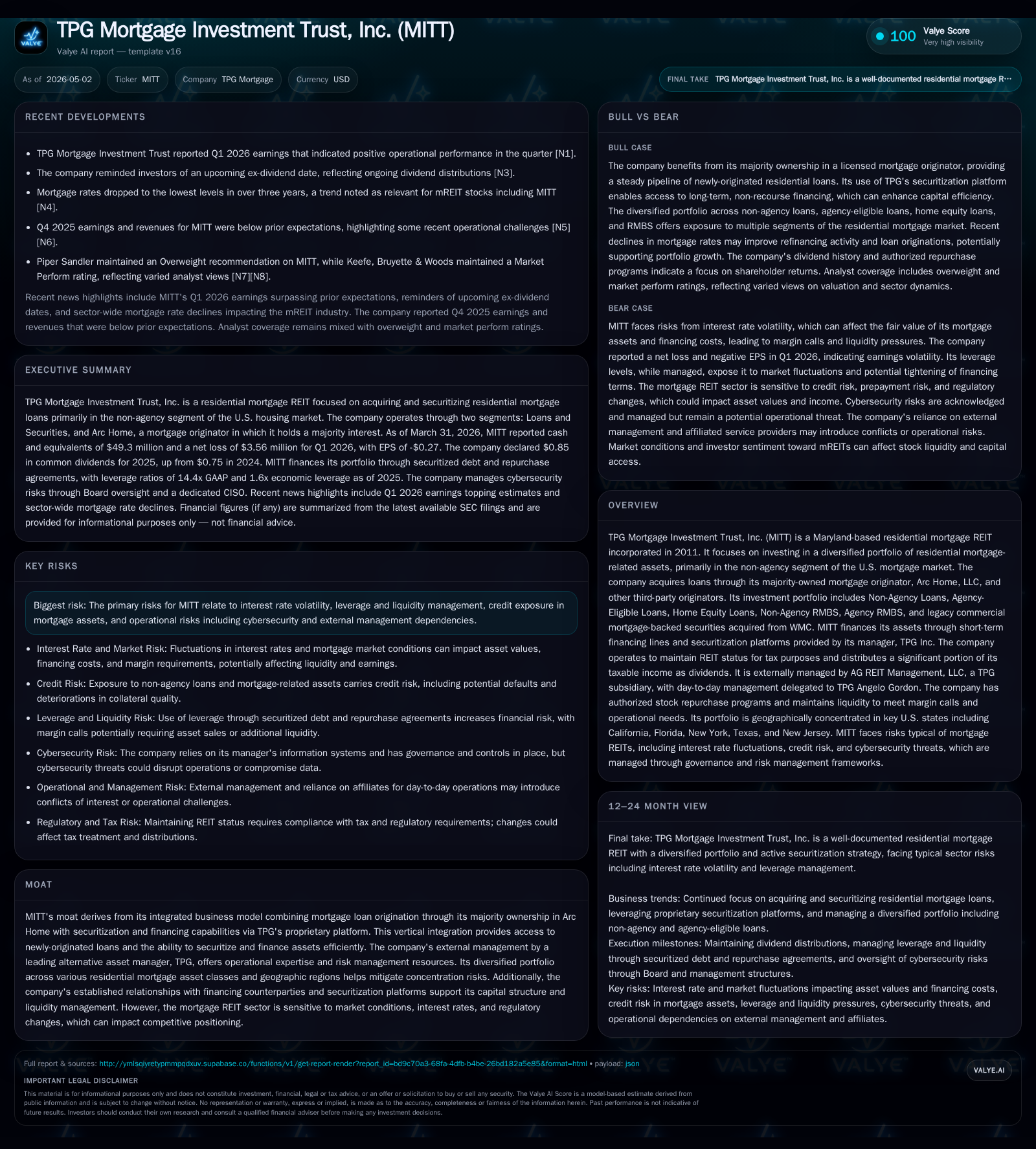
TPG Mortgage Investment Trust, Inc. (MITT) reinforced its strategic footing in Q1 2026 by leveraging its integrated mortgage origination and financing platform. The company’s vertical integration with Arc Home and proprietary securitization capabilities underpin scalable growth despite prevailing interest rate pressures. MITT’s diversified residential mortgage portfolio and established financing relationships provide a defensive moat, while risks related to market sensitivity and leverage management remain key watchpoints.
Latest Quarterly Developments Shape Operational Outlook
TPG Mortgage Investment Trust (MITT) disclosed its Q1 2026 results on May 1, underscoring operational stability supported by its integrated mortgage origination and financing model [S2]. The filings reveal consistent loan originations through its majority-owned Arc Home, LLC, which provides a steady pipeline of non-agency residential loans into the portfolio. This vertical integration remains a key competitive advantage allowing MITT to source assets efficiently without overreliance on intermediaries.
Simultaneously, the company maintained active securitization activities utilizing proprietary financing platforms from TPG Inc., reflecting a capital structure designed to optimize leverage while managing mark-to-market margin calls inherent in mortgage REIT operations. No significant changes were noted in dividend declarations or capital allocation strategies during this period [S2], reaffirming commitment to steady distributions aligned with REIT requirements.
An event filing dated April 29 reiterated management's view on liquidity sufficiency derived from available borrowing capacity coupled with internal cash flows to support funding needs including distributions and debt maturities [S3]. Recent analyst commentary reflected earnings surpassing expectations for Q1 2026 [N1], suggesting effective execution despite ongoing macroeconomic headwinds.
Business Model: Vertical Integration and Residential Mortgage Focus
MITT operates as a residential mortgage REIT focusing primarily on non-agency U.S. residential mortgages. Its business model is distinctive due to ownership of Arc Home LLC — a mortgage originator that feeds newly originated loans directly into MITT's investment portfolio. This ownership creates an internally sourced deal flow reducing dependency on third-party originators while controlling loan acquisition economics [S1]. Arc Home specializes in tailored underwriting within the non-agency space, where private-label loans offer differentiated risk/return profiles compared with agency-backed mortgages.
The investment portfolio encompasses multiple classes: Non-Agency Loans, Agency-Eligible Loans, Home Equity Loans, Non-Agency RMBS, Agency RMBS, plus legacy commercial MBS from the WMC acquisition [S1]. This diversification strategy mitigates idiosyncratic credit risk concentrations across product types and geographic regions.
Financing these assets involves TPG-backed secured short-term credit lines alongside bespoke securitization vehicles converting assets into long-term non-recourse debt funded by third parties. Such securitizations enable MITT to replace recourse borrowings with stable capital instruments that align with asset durations, thereby lowering funding costs and reducing margin call exposure [S1,S2].
Dividend policy aligns with REIT tax rules requiring distribution of at least 90% of taxable income; MITT routinely distributes significant portions as quarterly dividends under board discretion without fixed minimums [S12].
Industry Positioning: Competitive Moat and Market Dynamics
Within the mortgage REIT (mREIT) landscape dominated by firms like Ellington Financial and Redwood Trust, MITT differentiates itself through vertical integration — pairing originations (Arc Home) with proprietary securitization facilities under TPG management [S1,N8]. This integrated infrastructure curtails middleman fees and expedites asset acquisitions while providing flexibility in capital structure deployment.
The non-agency residential mortgage market exhibits cyclical sensitivities linked closely to interest rates and housing credit conditions. Demand for mREIT equities fluctuates accordingly; however, firms possessing reliable origination sources capture advantaged positions during cycle troughs through first-mover access to loans [N8].
Moreover, MITT benefits from well-established lender relationships that secure committed financing lines and reduce refinancing risk — critical given frequent margin calls triggered by fluctuating collateral valuations during volatile interest rate periods [S14,S24].
Still, pricing power exists within limits given competitive pressures among originators and securitization vehicles. Regulatory changes impacting agency eligibility criteria or capital rules can compress spreads or alter asset mix gains but have yet to materially disrupt MITT's platform.
Growth Prospects: Originations, Securitization Efficiency, and Portfolio Strategy
Expansion drivers fundamentally rest on increasing volume of loans originated via Arc Home which can be acquired at favorable terms feeding into higher-margin securitized portfolios. The proprietary financing platform facilitates scaling by replacing short-term recourse borrowings with longer-term non-recourse debt securities—improving net interest margin sustainability [S2,S3].
Management has articulated intentions to judiciously grow holdings across targeted residential mortgage sectors adjusting for prepayment behaviors and credit quality improvements discovered through active portfolio management [N1,S2]. Incremental investments in higher-yielding non-agency RMBS or selectively acquiring distressed home equity loans also serve as yield enhancers.
Efficiency gains stem from cost controls within origination pipelines plus optimization of securitization timing amid favorable credit markets. Ongoing enhancements to underwriting technologies at Arc Home could further improve loan quality while decreasing acquisition costs—an edge over less integrated competitors.
No explicit quantitative guidance was provided for future quarters but improved Q1 earnings above estimates indicate growing operating leverage potential ahead of expected rate normalization phases [N1,S2]. Monitoring increases in book value per share or reductions in funding spreads will be crucial metrics for validating growth narratives.
Risks and Constraints: Interest Rate Volatility, Leverage Management, and Regulatory Considerations
Interest rate volatility constitutes the principal systemic risk affecting MITT's asset valuations leading to potential margin calls where lenders demand additional collateral or debt paydowns if fair values decline below agreed thresholds [S4,S9]. In rising rate environments typical since late 2022 & early 2026 quarters per macro indicators (contextual industry trend), these dynamics compress net interest margins temporarily.
Leverage amplifies returns but simultaneously heightens liquidity risk if adverse price shocks necessitate rapid asset sales or deleveraging — especially given recourse nature of many financing agreements compared with the generally non-recourse securitizations [S13,S19,S27]. Maintaining adequate cash reserves (~$49.3 million as of March-end) along with unpledged Agency RMBS positions is part of the buffer strategy addressing this risk profile [F1,S4].
Operationally the external management model depends heavily on TPG's governance infrastructure which includes robust cybersecurity frameworks regularly reviewed by board-level committees per disclosures ensuring mitigation against operational disruptions or data breaches that could impact operations or investor confidence [S1].
Regulatory shifts within the residential mortgage finance arena pose medium-term uncertainties — changes in capital requirements or agency eligibility parameters could alter available market niches or increase compliance costs impacting returns but are standard sector risks documented in annual filings [S1,S26].
Dividend sustainability requires continued positive earnings coupled with disciplined capital deployment given dividend payout obligations under REIT structures. Volatility-driven earnings swings could pressure distributions temporarily as seen intermittently across mREIT peers.
Key Upcoming Catalysts to Monitor
Investors should prioritize tracking subsequent quarterly reports for:
- Changes in loan origination volumes via Arc Home indicating demand shifts or competitive dynamics [S2]
- Expansion or contraction in securitization issuance reflecting capital market receptivity and funding cost trends [S2]
- Frequency and magnitude of margin calls providing insight into collateral price movements amidst interest rate cycles [N3]
- Amendments or announcements related to regulatory policy impacting sector operating models
- Capital raising activities under existing equity distribution agreements that may signal strategic growth initiatives or liquidity adjustments [S10]
Industry-wide demand indicators such as housing market trends and credit environment analyses will add broader context but ultimately company-specific execution remains key for MITT's trajectory.
Summary Financial Context and Liquidity Assessment
As of March 31, 2026, MITT held approximately $49.3 million in cash and equivalents supporting operational liquidity needs including margin call requirements within its leveraged capital structure [F1]. Total reported debt figures are not explicitly updated beyond prior reference points; however internal liquidity buffers combined with committed financing lines stipulated in previous filings provide reasonable assurance of ability to meet near-term obligations absent extreme market dislocations [S3,S4].
The firm’s leverage profile balances recourse debt against longer-dated non-recourse securitized liabilities securing asset pools thus moderating default risk exposure while sustaining return enhancement potential.
MITT continues dividend payments consistent with REIT obligations while refraining from share repurchases recently—underscoring focus on balance-sheet preservation amid challenging macro conditions [S7,S10]. Monitoring net interest margins alongside cost-of-funds will remain essential measures reflecting operational efficiency going forward.
This analysis is based exclusively on publicly available SEC filings through May 2026 combined with selective relevant news sources without inference beyond documented evidence. It does not constitute investment advice.
Disclaimer: This is research-only, informational analysis and not investment advice. It may include AI-generated interpretation and general industry context. Always verify important details using primary sources.

Comments