
Delixy Holdings Faces Nasdaq Price Challenge While Expanding Oil Product Portfolio
The company confronts Nasdaq compliance pressures as it strategically broadens its product suite into LNG and LPG markets within a competitive oil trading landscape.
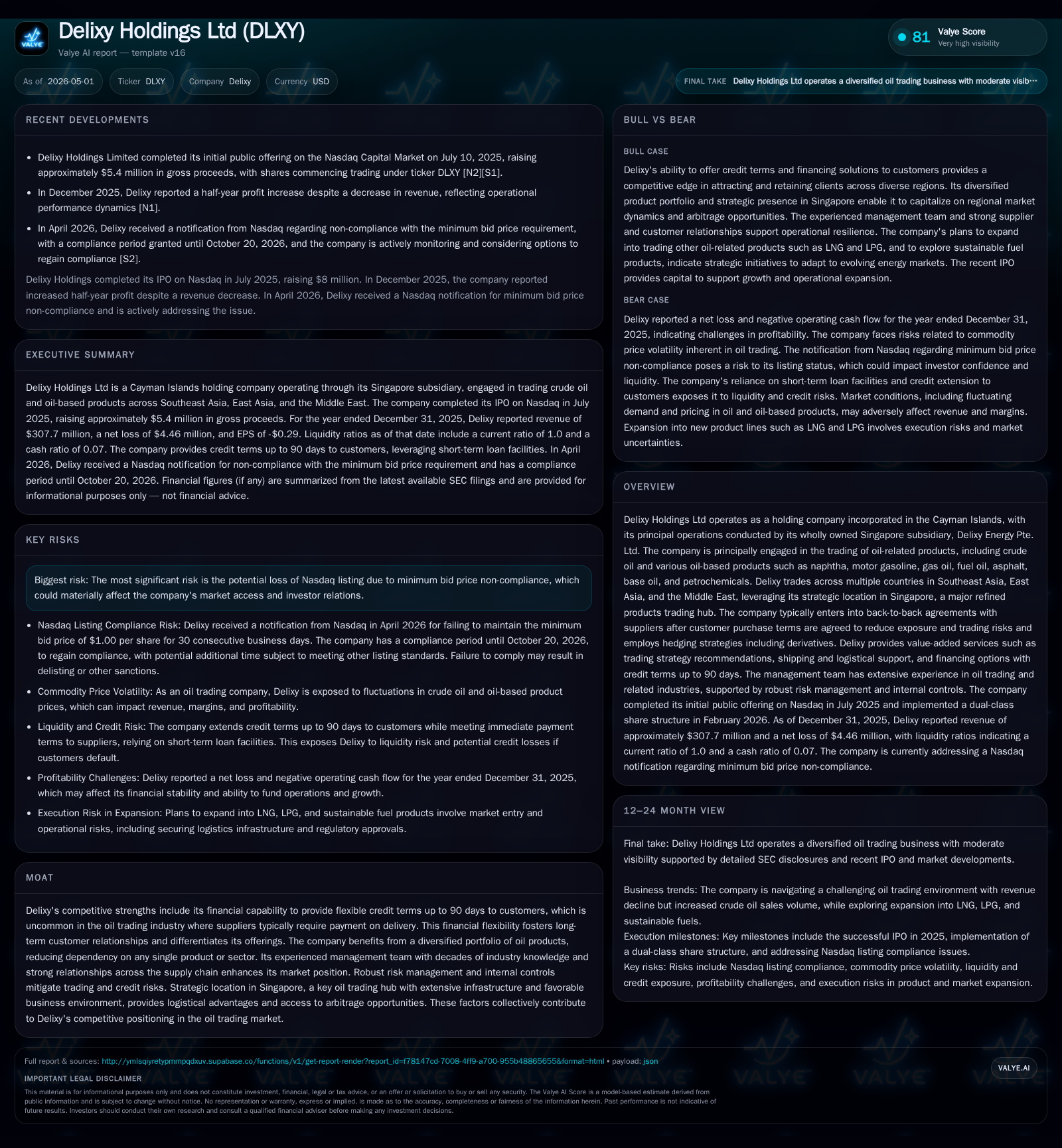
Delixy Holdings Limited recently received a Nasdaq notification regarding non-compliance with the minimum bid price rule, triggering a 180-day window to regain compliance. Despite this short-term regulatory challenge, Delixy continues to leverage its Singapore-based oil trading platform, expanding beyond crude oil and conventional oil products into liquefied natural gas (LNG) and liquefied petroleum gas (LPG). Its flexible credit terms and risk-managed back-to-back contracts remain core competitive advantages. The company must manage risks including credit exposure from extended receivables and volatile energy markets while monitoring liquidity and shareholder actions related to its dual-class share structure.
Nasdaq Listing Update and Near-Term Implications
On April 23, 2026, Delixy Holdings Limited received formal notification from Nasdaq regarding non-compliance with the minimum bid price requirement mandated under Rule 5550(a)(2) [S2]. The closing bid of Class A ordinary shares fell below $1.00 for 30 consecutive business days between March 11 and April 22, triggering this deficiency notice. Importantly, this does not immediately affect the trading or listing status but initiates a 180-calendar day compliance period ending October 20, 2026. Should Delixy be unable to restore a closing bid above $1.00 for ten consecutive business days within this period, it may qualify for a subsequent extension if it satisfies other listing criteria. This additional time could require implementing remedial actions such as a reverse stock split.
This regulatory pressure imposes heightened scrutiny from investors and stakeholders due to potential liquidity constraints and market perception challenges. However, management has signaled active monitoring of stock performance alongside evaluating all strategic options to regain compliance promptly [S2]. Maintaining Nasdaq listing status remains critical for capital access and visibility in global markets.
Core Business Model and Oil Trading Framework
Delixy operates principally through its wholly owned Singapore subsidiary engaged in trading crude oil and various refined oil-based products including naphtha, motor gasoline, gas oil, fuel oil, asphalt, base oils, and petrochemicals [S1]. Geographically, the company serves clients across Southeast Asia, East Asia, and the Middle East—key growing demand regions—leveraging Singapore's established infrastructure as a major oil trading hub.
The company employs back-to-back transactional agreements: once customer purchase terms are agreed upon, Delixy promptly enters supplier contracts at matching volumes and timings to reduce open exposure on volatile commodities. Further risk mitigation is executed through derivatives such as swaps to hedge price fluctuations [S1]. This model enables capital-efficient operations with controlled market risk.
Delixy’s significant strategic differentiation lies in offering flexible credit terms of up to 90 days—unusual in this industry segment where spot or near-immediate payments are typical—effectively extending financing solutions to customers while meeting suppliers’ upfront payment demands [S1]. This capability requires robust internal credit assessment procedures and ongoing monitoring to limit default risk.
Value-added services beyond trading include tailored strategy recommendations for customers — leveraging deep expertise — alongside shipping logistics coordination that enhances client service quality and retention.
Competitive Environment and Industry Positioning
Operating within a fragmented regional landscape characterized by numerous local and international commodity traders, Delixy competes primarily on financial flexibility, service integration, market intelligence, and supply chain reliability [S1]. The ability to extend interest-free credit creates meaningful switching costs for customers accustomed to upfront payments elsewhere.
Singapore’s role as an energy nexus provides logistical advantages through proximity to storage facilities, terminals, shipyards and financing institutions that facilitate high-frequency trade execution with minimal friction [S1]. An experienced management team with decades in oil refining and trade further strengthens relationship networks across suppliers (including national oil companies) and logistics providers.
Pricing power is influenced by global crude market fundamentals but tempered on refined product lines by competitive bidding among mid-size traders. Delixy’s diversification across crude plus multiple refined products reduces dependency risk relative to peers focused narrowly in one subsegment.
Growth Catalysts: Product Expansion and Market Penetration
Building upon existing oil trading competence, Delixy announced strategic expansion into liquefied natural gas (LNG) and liquefied petroleum gas (LPG) markets during the year-ending December 31, 2025 [S1]. Specialist traders have been recruited specifically for these energy products that respond increasingly to shifting global demand toward cleaner fuels.
Entering LNG/LPG markets enables revenue base diversification which can smooth cyclicality linked with crude pricing volatility. These segments also align with Singapore’s growing function as an LNG transshipment hub supporting regional energy transitions [S1].
Effective development of LNG/LPG trading capabilities—including mastering complex regulatory environments associated with these gases—will be a critical growth driver. Success here may improve margins given typically higher contract complexity versus commoditized crude trades.
Risk Profile and Operational Constraints
The most immediate risk lies in potential delisting from Nasdaq if minimum bid price standards are unmet past the October deadline [S2], which would impair investor access liquidity. Secondary risks arise from macroeconomic influences such as recessions or geopolitical tensions negatively impacting energy demand which weighs on trading volume or pricing environment [S1].
Credit exposure is notable given the extended accounts receivable—with net balances rising approximately 28% year-over-year reaching $22.4 million by end-2025—and absence of collateral or interest charges on these balances [S1]. Although no material collection issues have emerged so far per management assurance, longer repayment timelines increase working capital strain.
Intense competition places pressure on pricing sustainability especially amid new entrants or incumbents leveraging scale advantages or alternative financing models [S1]. Regulatory changes—particularly those affecting commodity trading licensing in Singapore like the Commodity Trading Act—require continuous compliance vigilance.
Operationally constrained working capital metrics underscore the necessity for tight cash flow management given the current ratio at approximately parity (1x), indicating limited buffer against unforeseen cash demands [F1].
Key Upcoming Milestones and Investor Considerations
Investors should focus on three main near-term developments:
- Progress toward remediating Nasdaq minimum bid price deficiency by October 20, 2026 deadline including anticipated stock price developments or corporate actions like share consolidation/reverse split approved provisionally in February extraordinary shareholder meeting [S2][S3]
- Execution effectiveness of LNG/LPG market entry: trader hires are underway; successful contract wins or volume ramp signals validation of diversification strategy [S1]
- Monitoring evolving credit risk profile given lengthening payable cycles; tightening internal controls can mitigate liquidity stress points [S1]
Additional governance alterations stem from February 23 shareholder resolutions reclassifying shares into dual-class structure creating concentrated voting power among Class B shares held predominantly by major shareholders; implications for future control dynamics merit attention [S3].
Financial Condition Snapshot
Latest financial snapshot
| Metric | Value | Period |
|---|---|---|
| Cash & equivalents | $1793000 | |
| 2025-12-31 | ||
| Current assets | $25mm | |
| 2025-12-31 | ||
| Current liabilities | $25mm | |
| 2025-12-31 | ||
| Current ratio | 1x | |
| 2025-12-31 |
Source: SEC companyfacts cache [F1].
| Metric | Value (USD) | Period End |
|---|---|---|
| Revenue | $307,747,000 | |
| 2025-12-31 | ||
| Operating Income | -$4,533,000 | |
| 2025-12-31 | ||
| Net Income | -$4,463,000 | |
| 2025-12-31 | ||
| Cash & Equivalents | $1,793,000 | |
| 2025-12-31 | ||
| Current Ratio | ~1 | |
| 2025-12-31 |
As of December 31, 2025, Delixy reported revenues just below $308 million representing slight decline despite an approximate 14% lift in traded volumes suggesting margin compression or product mix effects [F1][S1]. Operating loss near $4.5 million reflects elevated expenses including investment into LNG/LPG capabilities plus costs associated with public listing activities. Net loss closely tracks operating loss after tax impacts.
Cash reserves remain modest at $1.79 million with current assets nearly equal to liabilities indicating working capital sufficiency but little excess cushion for unexpected demands [F1]. Management emphasizes ongoing optimization efforts including netting payables against receivables where feasible alongside short-term bank facilities usage as per prior disclosures [S4][S11].
Liquidity also benefits from interest-free shareholder loans easing debt servicing pressures while IPO proceeds provide additional equity runway [S5][S6]. Nonetheless careful cash flow discipline remains imperative given negative operating cash flows observed over recent years paralleling growth investments.
This analysis synthesizes publicly available SEC filings including recent quarterly disclosures alongside annual reporting for context. It avoids speculative commentary beyond documented facts or explicit management guidance.
Disclaimer: This is research-only, informational analysis and not investment advice. It may include AI-generated interpretation and general industry context. Always verify important details using primary sources.

Comments