
American Assets Trust Strengthens Position in High-Barrier Markets Through Disciplined Redevelopment
Q1 2026 results emphasize leasing momentum and redevelopment progress within a tightly held multi-asset portfolio across select West Coast and Sun Belt markets.
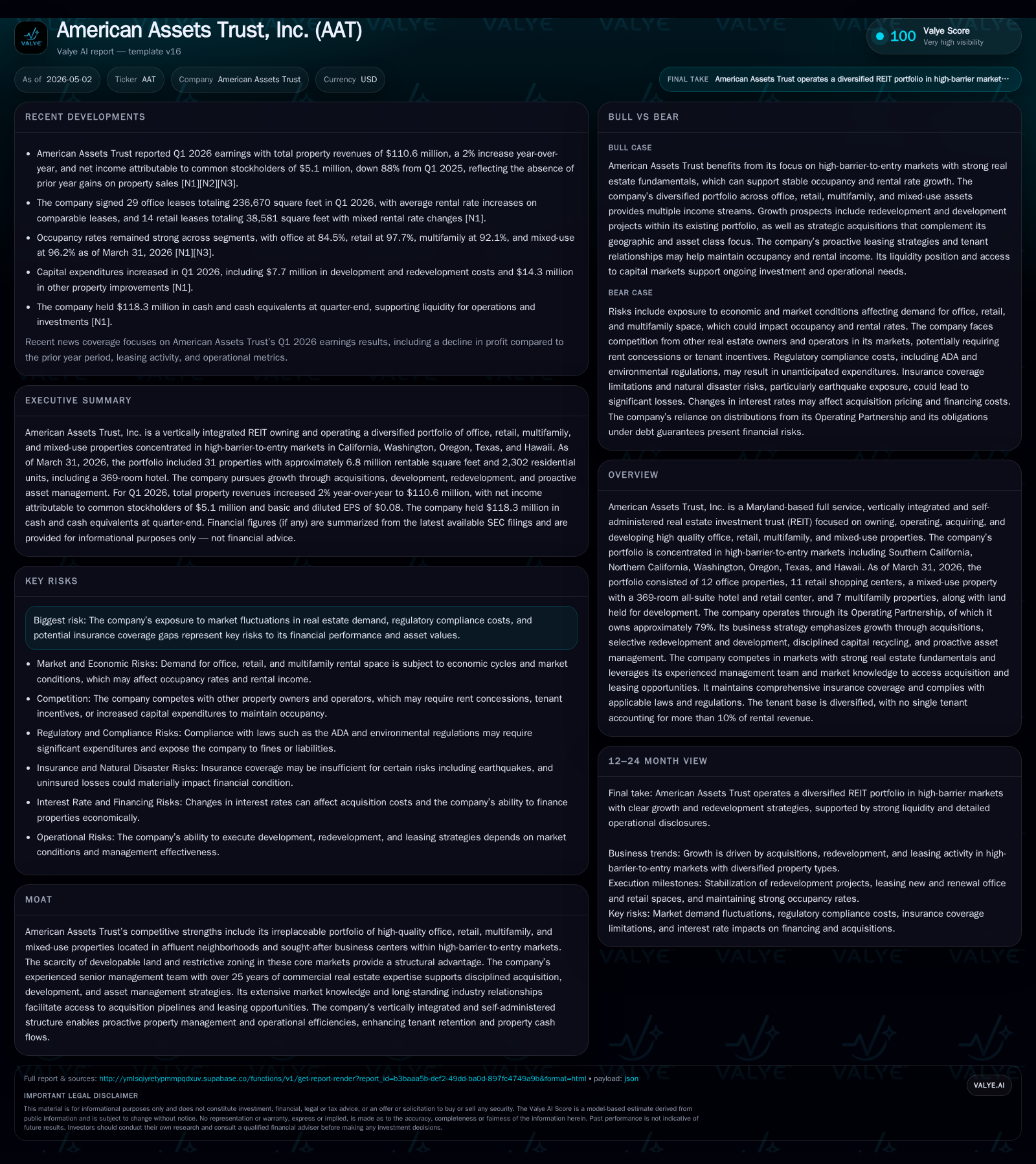
American Assets Trust (AAT) reported steady operating execution in Q1 2026, underpinned by selective redevelopment completions and stable leasing trends across its office, retail, multifamily, and mixed-use assets. The company’s vertically integrated and self-administered REIT model supports disciplined capital recycling and targeted growth in high-barrier-to-entry markets such as Southern California and the Pacific Northwest. While office occupancy showed some softness, retail and multifamily segments remain resilient. Capital allocation priorities focus on redeveloping key assets to enhance cash flow and tenant retention amid evolving market conditions. Ongoing monitoring of leasing velocity and development milestones will be critical to assessing near-term growth.
Q1 2026 Operating Update Highlights
In its latest 10-Q filing dated May 1, 2026 [S2], American Assets Trust reported a modest uptick in net cash provided by operating activities to $38.6 million for the quarter ended March 31, 2026, compared to $36.9 million in the prior-year period. This improvement reflects an increase in rental revenues supported by ongoing lease commencements primarily from recently redeveloped assets such as La Jolla Commons III — which was placed into service on April 1, 2025 — adding about $1 million of incremental non-same store rental revenue [S1].
Occupancy trends exhibited mixed signals by segment: office occupancy remained challenged at approximately 83%, down slightly from previous quarters with softness noted especially at Coastal Collection at Torrey Reserve and First & Main locations. However, new tenant activity at City Center Bellevue and Timber Ridge helped partially offset this softness [S1]. Retail assets retained high occupancy rates of roughly 97.7%, benefiting from stable demand within affluent trade areas where supply constraints persist due to restrictive zoning [S1]. Multifamily properties held steady with occupancy near 91%, driven by consistent leasing velocity [S1]. The mixed-use segment (including a hotel component) maintained approximately 96% leased status.
Capital expenditures surged during the quarter, increasing net cash used in investing activities to $23.2 million from a cash inflow context in Q1 2025 primarily due to increased tenant improvement projects, leasing commissions, and building renovations aligned with the company’s redevelop-and-reposition strategy [S21]. Concurrently, cash used in financing activities reduced markedly due to prior year principal repayments including the retirement of Series C Notes and Term Loans B & C completed in early 2025 [S21].
Overall portfolio occupancy on a same-store basis declined marginally by about 1% while same-store rental revenue was also slightly down reflecting sector-specific challenges particularly within office properties [S1][N2]. Nonetheless, recent redevelopments are contributing positively to rent roll growth and tenant retention.
Business Model and Portfolio Composition
American Assets Trust operates as a vertically integrated, self-administered REIT managing a multi-asset portfolio comprising office (12 properties), retail shopping centers (11), seven multifamily complexes, plus a signature mixed-use asset combining a 369-room all-suite hotel with retail components as of March 31, 2026 [S2][S1]. The company conducts operations through its Operating Partnership structure which it controls approximately 79% ownership of [S2][S1]. This vertical integration allows streamlined decision-making from acquisition through property management—a competitive advantage that aligns capital allocation tightly with operational insights.
Assets are concentrated in high-barrier-to-entry coastal and select Sun Belt markets including Southern California (notably San Diego), Northern California’s Bay Area, Washington’s Bellevue hub, Portland Oregon, Texas’s fast-growing markets like San Antonio, and Hawaii’s Oahu island market renaissance [S2][S1]. These geographies feature significant land scarcity coupled with stringent zoning regulations that constrain new supply—a structural moat underpinning long-term value creation.
Revenue is generated predominantly through base rents complemented by cost reimbursements and ancillary other property income streams such as parking fees or food-services revenue at their hotel segment [S1]. The mix of property types provides diversification: office leases tend to be longer term providing stable cash flow; retail leases offer both fixed rents plus percentage rent components tied to tenant sales performance; multifamily units deliver recurring monthly income typically under one-year leases; while mixed-use projects blend hospitality with commercial leasing upside.
Industry Position and Market Dynamics
AAT’s competitive strength resides largely in its portfolio footprint characterized by irreplaceable locations within affluent neighborhoods where few comparable alternatives exist [S1]. The scarcity of developable parcels coupled with complex environmental reviews limits new construction across its core markets. This backdrop elevates the value proposition for existing well-managed assets able to deliver modern amenities through redevelopment initiatives.
Market dynamics remain segmented: Office space has faced headwinds nationally linked to hybrid work models reducing demand for traditional footprints; however AAT’s assets demonstrate resilience aided by active leasing programs targeting knowledge economy tenants drawn to amenity-rich business districts [N1][S2]. Retail real estate shows signs of stabilization post-pandemic as experiential retail returns alongside necessity tenants perform steadily; limited new supply additionally supports occupancies [S1]. Multifamily housing remains structurally robust due to demographic trends favoring renting over homeownership among millennials and urban professionals in targeted metros.
Proactive asset management focused on tenant engagement—enabled by the company’s self-administration—helps drive above-average tenant retention rates relative to peers. Extensive local market expertise built over decades facilitates sourcing off-market acquisition opportunities enhancing portfolio quality selectively via accretive buys [S1].
Growth Drivers: Redevelopment, Selectivity, and Geographic Focus
Growth at AAT is anchored chiefly around three pillars: disciplined redevelopment of existing properties, highly selective acquisitions within core markets, and geographic concentration enabling deep local expertise.
Redevelopment initiatives such as La Jolla Commons III exemplify this approach—transforming older assets into modernized spaces commanding higher rents per square foot while improving tenant appeal [S2][N1]. Such efforts balance development risk against stable income generation characteristic of mature assets.
Capital recycling underpins acquisition funding; the recent sale of Del Monte Center exemplifies monetization employed to support higher-return redevelopment projects elsewhere [S1][S13]. This active repositioning fosters an improving product mix skewed towards premium offerings catering to affluent tenants.
Geographic focus enhances efficiency—stable local infrastructure fosters reliable demand bases while regulatory barriers limit competitor entry thus reinforcing pricing power over time. Markets like San Diego maintain upward pressure on rents driven by constrained housing availability indirectly supporting multifamily assets too.
Risks and Constraints: Leasing Environment and Capital Allocation
Key risks detailed include exposure to cyclical shifts especially within the office segment where evolving workplace behaviors may depress occupancy or lease renewals over extended periods [S2][S1]. Regulatory compliance costs including increased taxes or insurance premiums could further erode net operating income margins.
While leverage stands at approximately $1.7 billion total debt offset partially by $118 million cash on hand (resulting in net debt near $1.58 billion) [F1], capital flexibility exists through revolving credit facilities enabling funding for ongoing redevelopment or acquisition opportunities if warranted [S2][F1]. Nonetheless elevated leverage demands vigilant liquidity management amid uncertain macro credit conditions.
Dependence on distributions from the Operating Partnership reflects underlying operational performance; any disruptions there could impact dividend servicing capacity for common equity holders [S8][S15]. The company may need additional equity issuance opportunistically given REIT distribution requirements mandating payment of at least 90% taxable income annually [S11][S19]. Market volatility presents timing risk for such capital raises.
Next Steps: Monitoring Leasing Momentum and Development Progress
Important upcoming indicators include quarterly same-store rental rate trends across sectors—particularly whether office leasing exhibits stabilization or continued contraction amidst macro uncertainty [N2][S2]. Tracking absorption velocity at redeveloped properties like La Jolla Commons III will signal effectiveness of capital deployment strategies.
Execution timelines on land held for development projects reflect potential pipeline contributions beyond stabilized assets impacting medium-term growth pipelines. Any material acquisitions adding scale or diversity should be closely scrutinized given disciplined investment criteria pursued historically.
Monitoring capital recycling efficiency—how effectively sale proceeds translate into higher yielding assets—and observing potential shifts in dividend policy if market conditions deteriorate will be critical.[N1][S19]
Latest Financial Snapshot
Latest financial snapshot
| Metric | Value | Period |
|---|---|---|
| Cash & equivalents | $118mm | |
| 2026-03-31 | ||
| Total debt | $1700mm | |
| 2025-12-31 | ||
| Net debt | $1582mm | |
| 2025-12-31 |
Source: SEC companyfacts cache [F1].
FY end 2025 |
Liquidity remains adequate with substantial cash reserves supporting short-term obligations including operating expenses, scheduled debt service, dividends necessary for REIT qualification, capital expenditures for redevelopment projects, tenant improvements, commissioning fees, alongside potential acquisitions [F1][S12][S15].
This analysis synthesizes disclosures from American Assets Trust's most recent SEC filings as of April-May 2026 alongside contemporaneous earnings commentary without conjecture beyond documented facts. It adheres strictly to regulatory sources ensuring factual grounding without investment recommendations or forecasts.
Disclaimer: This is research-only, informational analysis and not investment advice. It may include AI-generated interpretation and general industry context. Always verify important details using primary sources.

Comments