
Ardelyx Advances Tenapanor Pipeline with Mixed Commercial Outcomes in Q1
Recent quarterly results show revenue resilience for Ardelyx amid persistent losses and reimbursement challenges, with ongoing clinical and international expansion efforts.
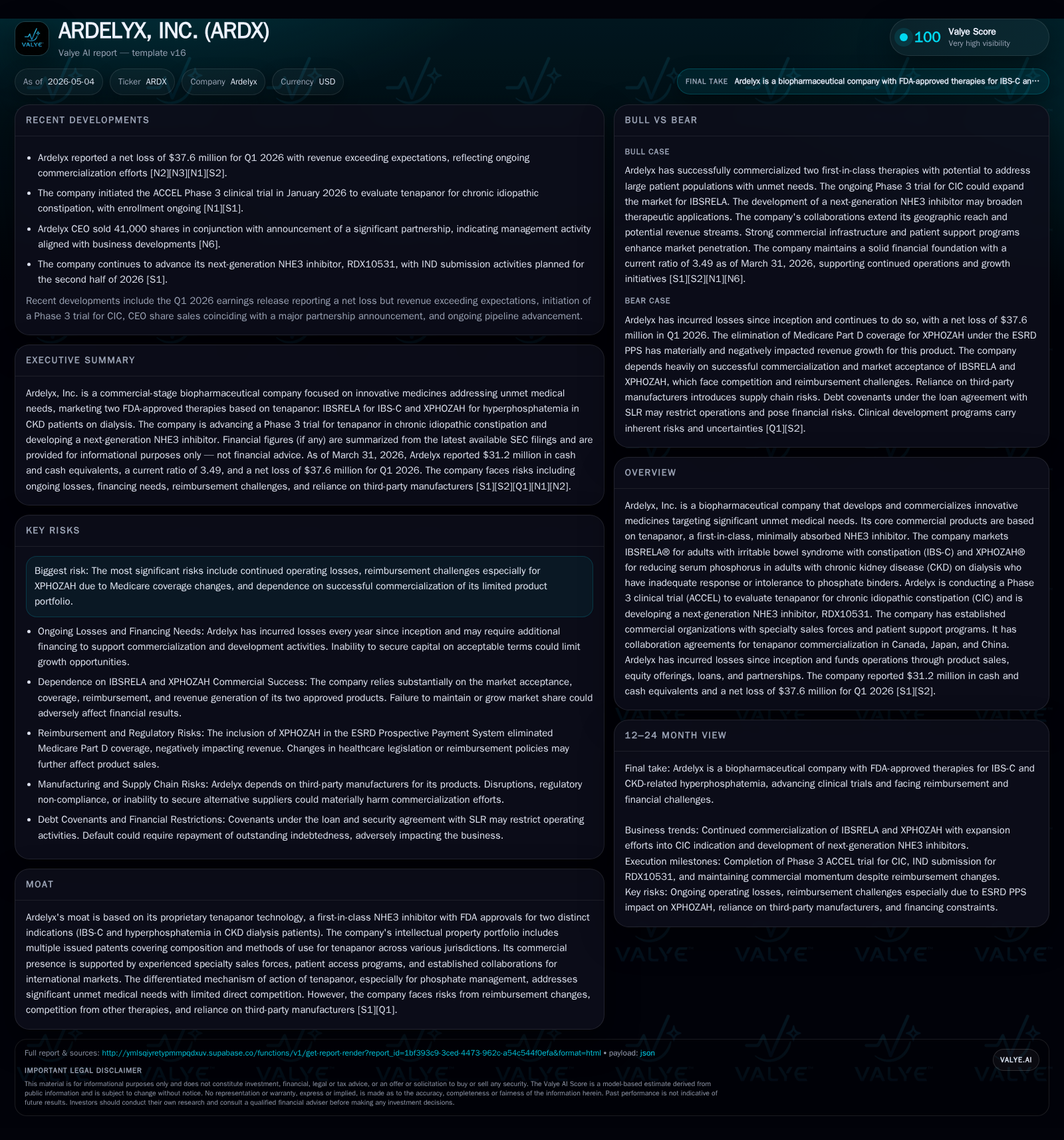
Ardelyx's Q1 2026 filings reveal revenue growth that outpaced expectations despite continued net losses, mainly due to lasting reimbursement headwinds for XPHOZAH following its inclusion in the ESRD Prospective Payment System. The company continues to commercialize two tenapanor-based therapies—IBSRELA and XPHOZAH—while advancing its pipeline through a pivotal Phase 3 trial for chronic idiopathic constipation and development of next-generation inhibitors. Ardelyx's competitive moat hinges on its proprietary NHE3 inhibitor platform, but market expansion is tempered by regulatory reimbursement shifts and manufacturing dependencies. Upcoming clinical milestones and international licensing partnerships serve as key growth drivers to monitor.
Q1 2026 Operating Update: Revenue Beats Despite Ongoing Losses
Ardelyx's latest quarterly report filed on April 30, 2026 [S2], complemented by an earnings announcement [S3], confirms a modest improvement in revenue performance against the backdrop of persistently negative net income. While the company continues to generate operating losses—as it has historically—revenues in Q1 outpaced analyst estimates [N2][N3], underscoring resilience despite significant external reimbursement challenges.
Central to this dynamic is XPHOZAH, Ardelyx’s phosphate binder adjunct approved for adults with chronic kidney disease on dialysis who inadequately respond to traditional binders. Since January 1, 2025, XPHOZAH was subsumed under the End-Stage Renal Disease Prospective Payment System (ESRD PPS), resulting in Medicare beneficiaries losing access to coverage under Medicare Part D [S1][S2]. This structural shift materially diminished XPHOZAH's revenue trajectory starting last year and persists as a drag on growth potential.
Meanwhile, IBSRELA—the company's therapy for irritable bowel syndrome with constipation (IBS-C)—continues its rollout supported by targeted specialty sales efforts [N1]. The company emphasizes maintaining commercial momentum for IBSRELA while mitigating headwinds from reimbursement changes on the CKD side. This mixed commercial outcome reinforces the company's need to diversify its growth beyond existing labels.
Ardelyx Business Model: Proprietary NHE3 Inhibition Focus and Product Portfolio
Ardelyx’s revenues are principally derived from two therapies based on tenapanor, a first-in-class sodium/hydrogen exchanger isoform 3 (NHE3) inhibitor that acts locally within the gut with minimal systemic absorption [S1][S25]. IBSRELA was approved for adult IBS-C patients and represents a differentiated approach compared to secretagogue competitors like Linzess or Trulance. Its local gut action reduces systemic side effects, potentially enhancing tolerability profiles.
XPHOZAH targets hyperphosphatemia management in dialysis-dependent CKD patients inadequately handled by phosphate binders alone—a sizable population burdened by elevated serum phosphorus levels contributing to cardiovascular morbidity [S1]. The uniqueness of tenapanor’s mechanism as an NHE3 inhibitor supports claimed efficacy complementary to existing therapies.
Ardelyx commercializes these products via established specialty sales forces who engage a concentrated pool of high-prescribing gastroenterologists and nephrologists. Alongside multichannel marketing, patient services programs like ArdelyxAssist aid patient adherence and payer navigation [S25]. However, Ardelyx relies heavily on third-party contract manufacturing organizations (CMOs), some single-sourced for key production steps. This creates inherent supply chain risks including regulatory compliance dependencies [S1][S6].
Competitive Dynamics and Industry Position in Gastrointestinal and CKD Therapies
Within the IBS-C market segment, Ardelyx competes against established branded secretagogue therapies but holds a strategic edge through its proprietary NHE3 inhibition platform targeting a different pathophysiology. This mechanistic differentiation can justify premium pricing; however, lasting pricing power is moderated by payor sensitivity and competitive generic alternatives [S1][N1].
For hyperphosphatemia treatment in CKD dialysis patients, XPHOZAH faces stiffer constraints following its inclusion in ESRD PPS which bundled oral drug payments. Consequently, this policy reduces direct reimbursement incentives thereby dampening prescriber adoption willingness and limiting market penetration speed [S1][S2]. Additionally, reliance on single-source CMOs exposes Ardelyx to potential supply volatility or inspection failures that would affect scale-up capabilities [S6][S15].
Regulatory complexity further amplifies uncertainty; navigating evolving healthcare reforms affecting Medicare/Medicaid coverage requires active engagement with payors and policymakers to safeguard adequate reimbursement levels essential for sustained uptake [S1][S15].
Growth Drivers: Pipeline Progression, International Collaborations, and Market Expansion
Ardelyx is actively pursuing organic growth through pipeline advancement centered on expanding tenapanor’s clinical utility beyond IBS-C. The ACCEL Phase 3 trial initiated in January 2026 evaluates safety and efficacy in chronic idiopathic constipation (CIC), a disorder affecting over 34 million Americans associated with similar gastrointestinal symptoms yet distinct diagnosis criteria [S1][S21][N1]. Topline results are anticipated in the second half of 2027.
Success here could significantly expand the treatable patient population if supplemental FDA approval follows. Concurrently, Ardelyx is developing next-generation NHE3 inhibitors exemplified by RDX10531 targeting broader applications across potentially multiple therapeutic areas; an IND submission is expected by late 2026 [S21].
International partnerships covering key markets such as Canada, Japan, and China diversify geographic risk away from US-centric reimbursement dynamics [S1]. These collaborations strengthen Ardelyx’s reach without immediate full commercialization overheads.
Risks and Constraints: Reimbursement Headwinds, Supply Chain Dependencies, and Regulatory Challenges
The most pressing risk remains reimbursement uncertainty—particularly impacting XPHOZAH after transitioning into ESRD PPS where Medicare Part D coverage ended effective January 2025 [S2][S8]. This pivot has already reduced revenues materially with no clear reversal timeline given policy rigidity.
Manufacturing concentration amplifies operational risk; dependence on specific contract manufacturers mandates rigorous quality oversight ensuring compliance with current Good Manufacturing Practice (cGMP) standards. Disruptions here could delay product availability impacting revenue streams significantly [S6][S15].
Finally, regulatory enforcement risks extend beyond approval hurdles into promotional conduct monitoring under FDA regulations; off-label marketing or insufficient adverse event reporting could invite costly sanctions undermining reputation and finances [S8][S18].
Near-Term Catalysts: Upcoming Clinical Data Releases, Commercial Scaling, and Reimbursement Developments
Key milestones include ACCEL trial enrollment progress throughout 2026 culminating in mid-to-late 2027 topline data release—a pivotal readout that could redefine tenapanor’s market potential substantially [N1][S21].
Monitoring quarterly revenue trends for both IBSRELA and XPHOZAH will indicate commercial traction amidst lingering payer restrictions. Notably, any improvements or clarifications around Medicare or private insurer coverage policies vis-à-vis ESRD PPS would be material positive events worth close attention.
Pipeline advancement activities surrounding RDX10531 IND filing represent early-stage catalysts toward longer-term diversification beyond current products. Further licensing deals or expanded collaborations internationally may also unlock additional upside sources.
Latest Financial Snapshot Highlighting Liquidity and Debt Profile
As of quarter-end March 31, 2026, Ardelyx holds $31.2 million in cash equivalents supporting near-term operational liquidity balanced against approximately $105 million of total debt outstanding at last available measurement from September 2024—and an implied net debt position around $73.7 million from those figures less cash reserves [F1][S2].
Ongoing investments into commercialization and clinical development mean continued funding requirements remain relevant considerations. The company maintains optionality with undrawn commitments under its loan facility expiring later this year but must carefully balance financing needs against dilution or leverage risks going forward [S5][S24].
Disclaimer: This analysis is based solely on publicly available SEC filings and news reports as cited; it does not constitute investment advice or recommendations regarding ARDX securities or any other financial instruments.
Disclaimer: This is research-only, informational analysis and not investment advice. It may include AI-generated interpretation and general industry context. Always verify important details using primary sources.

Comments