
Wayfair's Q1 2026 Update Highlights Continued Customer Growth and Margin Improvement Amid Operational Investments
Latest quarter reports steady active customer gains, margin resilience, and logistics investments shaping Wayfair’s omni-channel strategy.
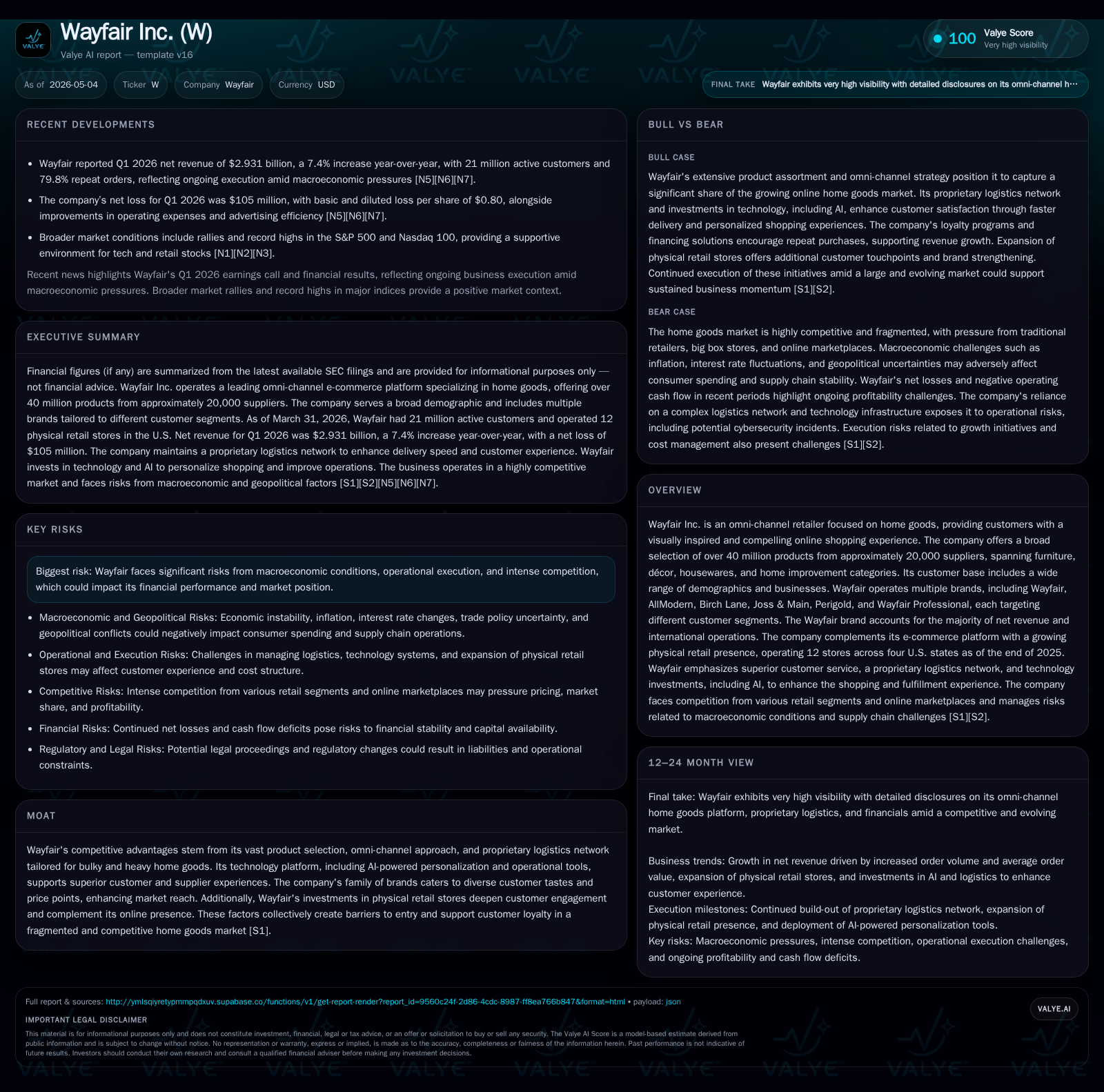
Wayfair Inc.'s first quarter 2026 results reflect steady growth in active customers and average order value, coupled with improved adjusted gross profit and narrower operating losses compared to the prior year. The company continues to balance cost discipline in advertising while investing in its proprietary logistics network and expanding physical retail stores, aiming to enhance the end-to-end home goods shopping experience. Despite macroeconomic headwinds and significant debt levels, Wayfair leverages its technology-driven platform and diverse brand portfolio to capture market share in a fragmented furniture and décor retail space. Key growth drivers include enhanced customer retention, omni-channel expansion, and further refinement of AI-powered personalization.
Recent Operating Update: Q1 2026 Performance
Wayfair’s latest quarterly filing (10-Q for period ended March 31, 2026) reveals several positive trends pivotal for assessing near-term momentum [S2]. Net revenue improved to $2.93 billion from $2.73 billion in Q1 2025, driven by higher orders delivered (9.4 million vs. 9.1 million prior year) and incremental gains in average order value ($312 vs. $301). Last twelve months (LTM) net revenue per active customer rose meaningfully to $591 from $562, signaling success in stimulating higher wallet share among its customer base.
Importantly, adjusted gross profit grew to $881 million — an advance over last year's $839 million figure — suggesting better cost absorption or favorable product mix [S12]. The company also trimmed its advertising expenses by $15 million (down 4.4%) reflecting strategic recalibration towards channels delivering better returns on ad spend during evolving consumer behaviors [S2]. Total customer service and merchant fees remained steady at 3.9% of net revenue, indicating controlled fulfillment costs even as order volume grew.
Operating loss narrowed dramatically to just $11 million compared to a substantial loss of $122 million last year’s quarter, underscoring operational leverage from scale and efficiency initiatives [S12]. Despite this improvement, net loss remained slightly elevated at $105 million mainly impacted by non-operating factors including a reported loss on debt extinguishment totaling $43 million during the quarter [S2].
Active customers increased marginally to 21.4 million with management highlighting that roughly 80% of orders stem from repeat buyers annually [S2],[S1]. This anchoring of a loyal user base is critical given the cyclical nature of discretionary furniture and home goods spending.
Business Model: Omni-Channel Home Goods Retailer With Deep Technology Foundations
Wayfair operates as an omni-channel retailer specializing in home goods spanning furniture, décor, housewares, and home improvement products sourced from ~20,000 suppliers offering more than 40 million SKUs [S1]. Its e-commerce platforms foster visually inspired shopping experiences with AI-driven personalization designed by an internal team of engineers and data scientists who continuously refine algorithms for product search relevance and recommendation engines [S1].
The company's revenue model depends primarily on direct sales through its growing family of brands—including Wayfair itself, AllModern, Birch Lane, Joss & Main, Perigold (luxury segment), and Wayfair Professional (trade customers)—each targeting distinct demographic or price segments [S1]. Approximately the majority of revenue stems from the flagship Wayfair brand which also leads international operations in Canada, UK, and Ireland.
Usage-based revenue recognition is anchored on order delivery dates; thus growth metrics like orders delivered and average order value serve as near-real-time proxies for sales momentum [S2]. Margins are influenced by product mix shifts (higher-end versus value segments), shipping costs (notoriously challenging for bulky goods), advertising efficiency, and fulfillment expenses primarily borne through proprietary logistics assets.
In addition to online commerce, Wayfair enhances customer engagement via a strategic physical store footprint—12 locations across four U.S. states by end-2025—to enable tactile product trials and services that complement digital shopping journeys [S1].
Industry Structure and Competitive Position
The online home goods retail sector is a fragmented market characterized by low brand loyalty outside major players due to highly substitutable products. Competitors range from traditional big-box retailers expanding their e-commerce presence (e.g., Home Depot), specialized furniture chains (e.g., La-Z-Boy), marketplaces like Amazon with broad selection but less curated experience, and boutique specialty platforms.
Wayfair’s competitive moat hinges largely on:
- Vast SKU breadth facilitating one-stop-shop convenience uncommon among peers.
- Omni-channel strategy merging digital reach with physical experiential touchpoints.
- Proprietary logistics network (CastleGate warehousing + Wayfair Delivery Network) optimized for bulky item shipping complexity unlike many generalist retailers relying on third-party couriers.
- Technology leverage enabling superior personalization which drives conversion rates.
- Multi-brand segmentation ensuring relevance across diverse style preferences and income levels.
These factors create tangible switching costs via differentiated service quality especially given the inconvenience traditionally associated with large-item home goods deliveries.
Growth Drivers
- Customer Base Expansion & Retention: Active customers increased steadily despite economic headwinds; management emphasizes repeat purchase rates exceeding 80%, indicating successful efforts to convert one-time buyers into regular shoppers.
- Average Order Value (AOV) Lifting: Incremental growth in AOV ($312 vs. $301 prior year quarter) reflects effective upselling strategies aided by AI recommender systems refining cross-sell opportunities.
- Logistics Network Optimization: Expansion of CastleGate facilities allows faster inventory positioning near demand clusters reducing delivery lead times—a key differentiation given challenges inherent with bulky merchandise fulfillment.
- Physical Store Expansion: Brick-and-mortar locations augment brand visibility while providing experiential environments supporting complex purchase decisions often associated with furniture.
- Technology Investment: Continued deployment of machine learning initiatives heightens merchandising precision improving conversion funnel efficiency.
- International Growth: Although still U.S.-centric, international markets through flagship Wayfair sites present incremental upside with tailored localized assortment strategies.[S1]
Risks / Watchpoints / Growth Constraints
- Macroeconomic Volatility: Given discretionary nature of many product categories sold, consumer spending sensitivity to inflationary pressures, rising interest rates affecting housing markets mortgage activity can dampen demand [S1],[S2].
- Trade Policy Uncertainties: Tariffs or import/export restrictions impacting supplier costs pose margin erosion risks; ongoing global trade tensions add unpredictability to cost structure [S1].
- High Leverage: With nearly $3 billion total debt including convertible notes maturing over coming years combined with a current ratio below 1 (0.76) liquidity constraints could limit operational agility or necessitate refinancing under potentially adverse terms [F1],[S2],[S5],[S6].[F1]
- Competitive Intensity: Large general merchandisers pushing aggressively into home category could pressure promotional activity or force marketing spend increases.
- Logistics Scaling Challenges: Maintaining fast delivery promises while controlling shipping costs for heavy items requires continual capital investment; inefficiencies or capacity constraints could impair profitability.
- Customer Acquisition Cost Sensitivity: Shifts in digital ad pricing or efficacy could require higher investment unless offset by organic growth levers.[S2]
What to Watch Next
Monitoring the following will provide insight into Wayfair’s execution trajectory:
- Quarterly updates on active customer count trends and repeat buyer percentages as indicators of engagement health.
- Average order values reflecting mix shifts or promotional intensity changes.
- Advertising spend relative to sales growth signaling ROI management.
- Progress towards expanding proprietary logistics capabilities that reduce reliance on third parties.
- Physical store rollouts beyond initial geographic regions confirming omnichannel expansion plans.
- Debt maturities refinancings or liability management activities demonstrating capital structure sustainability.[S2],[S5],[S6],[N5],[N6]
Financial Profile Overview: Q1 2026 Snapshot
Latest financial snapshot
| Metric | Value | Period |
|---|---|---|
| Cash & equivalents | $1004mm | |
| 2026-03-31 | ||
| Total debt | $3.0bn | |
| 2026-03-31 | ||
| Net debt | $1966mm | |
| 2026-03-31 | ||
| Current assets | $1568mm | |
| 2026-03-31 | ||
| Current liabilities | $2.1bn | |
| 2026-03-31 | ||
| Current ratio | 0.76x | |
| 2026-03-31 |
Source: SEC companyfacts cache [F1].
Liquidity remains solid at roughly $1 billion in cash with zero borrowings under the revolving credit facility but leverage remains notable given sizable convertible notes due within the next few years [F1],[S2],[S5],[S6]. Continued positive free cash flow generation will be critical for easing refinancing risk over time.
Conclusion
Wayfair stands out as a digitally native omni-channel retailer focused on home goods—a category notoriously difficult due to bulky freight challenges and discretionary buyer behavior. The latest quarterly update confirms progress toward profitability with improving margins driven by operational discipline and technological advantage. Customer metrics show stable engagement amid shifting economic terrain supporting structural demand rather than purely cyclical trends.
However, leverage levels demand caution alongside vigilance toward macroeconomic headwinds capable of curbing discretionary spending patterns. Sustaining differentiation through logistics innovation and AI-enhanced customer experiences will be decisive for maintaining competitive gaps against formidable incumbents encroaching on home goods e-commerce space.
This analysis is based solely on reported SEC filings up to April 30, 2026, Nasdaq news sources dated early May 2026 or earlier, and companyfacts financial snapshots dated March 31, 2026. It excludes any speculative forward-looking conclusions beyond documented disclosures.
Disclaimer: This is research-only, informational analysis and not investment advice. It may include AI-generated interpretation and general industry context. Always verify important details using primary sources.

Comments