
First Solar Expands U.S. Manufacturing Capacity While Managing Contract Disputes and Supply Risks
First Solar's Q1 2026 results highlight robust revenue growth driven by operational expansion amid ongoing legal and supply chain challenges.
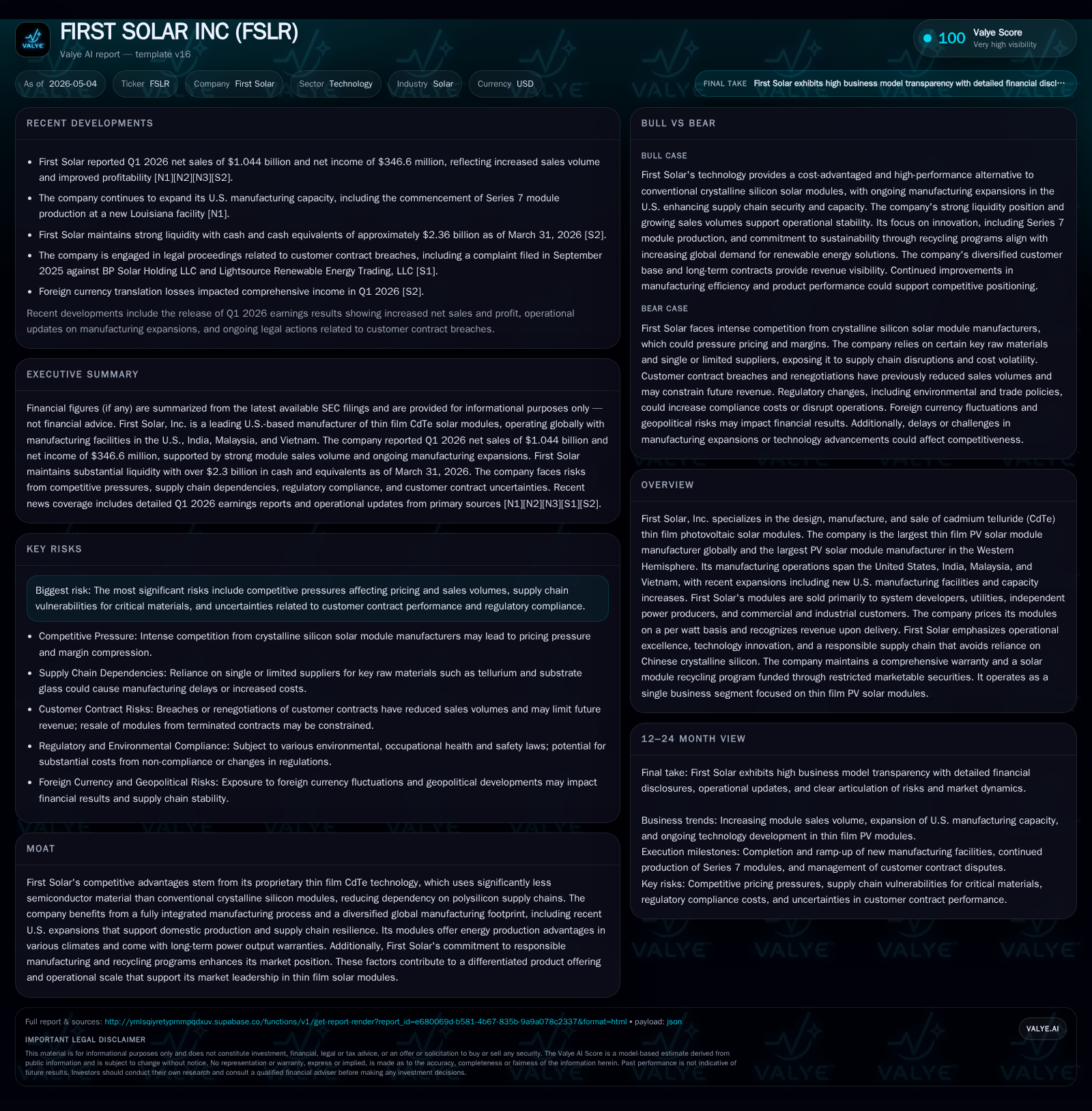
In Q1 2026, First Solar reported significant sales growth and margin improvement, supported by increased manufacturing output and strategic capacity additions, especially in the United States. The company continues to leverage its proprietary CdTe thin film technology to differentiate its products in a competitive solar industry landscape, focusing on sustainability and domestic supply resilience. However, risks from legal disputes with key customers and evolving geopolitical supply constraints remain notable. Upcoming milestones include resolution of contract litigation and further progress in U.S. capacity ramp-up.
Recent Operating Update
First Solar reported its first quarter results for the period ending March 31, 2026, on April 30, 2026. Net sales reached $1.04 billion, up roughly 23% compared to the prior year quarter's $844.6 million [S2]. This topline advance was accompanied by a gross profit increase of over 40%, reaching $486 million as cost of sales growth lagged behind revenue gains due to operational efficiencies. Operating income grew substantially to $345 million from $221 million in Q1 2025 despite a non-trivial production start-up expense of $8.5 million, down notably from $17.6 million previously as new production lines approach steady-state [S2].
The company's operating momentum stems primarily from volume expansions in both existing operations and commissioned new capacity focused on the U.S., India, Malaysia, and Vietnam [S3][S1]. First Solar recorded foreign currency headwinds in the quarter but benefited from increased interest income driven by higher cash balances [S2].
The balance sheet remains robust with cash and equivalents holding steady at $2.36 billion as of March 31, providing flexibility for ongoing investment in capacity projects such as the recently announced domestic manufacturing facilities aimed at reinforcing supply chain resilience [F1][S4][S6]. The current ratio remains healthy at about 2.56 indicating solid short-term liquidity [F1].
Business Model
First Solar generates revenue predominantly through the design, manufacture, and sale of cadmium telluride (CdTe) thin film photovoltaic (PV) solar modules priced on a per watt basis. Revenue is recognized upon delivery when control transfers to customers—system developers, utilities, independent power producers, commercial entities—and governed contractually with provisions for liquidated damages if deliveries or compliance with content requirements are missed or terminated early [S1][S12][S26].
The company's vertically integrated approach encompasses end-to-end manufacturing along a proprietary thin-film technology platform that uses substantially less semiconductor material versus conventional crystalline silicon modules. This method lowers polysilicon dependency—a critical advantage considering current global polysilicon supply disruptions—while enabling competitive cost structures and favorable energy yield particularly in high-temperature environments where thin film modules perform better energetically than their silicon counterparts [Valye overview; S1].
Warranty coverage is comprehensive with long-term power output assurances reinforcing customer confidence in module durability [S1]. Additionally, First Solar manages an industry-leading recycling program aiming to responsibly collect and recycle modules at end-of-life, further underscoring its commitment to sustainability—a growing market differentiator aligned with customer ESG priorities [S24].
Industry Structure and Competitive Position
First Solar operates within a highly competitive solar industry characterized by intense price competition due partly to structural overcapacity globally; estimated module production capacity exceeded demand by roughly one-third entering 2025 according to available industry data cited by the company [S22]. However, First Solar distinguishes itself via its unique CdTe technology which demands fewer critical raw materials like polysilicon—and leverages diversified geographic manufacturing footprints including recent U.S. expansions responding to geopolitical risk in global mineral supplies such as Chinese tellurium export restrictions affecting the solar sector broadly [S27].
Competitors largely operate in crystalline silicon PV technologies with differing cost/margin structures susceptible to raw material volatility; First Solar's niche facilitates some pricing power albeit within an environment still subject to cyclical price pressure.
Execution progress on new U.S.-based manufacturing facilities remains critical for volume growth and margin expansion given stated capex plans continuing through the year. Monitoring shifts in government incentives or trade policies impacting module subsidies or import/export conditions will be important given their direct influence on demand pacing.
Updates on patent litigation cases against TOPCon competitors will also illuminate future competitive dynamics around technological protective moats.
Operational KPIs such as module shipments volume growth rates, production yields improvements post start-up phase completion, backlog levels for module orders especially those tied to IRA-related projects should serve as tangible demand markers.
Financial Profile Summary
Latest financial snapshot
| Metric | Value | Period |
|---|---|---|
| Cash & equivalents | $2.4bn | |
| 2026-03-31 | ||
| Total debt | $374mm | |
| 2025-12-31 | ||
| Net debt | $-1989mm | |
| 2025-12-31 | ||
| Current assets | $5.6bn | |
| 2026-03-31 | ||
| Current liabilities | $2.2bn | |
| 2026-03-31 | ||
| Current ratio | 2.56x | |
| 2026-03-31 |
Source: SEC companyfacts cache [F1].
The firm ended Q1 2026 with a strong liquidity position holding approximately $2.36 billion in cash & equivalents against total debt of $374 million primarily attributable to India credit facilities used for local manufacturing investments [F1][S4][S21]. The resulting net debt is negative at about -$2 billion reflective of substantial cash buffers ensuring robust financial flexibility.
Q1 showed marked improvements in profitability metrics: gross margin expanded due to scale economies realized alongside disciplined cost control while operating expenses rose moderately consistent with strategic investments in R&D ($67 million) and sales/administration ($65 million), supporting continuous innovation efforts vital for sustaining product differentiation [S2][S20].
Overall financial health supports ambitious growth investments while cushioning near-term litigations risks without liquidity strain.
Disclaimer: This analysis is based solely on publicly available information including SEC filings dated through April 30, 2026, supplemented by recent news reports up to early May 2026. It does not constitute investment advice or recommendations regarding the securities discussed.
Disclaimer: This is research-only, informational analysis and not investment advice. It may include AI-generated interpretation and general industry context. Always verify important details using primary sources.

Comments