
Frontdoor Boosts Retention and Revenue Amid Consumer Confidence Shifts
Frontdoor's latest quarterly results highlight steady active customers and strong renewal-driven revenue against a backdrop of leverage and regulatory considerations.
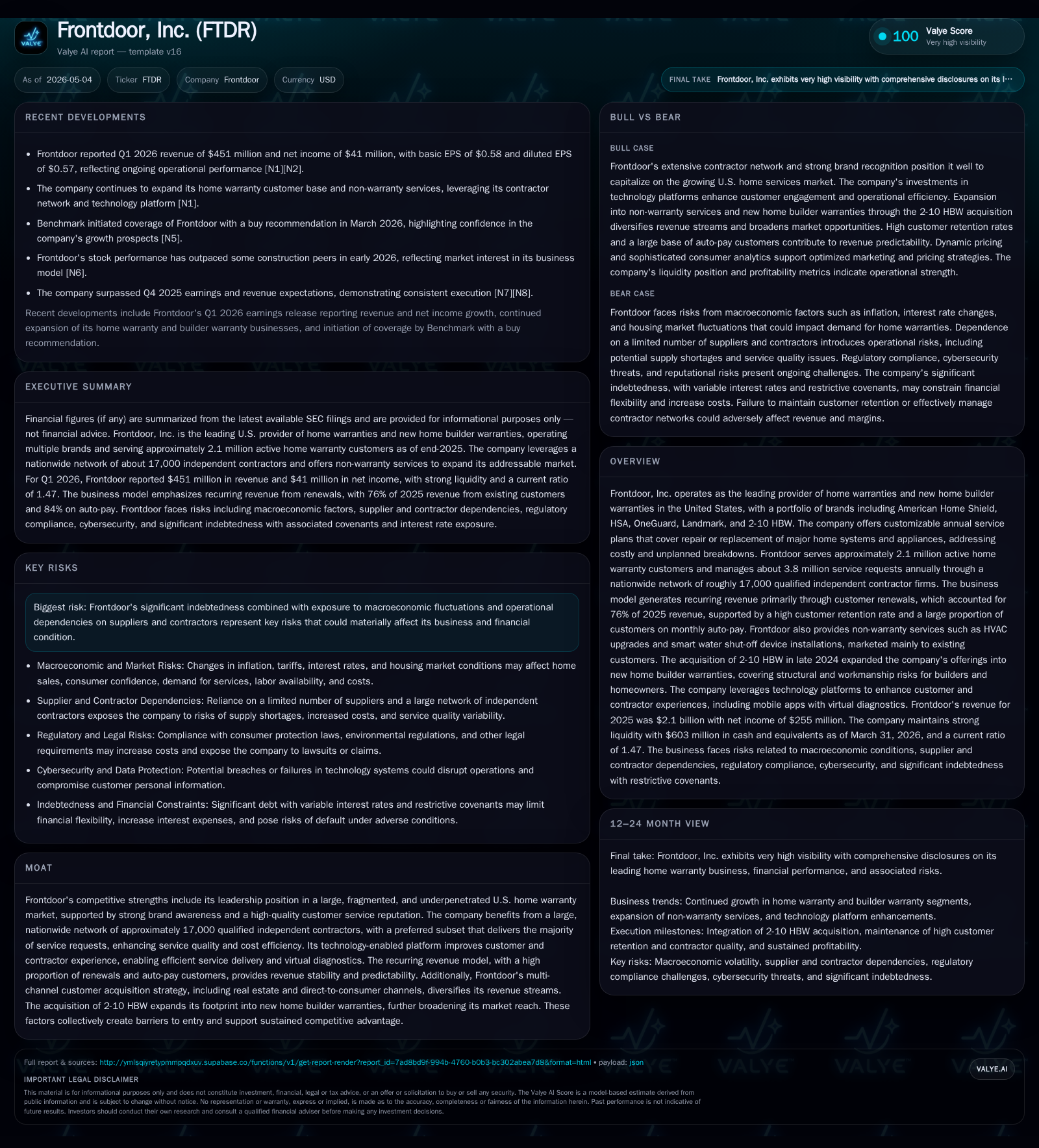
In Q1 2026, Frontdoor, Inc. maintained approximately 2.1 million active home warranty customers and processed around 3.8 million annual service requests through its contractor network, underlining the stability of its recurring revenue model. The company continued to derive the majority of its revenue from renewal channels, supported by a strong auto-pay adoption. Frontdoor’s leading position in the fragmented U.S. home warranty market is underpinned by its extensive network of approximately 17,000 qualified contractors and a multi-brand portfolio. However, the business faces risks from its $1.18 billion debt load amid variable interest rates, and operational dependencies on contractor quality amid evolving regulatory landscapes. Key growth drivers include expanding penetration into underinsured homeowner segments and enhancing customer acquisition channels.
Q1 2026 Operational Highlights: What Changed
Frontdoor’s latest quarterly filing for the period ending March 31, 2026 confirms operational stability with approximately 2.1 million active home warranty customers—the core of its recurring revenue base—and an annualized processing volume near 3.8 million service requests fulfilled via its nationwide network of about 17,000 independent contractors [S2][S3]. Renewal contracts accounted for roughly three-quarters (76%) of total revenues in the prior year, highlighting the company’s success in maintaining customer loyalty through ongoing coverage plans enhanced by monthly auto-pay adoption that reduces cancellation risk [N1][N2]. Earnings topped analyst expectations in Q1 2026, signaling effective cost management during ongoing investments in marketing and platform technology.
These operational metrics underscore Frontdoor's ability to deliver consistent service in a sector characterized by heavy reliance on repeat business and robust service infrastructure.
Core Business Model: Customizable Home Warranties and Service Excellence
Frontdoor operates primarily via customizable annual home warranty agreements that cover repair or replacement costs for major home systems and appliances subject to normal wear and tear—including plumbing, HVAC, electrical systems, water heaters, refrigerators, dishwashers, and ranges [S1][F1]. Its offering extends into new home builder warranties through brands like 2-10 HBW, providing coverage solutions tailored to builders seeking to mitigate post-sale repair risks.
Beyond warranties, Frontdoor has been growing ancillary services such as HVAC upgrades and partnerships focused on smart water shut-off technology. This diversification aligns with a broader industry trend of bundling maintenance-related services to enhance customer retention and margin expansion potential.
Revenue mechanics hinge significantly on subscription renewals (constituting about three-quarters of revenue), underpinned by high customer retention rates facilitated through easy-to-manage payment plans like monthly auto-pay subscriptions [S1][F1]. The large service volume generates scale benefits in contractor utilization efficiency while increasing customer switching costs through service familiarity.
Competitive Landscape: Network Scale and Multi-Channel Customer Acquisition
Frontdoor commands the largest share in the highly fragmented U.S. home warranty sector with a portfolio of well-known brands such as American Home Shield, HSA, OneGuard, Landmark, alongside new home builder focused brands like 2-10 HBW [S1][F1]. Its extensive national contractor network—approximately 17,000 vetted independent professional firms specializing in various trades—forms a critical moat. About 84% of service requests are fulfilled by “preferred” contractors who meet stringent performance standards around reliability, cost-effectiveness, and workmanship quality.
This large-scale network not only drives improved service consistency but allows Frontdoor technological leverage via platforms enabling virtual diagnostics and streamlined scheduling that competitors may find difficult to replicate quickly due to geographic scale or investment needs.
Customer acquisition occurs primarily through multiple channels including real estate broker relationships—capitalizing on buyer readiness—and direct-to-consumer marketing campaigns augmented by digital tools [S1]. These diversified acquisition approaches reduce dependency concentration risks from any single channel.
Analysis suggests moderate pricing power derived from brand recognition combined with cost controls achieved through preferred contractor engagements; nevertheless competitive pressures persist given local market entrants offering narrower or lower-cost alternatives.
Growth Drivers: Expanding Penetration and Enhancing Renewal Rates
Looking ahead, Frontdoor seeks to address underpenetrated homeowner segments where awareness or affordability constraints have limited prior warranty uptake—a structural growth opportunity in the $22 billion estimated U.S. home warranty market [N5][N6]. Increased penetration driven by product innovation plus targeted marketing could incrementally grow its active customer base beyond current levels around two million.
Higher renewal rates remain another lever; management has emphasized improving customer experience both via superior contractor quality standards and digital self-service options which contribute to elevated loyalty metrics.
Additionally, cultivating non-warranty services—such as energy-efficient HVAC upgrades or smart home device integration—offers pathways toward cross-selling within an existing subscriber base while improving average revenue per user.
Strategic investments backing these priorities include enhanced data analytics for customer profiling and optimized marketing ROI frameworks shared during recent analyst discussions [N1][N5], which are expected to be visible in upcoming quarters' key performance indicators.
Risk Factors: Leverage Position and Market Sensitivities
Frontdoor bears notable financial leverage risks stemming from $1.18 billion total debt balanced against $603 million cash equivalents as of quarter-end March 31, 2026—a net debt position near $579 million—and maintains a current ratio of roughly 1.47x reflecting sufficient short-term liquidity buffers [F1][S2]. A significant portion of this indebtedness bears variable interest rates referencing SOFR benchmarks with derivative contracts partially hedging exposures; thus rising interest rate environments could materially increase debt servicing costs impacting cash flow availability [S4][S5][S7].
Operationally, reliance on an extensive independent contractor network constitutes both a strength and vulnerability; any deterioration in contractor availability or quality could impair service delivery outcomes impacting renewal rates.
Macroeconomic variables influencing housing market activity also affect demand for warranty contracts—shifts in new home sales or consumer confidence serve as indirect demand drivers [S9]. Regulatory scrutiny presents additional complexity; compliance mandates related to consumer protection laws or telemarketing practices require constant adaptation to avoid penalties or reputational harm [S21][S22].
Latest quarterly disclosures indicate no material changes to risk factors from prior annual filings but reinforce vigilance on leverage management amidst capital markets conditions [S2].
Forward Look: Key Milestones and Monitoring Points
Key indicators to monitor include quarterly renewal percentages which will reveal retention trends reflecting service satisfaction; customer acquisition costs relative to lifetime value signaling marketing efficiency; contractor engagement metrics measuring field execution capacity; as well as any announcements regarding refinancing initiatives aimed at deleveraging or extending maturities enhancing balance sheet flexibility [S2][N1].
The upcoming release of updated guidance will provide further clarity on growth trajectory assumptions alongside expected margin developments tied to mix shifts toward higher-margin ancillary offerings.
Competitive dynamics remain relevant given evolving service model innovations; any shifts impacting pricing or regional market shares warrant attention for potential margin impact.
Latest Financial Snapshot: Debt and Liquidity Analysis
Latest financial snapshot
| Metric | Value | Period |
|---|---|---|
| Cash & equivalents | $603mm | |
| 2026-03-31 | ||
| Total debt | $1182mm | |
| 2026-03-31 | ||
| Net debt | $579mm | |
| 2026-03-31 | ||
| Current assets | $661mm | |
| 2026-03-31 | ||
| Current liabilities | $451mm | |
| 2026-03-31 | ||
| Current ratio | 1.47x | |
| 2026-03-31 |
Source: SEC companyfacts cache [F1].
This financial snapshot portrays solid liquidity coverage yet underscores material net leverage consistent with prior reporting periods that necessitates prudent capital allocation decisions balancing growth funding against debt servicing obligations.
This analysis is based entirely on verifiable SEC filings dated up to April/May 2026 together with corroborating recent analyst transcripts and public disclosures as cited; no forward-looking investment recommendations are provided herein.
Disclaimer: This is research-only, informational analysis and not investment advice. It may include AI-generated interpretation and general industry context. Always verify important details using primary sources.

Comments