
Asure Software's Q1 2026: Managing Growth Under Financial Constraints
Asure Software delivered modest net income in Q1 2026 while navigating restrictive credit covenants that cap its financial flexibility.
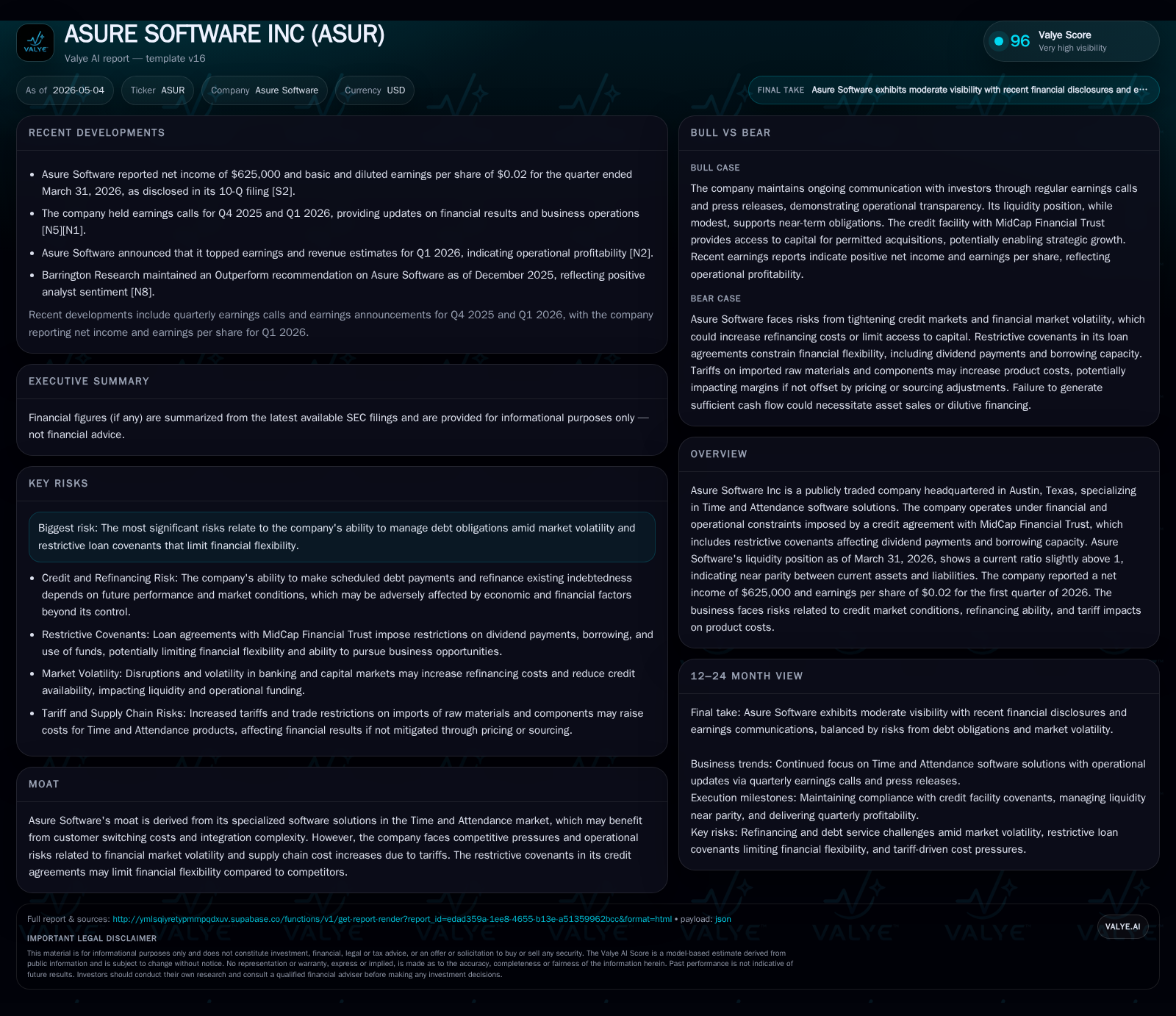
In its latest quarterly filing, Asure Software Inc reported a net income of $625,000 amid tight liquidity and restrictive loan covenants stemming from its credit agreement with MidCap Financial Trust. The company's cloud-based time and attendance SaaS solutions benefit from embedded switching costs but face competitive pressure and cost inflation due to tariffs. Growth potential hinges on expanding subscription revenue and selective acquisition, but financial constraints pose significant execution risks. Monitoring refinancing progress and demand traction will be key near-term focus points.
Q1 2026 Operating Update Highlights
Asure Software's first quarter ended March 31, 2026, was marked by a modest positive net income of $625,000 alongside a constrained liquidity profile. According to the April 30, 2026 10-Q filing [S2] and supplemental 8-K release [S3], the company held cash and equivalents totaling approximately $19.2 million against total debt of about $71.7 million as of quarter-end [F1]. This results in a net debt position near $52.5 million coupled with a current ratio standing at a narrow 1.05 [F1], illustrating near parity between current assets and liabilities.
Despite achieving profitability in the latest quarter — a notable milestone given historical losses — Asure continues operating under the shadow of restrictive covenants linked to its Credit, Security and Guaranty Agreement with MidCap Financial Trust [S2]. These covenants notably curtail dividend payments to shareholders and restrict further borrowing capacity, limiting capital availability for broad corporate initiatives beyond narrowly defined permitted acquisitions [S4,S5]. No material changes to disclosed risk factors were reported this quarter [S2], underscoring ongoing financial constraint themes already present in prior disclosures.
Business Model and Core Products Explained
Asure Software operates primarily within the workforce management technology segment, providing cloud-based Time and Attendance software solutions designed to streamline employee tracking for payroll and HR compliance purposes [S1]. Its revenue model is predominantly subscription-driven SaaS (Software as a Service), where customers typically pay recurring fees for platform access rather than upfront license costs.
The company’s offerings integrate deeply with client payroll, scheduling, and HR systems — establishing integration complexity that enhances switching costs for customers once onboarded [S1]. This ecosystem entrenchment underpins recurring revenue streams but also necessitates ongoing product development to maintain relevance amid evolving regulatory requirements and technological expectations.
Primary customer segments span small to mid-sized enterprises requiring efficient compliance tools alongside larger organizations implementing broader human capital management (HCM) solutions [S1]. Product quality leans on specialized features such as labor law compliance tracking across jurisdictions and integrated mobile applications for remote workforce scenarios.
These factors collectively reinforce customer retention levels but place a premium on continuous platform enhancements to avoid attrition amidst intensifying competition.
Competitive Positioning in the Time and Attendance Market
The time and attendance software market is highly competitive with numerous established players offering commoditized or differentiated SaaS solutions. Asure’s moat chiefly arises from software specialization tailored toward nuanced workforce management challenges combined with integration complexity that raises switching friction [S1]. However, this moat must be viewed alongside its financial constraints which potentially limit aggressive pricing strategies or extensive market spend compared to peers without similar indebtedness burdens.
Recent risk disclosures additionally highlight operational pressures from increased tariffs impacting the cost structure of hardware components bundled with certain Time & Attendance products [S19,S21]. Tariff-related cost inflation introduces margin compression risk if not offset by price adjustments or alternative sourcing strategies.
Moreover, MidCap’s restrictive covenants impose strategic handicaps relative to competitors potentially enjoying freer access to capital markets for growth initiatives [S4,S5]. These limitations may reduce Asure's competitive responsiveness in dynamic market conditions where velocity in innovation or M&A activity can be pivotal.
Key Growth Drivers and Opportunity Catalysts
Asure’s growth levers remain centered around increasing subscription revenues through both organic customer base expansion and upselling additional SaaS modules that enhance workforce analytics and compliance capabilities [N1]. Penetrating vertical industry niches within SMEs offers scope for revenue diversification as smaller clients increasingly prioritize digital workforce management tools.
Enhancing platform integration capabilities to deepen stickiness represents another catalyst enabling higher lifetime value per customer by embedding Asure’s solutions more centrally within client IT ecosystems [S1,N1]. Failure to meet scheduled debt obligations or refinance at favorable terms could trigger default scenarios forcing accelerated repayments that severely impair operating capital availability.
Restrictive loan covenants limit dividend payouts along with borrowings and precisely delineate permissible uses of credit proceeds — excluding general corporate purposes except narrowly defined acquisitions — thereby constraining flexibility in responding tactically to market opportunities or operational exigencies [S4,S5].
Tariff-induced increases in component costs for hardware products have been explicitly cited as potential upward pressure on cost-of-sales absent mitigating actions like price increases or alternative suppliers [S19,S21]. These factors may depress gross margins if market pricing power does not allow full pass-through.
Lastly, the company must navigate execution risks associated with balancing sustainable cash flow generation alongside technology investment demands critical for maintaining differentiation amid intensifying competitive pressures [S2,S18]. These interlocking constraints can cap growth pace over the short-to-medium term.
Monitoring Future Milestones and Market Signals
Key indicators to watch include forthcoming quarterly guidance updates emphasizing liquidity status along with any disclosed plans or progress related to refinancing existing indebtedness within its credit facility framework [N1,N2].
Customer expansion metrics such as new contract wins or incremental module uptake provide critical insight into demand-side momentum that could validate growth assumptions despite capital constraints.
Stakeholders should therefore pay close attention to earnings call commentary around these topics as immediate quarters unfold.
Latest Financial Snapshot: Liquidity and Leverage Analysis
Latest financial snapshot
| Metric | Value | Period |
|---|---|---|
| Cash & equivalents | $19mm | |
| 2026-03-31 | ||
| Total debt | $72mm | |
| 2026-03-31 | ||
| Net debt | $52mm | |
| 2026-03-31 | ||
| Current assets | $259mm | |
| 2026-03-31 | ||
| Current liabilities | $246mm | |
| 2026-03-31 | ||
| Current ratio | 1.05x | |
| 2026-03-31 |
Source: SEC companyfacts cache [F1].
| Metric | Value | Date |
|---|---|---|
| Cash & Equivalents | $19.22M | |
| 2026-03-31 | ||
| Total Debt | $71.70M | |
| 2026-03-31 | ||
| Net Debt | $52.48M | |
| 2026-03-31 | ||
| Current Assets | $259.10M | |
| 2026-03-31 | ||
| Current Liabilities | $246.28M | |
| 2026-03-31 | ||
| Current Ratio | 1.05 | |
| 2026-03-31 |
This snapshot encapsulates Asure Software’s tight liquidity situation coupled with a moderately high leverage profile which continues to impose operational caution as evidenced by subdued dividend activity and measured capital deployment consistent with covenant restrictions. The net debt position approaching $52.5 million accentuates sensitivity around refinancing cycles amid current credit market conditions.[F1]
Disclaimer: This analysis is based solely on publicly available filings as of April 30, 2026. It does not constitute investment advice or recommendations regarding Asure Software Inc securities. Readers should consult independent sources before making decisions.
Disclaimer: This is research-only, informational analysis and not investment advice. It may include AI-generated interpretation and general industry context. Always verify important details using primary sources.

Comments