
Proto Labs’ Q1 2026: Accelerating Innovation in Digital Manufacturing
Proto Labs delivered strong Q1 results, underscoring its leadership in automated digital manufacturing through strategic investments and a hybrid production model.
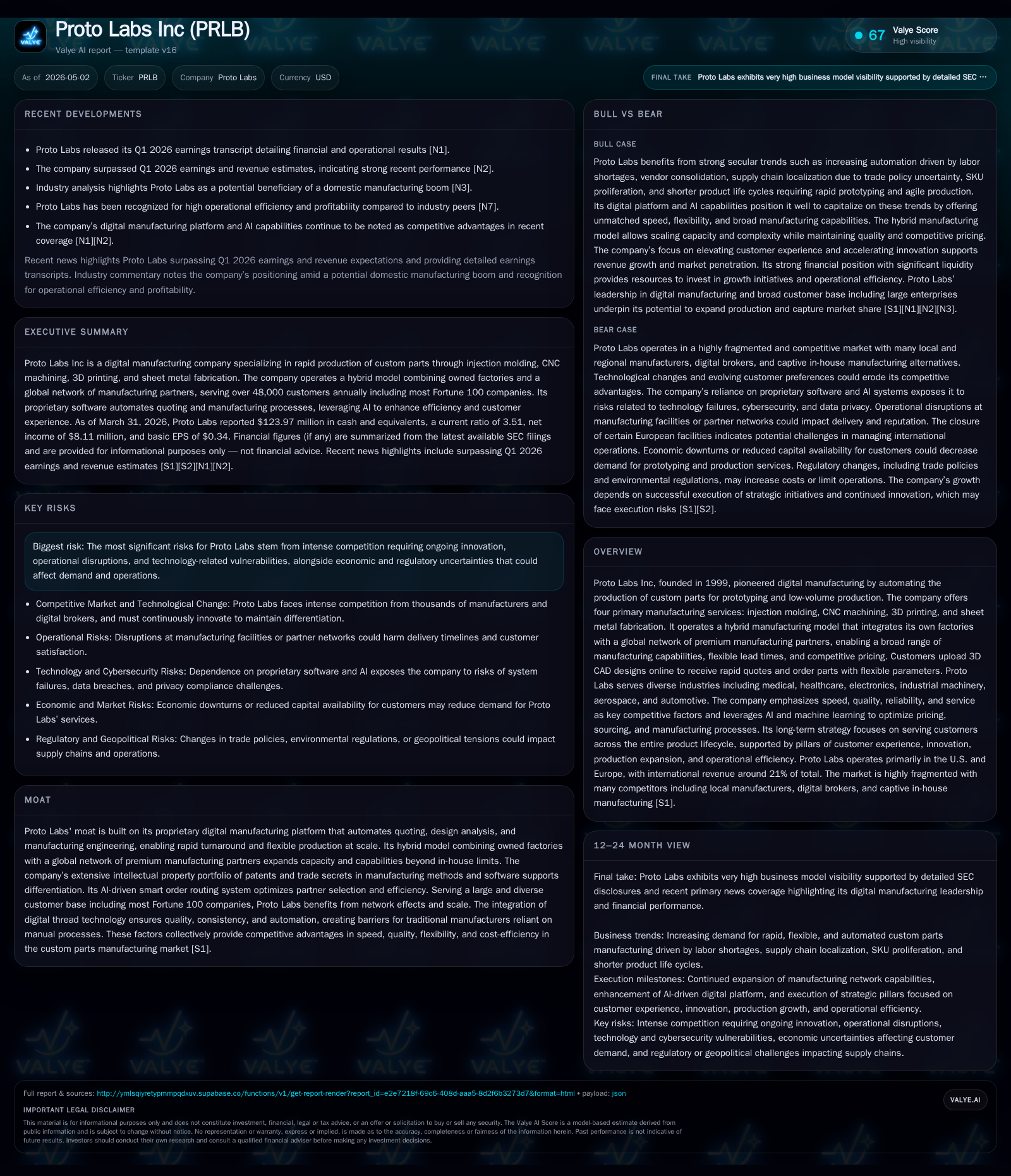
In its Q1 2026 filing, Proto Labs showcased continued momentum driven by its AI-enabled digital manufacturing platform and expansion of its global manufacturing partner network. The company’s hybrid Factory-and-Network model combined with proprietary automation and AI-infused order routing cements its competitive advantage in rapid prototyping and low-volume production across diverse industries. Growth is propelled by deep penetration in Fortune 100 accounts and enhanced operational efficiencies, though competition and technological disruption remain key risks. Financially, Proto Labs holds a robust liquidity position with negligible debt, supporting further investments to scale innovation and production capabilities.
Q1 2026 Operating Highlights and Recent Developments
Proto Labs’ latest quarterly filing (10-Q dated May 1, 2026) confirms sustained operational strength as the company advances its leadership in digital manufacturing [S2]. The firm reported surpassing earnings and revenue estimates for Q1 2026 as highlighted in recent market commentary [N2], signaling healthy demand traction across its core offerings. Concurrently filed Form 8-K reiterates these results via an official earnings release signed by CFO Daniel Schumacher [S3].
Operationally, Proto Labs continues to emphasize technology investments bolstering AI-enhanced quoting accuracy, smart order routing efficiencies through its partner network, and capacity expansion aligned with strategic customer priorities. The company’s focus remains on serving a broad customer base spanning industries such as medical devices, aerospace, industrial machinery, electronics, and automotive where speed-to-market and quality consistency are paramount [S1].
Management remains focused on elevating customer experience through frictionless digital interfaces while accelerating innovation within four principal manufacturing services: injection molding, CNC machining, 3D printing, and sheet metal fabrication. Its hybrid business model uniquely integrates owned factories with a global network of premium manufacturing partners (the Protolabs Network), delivering an unmatched combination of speed, capability breadth, pricing flexibility, and scalable capacity [S7].
Customers upload detailed 3D CAD designs online to access instantaneous pricing quotations that factor in manufacturability feedback powered by integrated AI algorithms analyzing over 18 million unique part designs historically [S14]. This “digital thread” seamlessly ties conception through delivery ensuring rapid turnaround times ranging from prototype runs to low-volume production batches.
AI-driven components—such as intelligent pricing models optimizing part sourcing between factories or partners—enhance operating efficiency while maintaining rigor in quality inspection (e.g., automated mold inspection) and toolpath verification for CNC machining processes [S19]. Over 60 patents protecting proprietary software tools and manufacturing method innovations support strong intellectual property defensibility that raises switching costs.
Such automation not only reduces reliance on manual engineering labor but also enables scaling to thousands of simultaneous part quotes globally without compromising consistent service quality or delivery reliability. Proto Labs deliberately avoids commoditized high-volume runs preferring differentiated applications requiring fast iteration cycles or production agility [S5].
Competitive Landscape and Industry Dynamics
The custom parts manufacturing market remains highly fragmented consisting of local machine shops; mid-sized contract manufacturers; captive in-house prototyping units within OEMs; additive printing specialists; plus emerging digital brokers aggregating capacity [S15]. Competitors range widely by resources—from small vendors to large contract manufacturers—with varying degrees of automation sophistication.
Key competitive factors shaping the sector include turnaround speed for both quotation and physical part delivery; dimensional accuracy; process documentation quality; capacity to handle complex geometries; pricing competitiveness relative to total cost of ownership; customer service experience; as well as the ability to manage demand volatility without minimal order constraints [S15].
Proto Labs' moat derives from its digitally integrated platform enabling speed at scale combined with a hybrid supply model that flexibly routes orders to strategically chosen factory or network partners optimized via machine learning data from millions of past jobs. This provides resilient capacity balancing while maintaining premium quality controls. The extensive IP portfolio further separates Proto Labs from competitors who mostly rely on traditional manual methods or less integrated platforms.
While some competitors have begun exploring similar automated quoting systems or additive technology innovations to erode differentiation, Proto Labs aims to maintain leadership through continuous R&D investment focused on AI advancements, multi-process integration within one interface, plus expanding geographic reach through partner network scales [S15].
Strategic Growth Drivers and Innovation Focus
Proto Labs pursues growth primarily through deeper penetration of existing accounts—including nearly all Fortune 100 companies—by extending use cases beyond rapid prototyping into more production-oriented volumes featuring tighter tolerances or regulatory documentation requirements [S19][S7]. This evolution expands average revenue per customer while enhancing predictability.
New capability introductions across manufacturing processes—such as liquid silicone rubber parts—and broader material options aim to capture additional customer segments requiring complex or specialized parts [S11]. Leveraging AI-powered process efficiencies accelerates response times even under higher demand loads while preserving margins.
Scaling the Protolabs Network enhances geographic accessibility reducing lead times for customers worldwide while offering competitive price points that complement owned factory capacity. This network also enables Proto Labs to manage demand surges effectively without capital-heavy factory expansions.
Near-term growth KPIs include rising order volumes per customer cohort; shrinking lead times enabled by improved partner routing algorithms; higher mix of production volume versus prototype orders demonstrating customer stickiness; factory utilization trends; and growth in geographic footprint projected via network onboarding metrics [N1][S2].
Risks, Constraints, and Competitive Challenges
Exposure to intensified competition remains a core risk. Well-funded incumbents or emerging additive technology vendors developing proprietary materials could challenge Proto Labs’ current value proposition if they offer equal or superior quality alongside competitive pricing. Advances outside Proto Labs’ patent coverage could also introduce disruptive alternatives forcing accelerated innovation cycles that may pressure margins [S1][S6][S8].
Operational complexity inherent in managing a hybrid model spanning owned factories plus heterogeneous global partners poses execution risks including potential disruptions impacting lead times or quality consistency.
The evolving regulatory landscape around e-commerce platforms servicing international transactions may impose compliance burden or raise costs. Economic cyclicality affecting client industries such as automotive or aerospace could introduce order variability impacting utilization rates.
Intellectual property defense challenges could hamper ability to protect proprietary automation tools or novel manufacturing methods risking dilution of competitive advantages.
Key Near-Term Monitorables and Execution Milestones
Investors should closely follow quarterly order volume trends especially within high-value verticals like medical devices or aerospace that require regulated part traceability. Monitoring margin differentials between Factory-produced versus Network-routed parts will provide insights into operational efficiency gains.
Progress updates on AI deployment initiatives—such as improved smart order routing speeds or enhanced DFM feedback accuracy—serve as bellwethers for sustaining technological leadership. Customer retention rates among strategic accounts signal success of the customer experience pillar.
Announcements regarding capability expansions (new materials or process offerings) will indicate breadth increase aligned with growth strategy. Lastly, management commentary on capacity utilization balancing amid volatile demand can help assess operational scalability.
Current Financial Position
Latest financial snapshot
| Metric | Value | Period |
|---|---|---|
| Cash & equivalents | $124mm | |
| 2026-03-31 | ||
| Current assets | $249mm | |
| 2026-03-31 | ||
| Current liabilities | $71mm | |
| 2026-03-31 | ||
| Current ratio | 3.51x | |
| 2026-03-31 |
Source: SEC companyfacts cache [F1].
Proto Labs maintained a solid financial footing entering Q2 2026 supported by approximately $124 million in cash & equivalents with near-zero outstanding debt estimated at $0.15 million as reported in the most recent quarter ending March 31, 2026 [F1].
| Metric | Value (USD) |
|---|---|
| Cash & Equivalents | $123.97 million |
| Total Debt | $0.15 million |
| Current Assets | $248.58 million |
| Current Liabilities | $70.72 million |
This analysis strictly references regulatory filings supplemented by recent public disclosures without speculative assumptions. Proto Labs exemplifies how industrial manufacturers can harness AI-infused software platforms coupled with hybrid operational models to deliver fast-turnaround custom parts globally at scale while navigating fragmented competitive landscapes. Continuous monitoring of technological evolution alongside stringent execution will remain critical to sustaining its differentiated market position going forward.
Disclaimer: This is research-only, informational analysis and not investment advice. It may include AI-generated interpretation and general industry context. Always verify important details using primary sources.

Comments