
Teradyne Navigates Semiconductor Cyclicality with Strong Q1 Execution and Innovation
Teradyne's Q1 2026 results highlight resilient semiconductor test and automation demand amid industry headwinds and evolving trade restrictions.
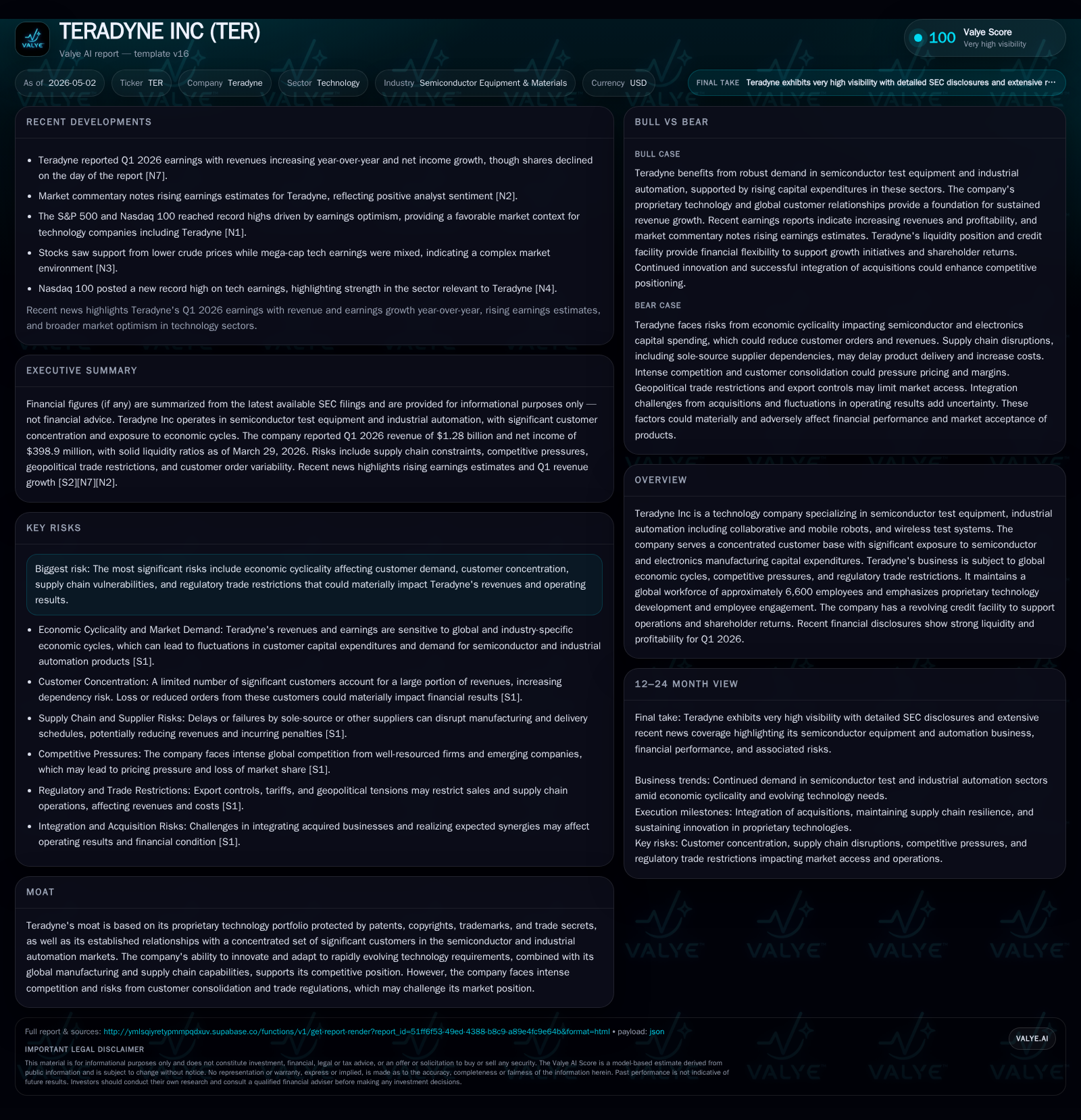
Teradyne’s latest quarterly filing reveals solid top-line growth and operational strength despite ongoing semiconductor market cyclicality and geopolitical trade constraints. The company leverages a proprietary technology portfolio across its semiconductor test, industrial automation, and wireless test segments to serve a concentrated customer base reliant on capital expenditure cycles. While competitive pressures and supply chain risks persist, Teradyne’s strategic investments in robotics and expanded manufacturing capacity underpin its growth trajectory. Key watchpoints include order timing volatility, regulatory export controls, and supply chain execution.
Recent Operating Update
Teradyne's Q1 2026 earnings release and accompanying 10-Q filing dated May 1, 2026 [S2][S3] confirm the company’s continued ability to deliver revenue growth amid persistent semiconductor industry cyclicality. The filing emphasizes operational execution supporting ramped manufacturing capabilities for core Semiconductor Test products as well as expanding sales of industrial collaborative robots. While Teradyne reported higher revenues year-over-year, it noted potential order timing variability typical of capital equipment businesses — reflected in their disclosures regarding backlog unpredictability and customer ordering patterns [S2][S18].
The company maintains strong liquidity with approximately $242 million in cash/test equivalents against minimal debt exposure [F1], giving it flexibility to invest organically or via M&A. Management also highlighted the impact of ongoing U.S. export controls on specific Chinese customers which continue to constrain some sales opportunities but reaffirmed their compliance focus [S2][S28].
Business Model
Teradyne generates most of its revenue by designing, manufacturing, and selling advanced automated test equipment (ATE) used primarily to validate semiconductor devices during production. This constitutes its largest business segment - Semiconductor Test - catering to high-volume chip manufacturers who require precise functional and parametric testing to ensure product quality before shipment.
Complementing this is a growing Industrial Automation segment producing collaborative (cobot) robots designed to work alongside humans in factory environments. These robots target productivity improvements across diverse industries beyond semiconductors. The Wireless Test Systems segment provides specialized radio frequency test instruments for wireless device manufacturers.
Revenue from these segments relies on capital-intensive customers making cyclical purchases aligned with chip fabrication capacity expansions or new technology nodes. Teradyne’s products command premium pricing tied to their performance specifications, yield enhancements offered, software capabilities for automated testing sequences, and total cost of ownership benefits versus alternatives.
Proprietary intellectual property underpins product differentiation: extensive patents on hardware architectures and software algorithms protect critical aspects of Teradyne’s offerings [S18]. This IP fortress is supplemented by long-standing relationships with a concentrated group of large semiconductor manufacturers accounting for nearly half of total revenue [S4][S5]. Those customers specify and purchase directly significant portions of Teradyne’s output.
Industry Structure and Competitive Position
The semiconductor equipment market where Teradyne competes is oligopolistic with few dominant suppliers specializing in different segments (e.g., Applied Materials in fabrication tools). Teradyne focuses on testing equipment—a niche with high barriers to entry due to technical complexity, certification requirements, integration challenges, and sheer scale.
Major competitors include Advantest Corporation (Japan) among others globally. Asian entrants are increasing competitive pressure with lower-cost alternatives but often lack the breadth of advanced features or global service capabilities Teradyne offers [S5].
Industry consolidation trends affect both suppliers like Teradyne’s customers and their competitive dynamics. Larger consolidated customers can exercise more pricing pressure or delay orders strategically. This dynamic heightens the importance of technological leadership to maintain relevance [S4][S5].
Further complexity arises from geopolitical trade restrictions—particularly U.S.-China tensions imposing export limits on certain technologies that inevitably affect potential sales volumes or dictate compliance costs [S25][S28]. Teradyne must navigate these carefully without losing clients or incurring penalties.
Growth Drivers
Semiconductor Industry Expansion: Demand growth for advanced semiconductors—driven by AI compute chips, 5G infrastructure components, automotive electronics, IoT devices—fuels increasing CAPEX among chipmakers who are primary buyers of test equipment.
Technology Node Advancements: Newer nodes require more sophisticated testing with higher precision; Teradyne invests heavily in R&D to keep pace with evolving product specifications required by chip manufacturers [S10].
Robotics Adoption: Industrial automation adoption outside semiconductors presents an expanding opportunity where Teradyne’s collaborative robots gain traction for flexible manufacturing lines or logistics tasks.
Global Manufacturing Capacity Increases: Investments in global fabs stimulate corresponding upstream increases in test equipment usage; similarly scaled supply bases necessitate expanded service contracts.
Aftermarket Service Revenue: Ongoing service contracts for maintenance, software updates enhance recurring revenue stability amid fluctuating capital equipment sales.
Supply Chain Resilience Investments: Efforts to multi-source components help mitigate supply shocks enabling steadier delivery cadence critical for customer satisfaction [S18][S26].
Risks / Watchpoints / Growth Constraints
- Cyclicality: Semiconductor CAPEX cycles remain volatile; abrupt end-market slowdowns can cause postponed orders impacting quarterly performance unpredictably [S20].
- Customer Concentration: The heavy dependence on a few major customers entails order timing risk; loss or reduction could materially impair revenue [S4][S5].
- Export Controls & Trade Restrictions: Compliance with U.S. export regulations restricting sales into China creates uncertainty around addressable markets and may invite costly audits or license delays [S25][S28].
- Supply Chain Disruptions: Component shortages or supplier failures could delay fulfillment or increase costs; sole-source reliance on some parts exacerbates this risk [S18][S26].
- Competitive Pressures: Continued advancement by competitors may erode technological lead or force pricing concessions reducing margins [S5].
- Technological Change Risk: Failure to innovate timely against rapidly advancing chip designs or robotic automation needs can impair market acceptance [S10].
- Regulatory Environment: Environmental compliance requirements or litigation exposures pose potential operating cost increments [S29].
- Foreign Exchange Impact: Given diversified global operations with foreign revenues denominated in non-USD currencies, currency volatility can adversely affect revenues reported in USD terms [S15].
- Order Timing & Backlog Variability: Customers' delayed delivery decisions create booking uncertainties complicating forward visibility [S1][S18][S20].
What To Watch Next
- Q2 order flow trends reflecting any acceleration or delay from leading customers providing insight into cyclicality timing.
- Updates from management regarding mitigation strategies around export regulation impacts.
- Progress on scaling robotic automation installations across non-semiconductor sectors.
- Supply chain status reports addressing component availability improvements or persistent bottlenecks.
- Any new product introductions aligning with nascent semiconductor technologies such as sub-nanometer nodes or advanced packaging tests.
- Changes in backlog levels that might signal shifts in market demand velocity.
- Monitoring competitor moves affecting pricing structures or service offerings.
- Potential announcements on M&A activities leveraging strong liquidity position both for inorganic growth and technology acquisition.
Financial Profile (Latest Quarter Context)
Latest financial snapshot
| Metric | Value | Period |
|---|---|---|
| Cash & equivalents | $242mm | |
| 2026-03-29 | ||
| Current assets | $2.2bn | |
| 2026-03-29 | ||
| Current liabilities | $1012mm | |
| 2026-03-29 | ||
| Current ratio | 2.15x | |
| 2026-03-29 |
Source: SEC companyfacts cache [F1].
Teradyne maintains a robust balance sheet at the end of Q1 2026 with $241.9 million cash & equivalents against very low debt of roughly $2 million yielding a current ratio above 2x (2.15), signaling strong short-term liquidity [F1]. The negligible net debt position supports financial flexibility amid capex growth cycles or shareholder return programs.
This analysis is based solely on public regulatory filings dated through early May 2026 combined with corroborating news disclosures relevant to Teradyne Inc (TER). It does not constitute investment advice but serves as an informed operational review grounded in disclosed data.
Disclaimer: This is research-only, informational analysis and not investment advice. It may include AI-generated interpretation and general industry context. Always verify important details using primary sources.

Comments