
Sandisk Corp Accelerates Growth with Strategic Flash Ventures Partnership
Sandisk's Q3 2026 results show robust revenue growth driven by datacenter demand and Asia expansion, supported by scalable NAND flash supply from its joint ventures.
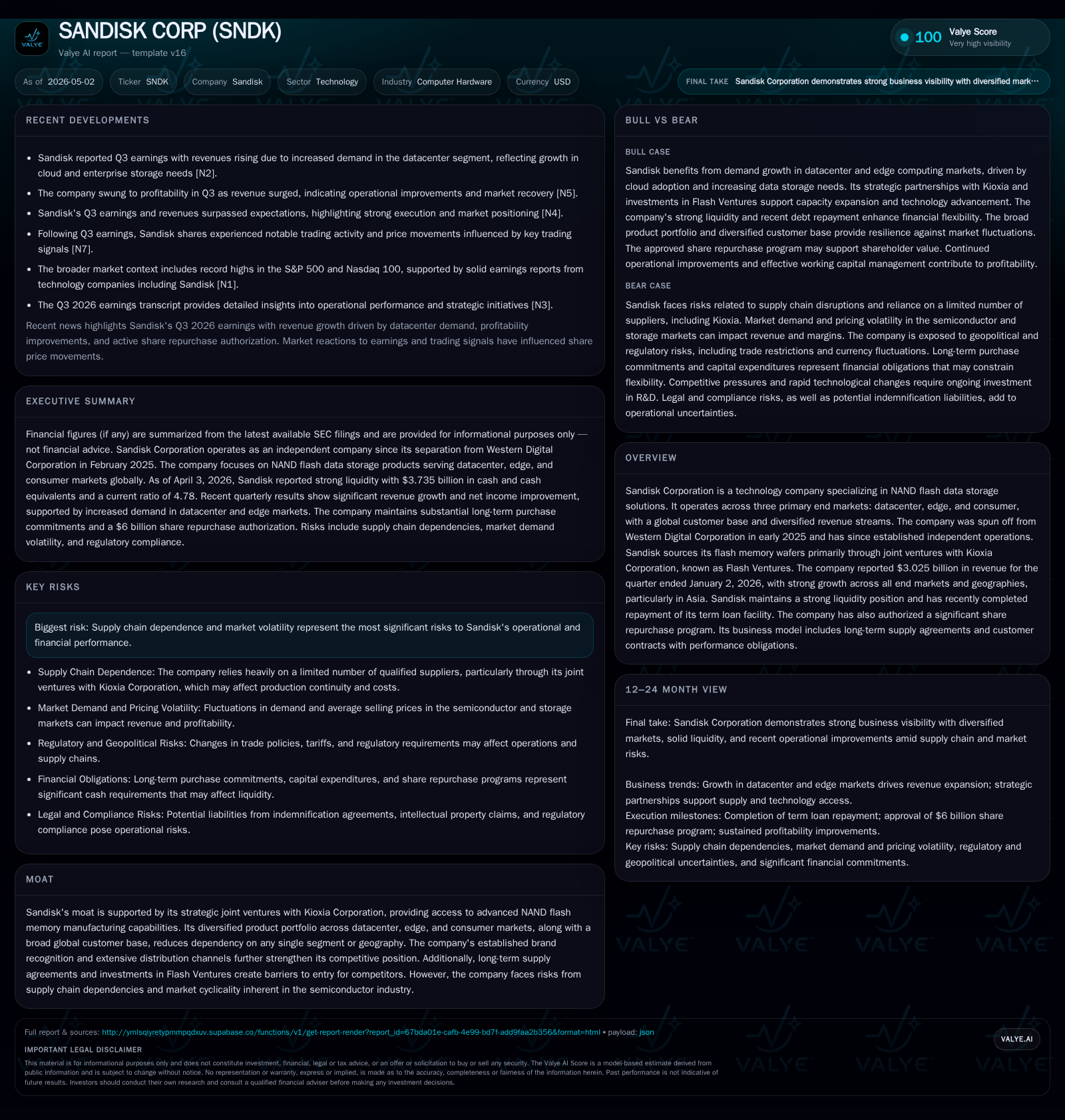
In its latest third quarter filing, Sandisk reported $3.025 billion in revenue, reflecting strong momentum particularly in the datacenter segment and Asia-Pacific markets. The company’s partnership with Kioxia Corporation via Flash Ventures remains a strategic cornerstone, enabling capacity alignment with growing customer demand. Operational improvements in cash conversion and inventory management underscore enhanced scaling efficiencies. While semiconductor cyclicality and supply chain concentration pose ongoing risks, recent balance sheet deleveraging and a $6 billion share repurchase program highlight Sandisk's financial confidence as it pursues diversified growth across multiple end markets.
Q3 2026 Operating Highlights: Revenue Growth and Margin Trends
Sandisk’s fiscal third quarter ending April 3, 2026 revealed a sharp acceleration in top-line performance with revenues reaching $3.025 billion [S2], outpacing consensus estimates significantly [N4][N6]. This surge was propelled primarily by increased demand within the datacenter market segment, anchored by rapid adoption of high-density NAND flash solutions driven by cloud service providers' ongoing storage expansion initiatives. Additionally, the Asia-Pacific region emerged as a standout geography, contributing materially to growth due to regional hyperscale buildouts alongside sustained consumer device momentum.
Operationally, Sandisk demonstrated effective working capital management amidst this volume scaling. Days sales outstanding (DSO) contracted by 11 days compared to the prior year period, moving from 53 to 42 days [S2][S8], attributable to both strong receivables collections and higher revenue capture. Days inventory outstanding (DIO) rose modestly by 8 days due to intentional inventory builds aligned with forecasted demand spikes, reflecting prudent supply chain positioning to avoid bottlenecks. Concurrently, days payable outstanding (DPO) extended by 7 days as payment terms were moderately stretched to optimize cash flow.
As a result, the overall cash conversion cycle improved materially from 150 days to 140 days year-over-year [S2], signaling that Sandisk is leveraging scale efficiently while balancing inventory inflows consistent with demand trends. These dynamics supported positive margin leverage despite typical cost absorption pressures seen in semiconductor production ramp-ups.
Business Model: Leveraging NAND Flash Innovation Across Segments
Sandisk operates principally within the NAND flash memory domain, serving three diversified end markets: datacenter storage infrastructure; edge computing segments including enterprise endpoint devices; and consumer markets featuring embedded storage solutions for mobile devices and personal electronics [S1]. Revenue generation hinges on both volume shipments tied to sizeable long-term supply agreements and innovative product offerings tailored for performance-sensitive applications.
A defining strength of Sandisk’s business model is its robust supply chain nexus centered on the Flash Ventures joint venture with Kioxia Corporation [S1]. Flash Ventures supplies the majority of Sandisk's advanced NAND flash wafers produced at state-of-the-art facilities in Japan (Yokkaichi and Kitakami sites). This partnership grants Sandisk privileged access to leading-edge fabrication technologies and capacity allocation secured through substantial equity investments and long-term collaboration contracts that extend through 2034 [S1][S16].
These arrangements insulate the company from some competitive pressures tied to wafer shortages commonly experienced across semiconductor suppliers while enabling a faster innovation cadence in delivering multi-level cell architectures essential for high-density data storage applications. Unlike vertically integrated semiconductor firms competing directly on fabrication ownership, Sandisk's focus on flash design expertise combined with wafer sourcing flexibility through these alliances affords it a competitive moat.
Its customer base spans major hyperscalers requiring large-scale flash arrays for cloud compute deployments, regional telecom infrastructure platforms demanding low-latency edge storage solutions, plus a range of consumer OEMs embedding high-capacity SSDs into personal computing devices. Such diversity reduces reliance risks linked to any single market vertical or geographic region.
Competitive Positioning: Supply Partnerships and Market Reach
Sandisk’s moat derives predominantly from its strategic partnerships anchored by Flash Ventures with Kioxia. This joint venture is critical not only for wafer procurement but also for collaborative R&D investment that secures early access to next-generation NAND memory technologies. By holding near-equal equity stakes and operational influence over manufacturing output schedules at Yokkaichi's advanced fabs (K1/K2) plus Kitakami site (Y7), Sandisk mitigates raw material scarcity risks endemic across the industry.
Brand credibility further strengthens its global reach alongside deep distribution networks staffed with specialized sales teams serving hyperscaler clients in North America, Europe, and fast-growing Asian markets like China and India [S1]. The blend of direct contractual relationships buttressed by channel partners amplifies Sandisk’s market penetration capabilities.
However, this reliance on a concentrated wafer source introduces supply chain vulnerability if unforeseen disruptions arise at Flash Ventures facilities or if strategic misalignments occur between partners. Nevertheless, near-constant full-capacity utilization historically achieved at these fabs coupled with recent capacity expansions reflect supply chain robustness relative to peers facing more fragmented procurement challenges [S1][S14].
Market cyclicality remains another external challenge given NAND price volatility influenced heavily by macroeconomic demand swings among cloud providers and consumer electronics manufacturers alike.
Growth Drivers: Datacenter Demand, Geographic Expansion, Product Diversification
The primary growth vector surfaced clearly in Q3 was the surge in datacenter demand triggered by accelerated cloud adoption of AI workloads requiring extensive flash storage arrays optimized for high throughput and low latency [S2][N5]. Backup data center modernization programs fueling public cloud providers’ infrastructure upgrades continue exhibiting structural upward trends.
Complementary geographic expansion efforts leveraged Asia’s rapid digitalization wave — particularly investments targeting Chinese hyperscale operators — providing significant incremental revenue contributions during Q3 [S2]. Sandisk’s established Unis Venture joint operations further extend its footprint into China’s high-growth enterprise computing sector.
Product innovation also plays a key role; Sandisk is advancing newer generations of multi-level cell (MLC) technologies along with proprietary controller enhancements enhancing overall system reliability and energy efficiency critical for edge computing applications [S1]. This diversification supports cross-selling opportunities across end markets beyond core datacenter configurations.
Capacity additions within Flash Ventures are ongoing investments meant to sustain production scaling aligned with forecasted demand increases — these will be critical execution points going forward as backlog orders climb [N5].
Risks and Constraints: Supply Dependence and Semiconductor Cyclicality
Despite operational strengths, Sandisk faces notable risks centered around its wafer source dependencies. With approximately half of its wafer supply locked into Flash Ventures output constraints subject to concerted capital spending plans shared exclusively between Sandisk and Kioxia [S1], any production interruptions or disagreements could materially impact Sandisk’s ability to fulfill orders timely.
Furthermore, the semiconductor industry's inherent cyclicality manifests acutely within NAND pricing structures that swing based on global inventory glut or shortage conditions driven by changes in consumer device cycles or macroeconomic slowdowns impacting data center capex patterns. Such fluctuations place pressure on margins given fixed components of manufacturing expense allocations [S19].
Trade policy shifts or geopolitical tensions affecting Japan-based semiconductor fabrication sites could introduce regulatory uncertainties impacting long-term operating stability.
Inventory management balancing act remains essential—inventory builds intended for demand anticipation could conversely exacerbate write-down risk during sudden downturns.
Upcoming Catalysts: Guidance, Contract Wins, and Capacity Expansion Plans
Investors should watch closely forthcoming quarterly earnings updates where management is expected to disclose updated guidance reflective of Q4 sales bookings especially pertaining to datacenter pipeline projects [S2][N5]. New contract announcements tied to hyperscale customers or telecom infrastructure deployments would serve as tangible evidence supporting sustained growth trajectories.
Additional disclosures around planned capital expenditures relating to Flash Ventures facilities will provide insights into expected capacity ramp timing that could drive future revenue scalability.
Monitoring utilization rates at Flash Ventures is vital given previous temporary curtailments during weaker flash pricing environments have impacted output levels but are expected now to stabilize or expand congruent with current market signals.
Investor communications addressing strategy shifts regarding product portfolio enhancements will also be relevant as Sandisk navigates technology transitions toward next-gen NAND architectures.
Financial Profile Snapshot: Liquidity Strength and Balance Sheet Health
Latest financial snapshot
| Metric | Value | Period |
|---|---|---|
| Cash & equivalents | $3.7bn | |
| 2026-04-03 | ||
| Total debt | 0 USD | |
| 2026-04-03 | ||
| Net debt | $-3.7bn | |
| 2026-04-03 | ||
| Current assets | $9.2bn | |
| 2026-04-03 | ||
| Current liabilities | $1917mm | |
| 2026-04-03 | ||
| Current ratio | 4.78x | |
| 2026-04-03 |
Source: SEC companyfacts cache [F1].
At quarter-end April 3, 2026, Sandisk held $3.74 billion in cash and equivalents against zero stated total debt resulting from full term loan prepayments earlier in Q3 [F1][S6][S11]. This left the company with an impressive net cash position of approximately negative $3.74 billion net debt (cash minus debt), implying substantial financial flexibility.
Current assets stand at $9.17 billion against current liabilities of $1.92 billion delivering a robust current ratio of 4.78x on the date reported [F1], highlighting strong short-term liquidity able to comfortably cover immediate obligations.
Operating cash flow has remained positive reflecting profitable product mix shifts alongside disciplined working capital management evidenced by improving DSO metrics despite inventory accumulation consistent with expansion plans [S2][S18].
This healthy balance sheet underpins the recently approved $6 billion share repurchase program announced April 30, 2026 aimed at returning capital progressively funded through operating cash flows — an indication of management's confidence in sustainable free cash generation streams [S15][S12].
This analysis is based exclusively on publicly available SEC filings and related regulatory disclosures up to May 2026 along with validated numeric data from official XBRL sources without speculative assumptions beyond documented evidence.
Disclaimer: This is research-only, informational analysis and not investment advice. It may include AI-generated interpretation and general industry context. Always verify important details using primary sources.

Comments