
Crown Holdings’ Q1 2026 Update Highlights Resilience Amid Raw Material Cost Pressures and Customer Consolidation
Latest quarterly results affirm Crown’s strategic focus on beverage can growth and sustainability despite margin headwinds.
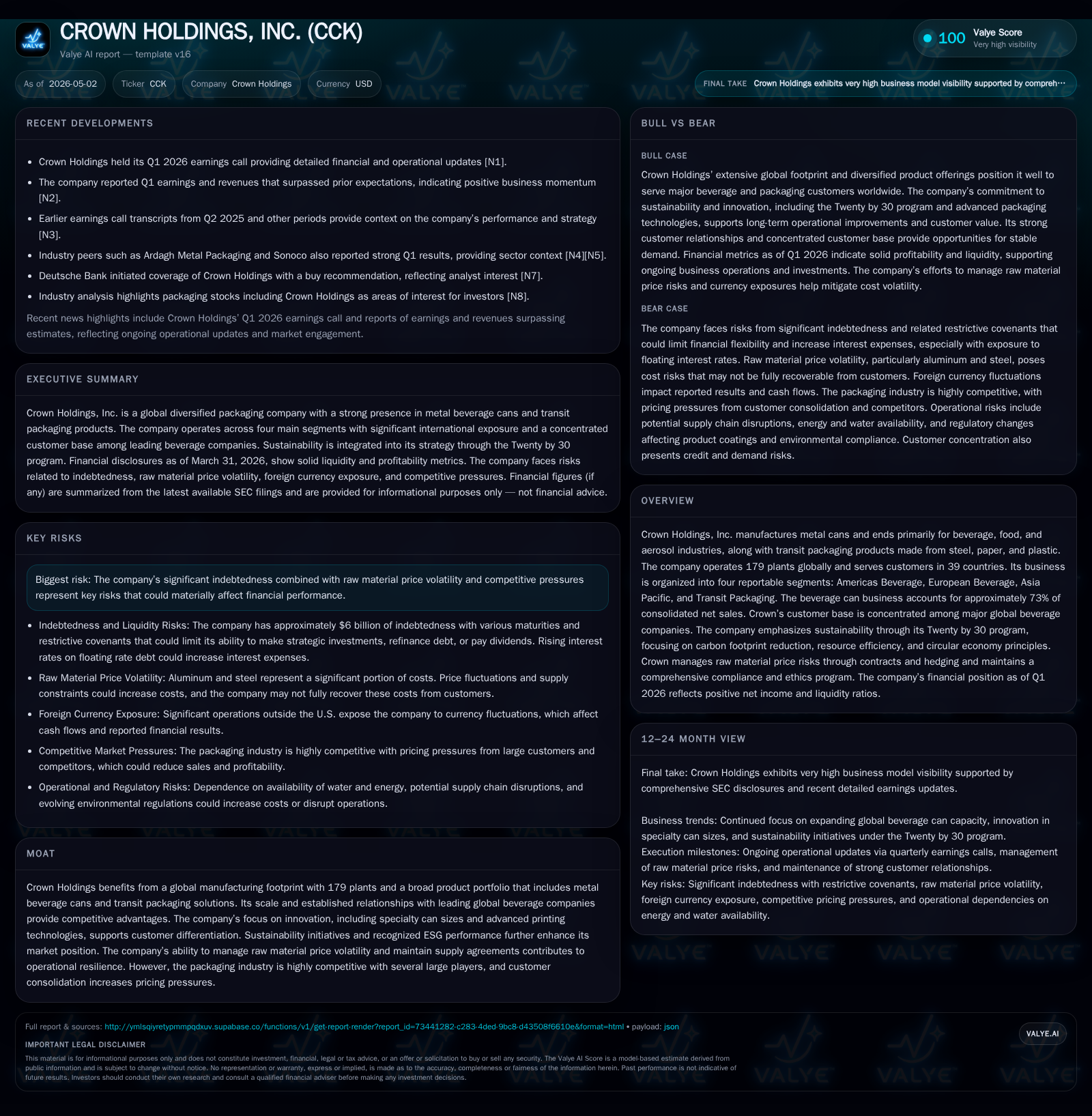
In the first quarter of 2026, Crown Holdings reported solid revenue performance driven by its global beverage can business but faced margin pressures from raw material cost inflation and competitive pricing dynamics. The company’s broad manufacturing footprint and innovation in specialty cans underpin its strong position against a backdrop of customer consolidation and cyclical input cost volatility. While sustainability initiatives and new product development foster differentiation, Crown’s high leverage and exposure to commodity price swings remain critical risks. Watching operational execution on capacity expansion and pricing pass-through will be key to gauging near-term growth trajectory.
Recent Operating Update
Crown Holdings’ first quarter 2026 filing (Form 10-Q filed May 1, 2026) signals continuing operational resilience despite challenging cost environments [S2]. Revenue remained healthy, supported by strong demand in the global beverage can segment that constitutes approximately 73% of consolidated net sales [S2][S1]. However, escalating raw material costs—primarily aluminum and steel—have put pressure on operating margins, as not all increased input costs could be fully passed to customers immediately [S2][N2]. The company also noted ongoing competitive pricing dynamics exacerbated by customer consolidation in the beverage industry [S2][S24].
A recent event filing (8-K dated April 27, 2026) reiterates commitments to maintaining supply chain stability and managing working capital through various financing facilities [S3].
Business Model
Founded in 1892, Crown Holdings is a global leader in metal packaging manufacturing, predominantly aluminum and steel cans and ends for beverages, food products, and aerosols. It also offers transit packaging solutions from diverse substrates including steel, paper, and plastics [S1]. The company's business model generates revenue via large volume contracts with leading beverage companies worldwide who pay for metal cans customized to their packaging needs.
Revenue drivers are volume-based with price adjustments influenced by raw material cost trends embedded in supply agreements—some with multi-year terms reflecting fluctuating aluminum prices; others are shorter duration or fixed price [S1]. Specialty product offerings like slim and sleek cans and sophisticated decorating techniques generate incremental value by enabling customers to differentiate on shelves.
Margins are sensitive to commodity price swings. Crown employs hedging strategies alongside risk-sharing contractual mechanisms to mitigate raw material volatility. However, rapid commodity inflation or inability to pass costs impacts profitability periodically.
The company emphasizes sustainability via its Twenty by 30 TM program targeting carbon reduction and enhanced recyclability of metal packaging – a critical differentiator aligned with rising ESG expectations across consumer brands [S1]. Transit packaging complements core beverage products with automation technologies servicing adjacent industrial sectors.
Industry Structure and Competitive Position
Crown operates within a concentrated global market characterized by a few large competitors producing metal packaging solutions. Its scale — with 179 plants globally serving customers in 39 countries — provides a significant competitive moat through manufacturing flexibility, geographic reach, and longstanding customer relationships [S1].
The largest clients are global beverage conglomerates whose consolidation heightens their purchasing power over suppliers like Crown. This dynamic increases pricing pressures but simultaneously drives volume growth as premium beverage categories expand.
Innovation is pivotal: Crown’s advanced R&D capabilities foster continuous development of specialty can formats which capture emerging consumer trends such as product premiumization.
Furthermore, strict compliance with environmental regulations—including evolving restrictions on substances like bisphenol-A—demands investment but offers an opportunity for leadership via safer coating technologies [S17][S18].
Growth Drivers
Capacity Expansion: Continued capital deployment aims at increasing beverage can production capabilities worldwide to meet rising demand for both alcoholic and non-alcoholic beverages. This includes targeted growth in emerging markets as well as mature regions where new product introductions favor metal packaging [S1][N1].
Product Innovation: Introducing novel can sizes (slim/sleek) supports customer brand differentiation amidst crowded categories. Technologies improving decoration quality enhance shelf impact which is crucial for market share gains.
Sustainability Leadership: Leveraging the recyclable nature of metal containers under its Twenty by 30 program strengthens Crown’s appeal amid growing regulatory scrutiny and consumer preference shifts towards eco-friendly packaging.
Transit Packaging Solutions: Expansion into automation equipment enhances service offerings across broader industrial markets creating cross-selling opportunities.
Risks / Watchpoints / Growth Constraints
Raw Material Price Volatility: Aluminum (47%) and steel (8%) represent significant portions of production costs with prices influenced by global trade policies (tariffs remain uncertain following recent U.S. Supreme Court rulings) causing earnings unpredictability if costs cannot be fully passed on swiftly [S1].
Customer Consolidation: Major buyers’ growing scale imposes intense pricing pressure; loss or reduced volumes from any large customer could materially impact revenue given client concentration levels [S24].
Regulatory & Litigation Exposure: Pending asbestos-related litigation accruals (~$177 million as of end-2025) combined with ongoing European antitrust probes present potential liabilities; environmental regulatory tightening could increase compliance costs or restrict certain materials use including bisphenol-A coatings [S7].
Operational Disruptions: Large-scale manufacturing facilities face risks from natural disasters or cyberattacks that could interrupt production streams essential for timely delivery obligations [S18].
What to Watch Next
Investors should monitor:
- The pace of raw material cost passthrough effectiveness amid persistent commodity inflation.
- Execution updates on new capacity ramp-ups particularly in Asia Pacific and Americas Beverage segments.
- Renewal terms for major customer contracts reflecting pricing power trends.
- Progress reports under sustainability initiatives including recycled content targets under Twenty by 30 TM.
- Developments related to regulatory investigations or litigation outcomes influencing contingent liabilities exposure.
- Quarterly margin trends signaling operational leverage amidst volume fluctuations.
Financial Profile (Latest Quarter Context)
At March 31, 2026, Crown Holdings held approximately $584 million in cash and equivalents against total debt near $6.25 billion resulting in a net debt position around $5.67 billion [F1]. Current assets totaled about $4.53 billion versus current liabilities of roughly $4.06 billion yielding a current ratio near 1.12 which signifies an adequate short-term liquidity buffer [F1].
Operating income trends have experienced compression due to input cost surges though nominal revenues grew supported by strong beverage segment volumes [N2][N9]. Interest expense remains substantial given floating rate exposures though partially mitigated by hedging programs leaving room for caution amid changing rate environments [S11].
Conclusion
Crown Holdings maintains a strategically defensible position within global metal packaging driven by scale, innovation focus, and sustainability commitments. The recent quarterly report confirms sustained top-line growth propelled mainly by its core beverage can business yet underscores margin vulnerability due to volatile raw material inputs coupled with customer-driven price discipline.
Longer-term growth hinges on effectively scaling new product innovations while navigating increasing regulatory complexity plus maintaining financial discipline against elevated indebtedness levels. Balancing these factors will be crucial as the company seeks to capitalize on evolving consumer preferences favoring environmentally responsible metal packaging solutions amid ongoing industry consolidation.
Disclaimer: This report is for informational purposes only based on publicly available filings and news sources as of early May 2026. It does not constitute investment advice or a recommendation to buy or sell any securities.
Disclaimer: This is research-only, informational analysis and not investment advice. It may include AI-generated interpretation and general industry context. Always verify important details using primary sources.

Comments