
Ultra Clean Holdings Advances Market Share on AI-Driven Semiconductor Demand
Ultra Clean's latest quarterly results highlight resilient order momentum and backlog expansion amid AI-driven semiconductor capital spending, supported by its vertically integrated business model.
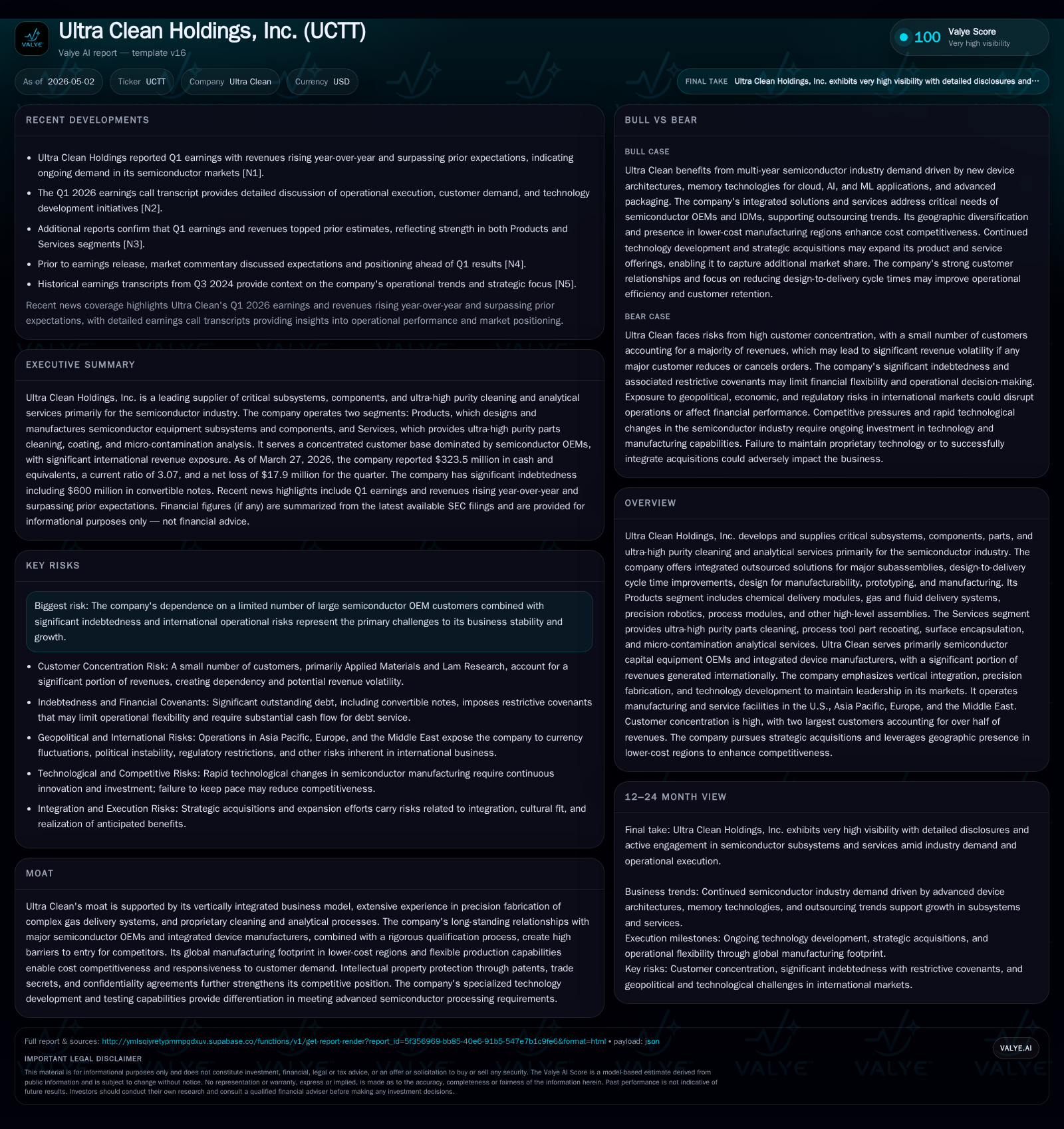
In Q1 2026, Ultra Clean Holdings reported revenue growth above expectations and an expanding backlog, signaling market share gains driven by strong semiconductor industry investment focused on AI and advanced packaging. The company’s vertically integrated offering spanning precision subsystems to ultra-pure cleaning and analytical services bolsters its competitive moat. Customer concentration and significant indebtedness remain critical risk factors to monitor. Upcoming milestones include execution on capacity expansions, CFO succession, and managing supply chain scaling.
Latest Operating Developments Reflect Strengthened Demand and Execution
Ultra Clean Holdings’ Q1 2026 filing dated April 29 reveals a notable uptick in demand driven by robust semiconductor capital expenditure growth linked to artificial intelligence applications [S2]. The company beat earnings estimates and reported year-over-year revenue improvements largely fueled by its Products segment’s integrated subsystem solutions and sustained expansion in Services providing ultra-high purity cleaning and micro-contamination analytics [N1], [N3]. Demand visibility through backlog figures has improved relative to prior quarters, indicative of accelerating qualification cycles that benefit Ultra Clean's design-for-manufacturability practices.
The recent CFO retirement announcement (April 28) introduces subtle execution risk but was managed proactively with a search initiated to ensure smooth transition [S3]. This leadership continuity effort is particularly relevant given the company's complex supply chain scaling requirements amid intensified competition for components and skilled labor.
Business Model: Vertically Integrated Solutions for Subsystems and Services
Ultra Clean operates two primary segments: Products offering critical semiconductor equipment subsystems (chemical delivery modules, gas delivery systems, precision robotics) and Services providing specialized parts cleaning, recoating, surface encapsulation, and analytical verification [S1]. This vertical integration—from prototype through final assembly combined with ultra-pure surface treatments—facilitates compressed design-to-delivery cycle times that are crucial given semiconductor OEMs’ evolving node transitions.
Strategic investments in manufacturing facilities across US, APAC (notably Malaysia), and EMEA underpin flexible global production capacity aligned with customer geographies [S1]. Proprietary cleaning recipes protected by patents contribute substantial differentiation versus competitors mainly serving single functions or lacking full subsystems expertise. This integrated approach helps optimize cost structures while meeting stringent quality demands that define customer retention barriers.
Competitive Position within the Semiconductor Supply Chain
Ultra Clean serves primarily semiconductor capital equipment OEMs like Applied Materials and Lam Research, whose combined orders represent close to 60% of total revenues [S16], [S27]. The rigorous supplier qualification cycles function as a formidable switching-cost moat—new entrants face long audit periods covering engineering sophistication, manufacturing processes, and quality controls.
Major direct competitors in gas delivery systems include Ichor Systems and Fujikin; other competitors span various subsystem components providers such as Jabil or Foxsemicon in parts fabrication [S27]. For cleaning/coating services analysts note firms like KoMiCo or EnPro. Despite this crowded landscape, Ultra Clean’s multi-layer IP protection combined with deep integration into customers' design specifications reduces risk of commoditization. However, risks persist around OEMs potentially internalizing certain functions to lower reliance on outsourced providers.
Key Growth Drivers Accelerated by AI and Advanced Packaging Trends
The current semiconductor cycle is structurally elevated by demand for AI/ML workloads driving massive investments in advanced node equipment. Ultra Clean highlights new device architectures including gate-all-around transistors and backside power distribution as increasing complexity necessitating their precise subsystem offerings [S1]. Additionally, memory technologies like high bandwidth memory further catalyze expanded wafer fabrication tool requirements.
Services are also expanding; device makers increasingly outsource ultra-high purity cleaning/coating to ensure tighter process control at scaled volumes. This shift enlarges total addressable market beyond traditional component sales. Management underscores opportunities to grow market share both through design-to-delivery improvements that shorten OEM qualification timelines and expanding service penetration amidst broader outsourcing trends.
Risk Factors Including Customer Concentration and Indebtedness Exposure
Two semiconductor OEM customers have historically dominated Ultra Clean’s revenue mix (~58-59% range), exposing the company to pronounced concentration risk should outsourcing preferences shift or orders slow abruptly [S16], [S18]. Volatility linked to cyclical capex spending patterns in semiconductors compounds uncertainty around consistent revenue streams.
Financial leverage has increased following a $600M principal Convertible Notes issuance in March 2026 alongside credit facility borrowings totaling ~$19.4M [S2]. While the current ratio of 3.07 indicates liquidity sufficiency to meet near-term obligations [F1], restrictive covenants on debt including leverage caps impose operational constraints.
Supply chain tightness for critical materials and skilled labor during peak demand phases remains a key watchpoint; inability to timely expand capacity can lead customers to divert volume elsewhere. Additionally, geopolitical tensions affecting exports or local sourcing policies in APAC regions impose regulatory risks potentially impacting cost competitiveness.
Near-Term Catalysts and What Investors Should Monitor Next
Key indicators include sequential confirmation of revenue growth beyond Q2 amid ongoing AI-capital equipment investments alongside gross margin performance as manufacturing expansions in Malaysia progress [S2]. Success in transitioning CFO leadership without disruption will be pivotal for sustaining investor confidence during this period of scaling complexity [S3]. Order backlog evolution will be an important metric for gauging sustainable demand vs lumpiness typical of semiconductor cycles.
Close attention should also be paid to updates regarding debt refinancing strategies or covenant compliance given the significant indebtedness load size relative to operating cash flow generation.
Current Financial Position Snapshot
As of March 27, 2026 quarter-end, Ultra Clean maintains cash balances of approximately $324 million against total debt of about $619 million, resulting in a net debt position near $296 million [F1]. The company’s current ratio stands at a healthy 3.07, indicating sufficient liquidity to cover short-term obligations [F1]. This financial structure reflects elevated leverage primarily due to recent convertible bond issuance and credit facility borrowings [S2]. Maintaining robust operating cash flow conversion will be essential to manage this financial profile over upcoming quarters.
Disclaimer: This analysis is based solely on publicly available SEC filings dated through April 29, 2026, Nasdaq news reports up to May 2, 2026, and companyfacts data current as of March 27, 2026. It does not constitute investment advice or recommendations but aims to provide an objective review grounded in disclosed operating facts.
Disclaimer: This is research-only, informational analysis and not investment advice. It may include AI-generated interpretation and general industry context. Always verify important details using primary sources.

Comments