
Robert Half’s Q1 2026 Reflects Macro Uncertainty and Emerging Opportunities in Talent and Consulting
Revenue declined modestly across talent solutions and Protiviti in Q1, with efficiency-driven consulting demand signaling a pivot amidst shifting regulatory landscapes.
Robert Half Inc.’s first quarter of 2026 showed a 3.8% revenue decline to $1.30 billion amid lingering economic uncertainty impacting client and candidate confidence. Contract talent solutions led the top-line softness, with hours worked down despite modest rate increases, while permanent placement activity remained sensitive to extended hiring timelines. Protiviti saw revenue decreases driven by fewer large-scale remediation projects but is capitalizing on rising demand for technology-enabled efficiency services. The company continues investing in proprietary AI tools and digital experiences to strengthen competitive differentiation and capture growth as economic conditions stabilize.
Recent Operating Update
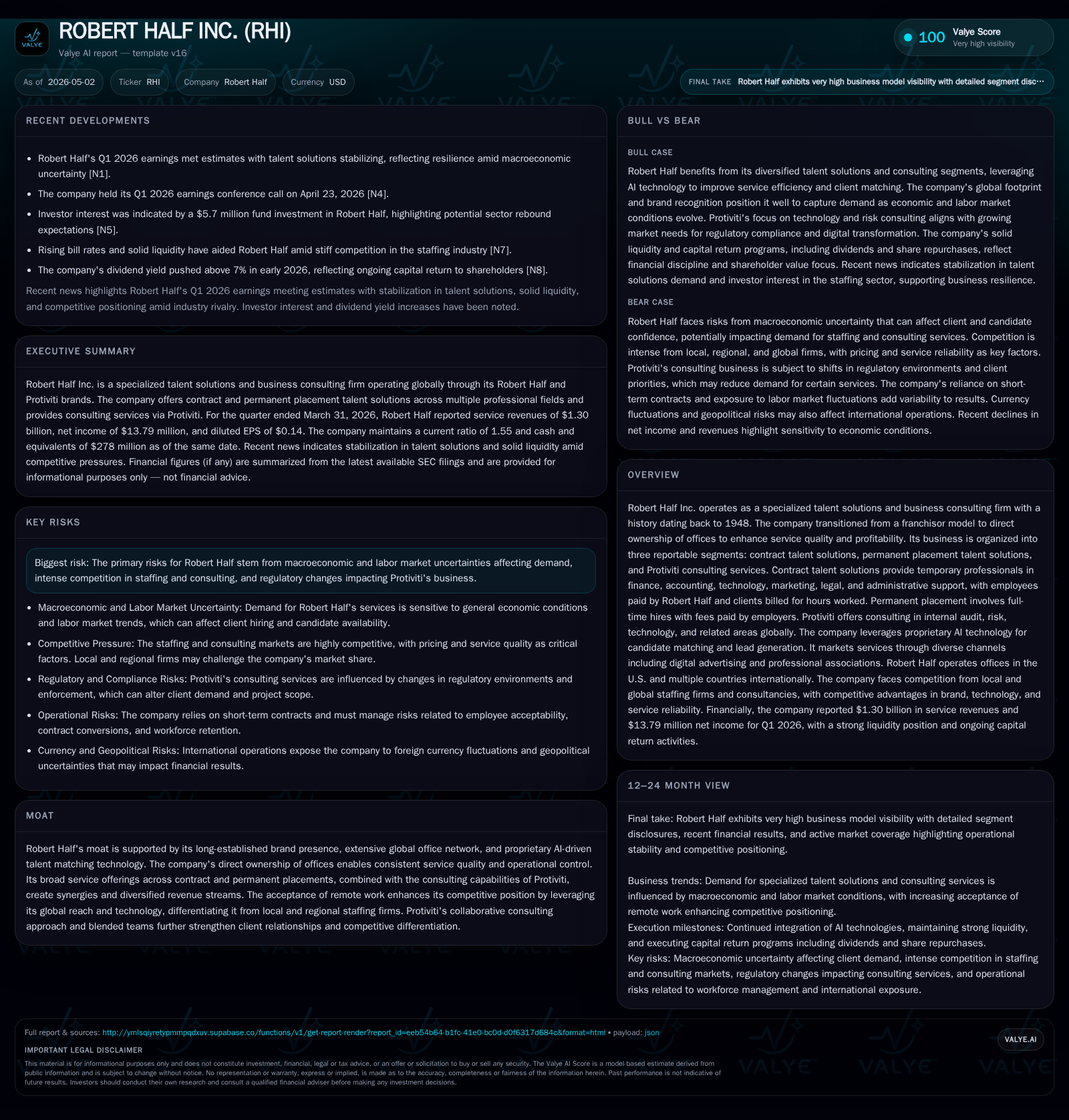
Robert Half Inc.'s latest quarterly filing for Q1 2026 reveals a mixed but strategically nuanced picture against persistent macroeconomic headwinds [S2]. Total service revenues declined 3.8% year-over-year to $1.30 billion, driven by softer demand across its core businesses: contract talent solutions, permanent placement talent solutions, and its consulting arm, Protiviti.
Contract talent solutions revenues fell 5.0% globally, with notable pressure on the hours worked metric (-7.2%) despite a price-driven uplift (+2.4% in average bill rates). The U.S., representing the lion's share (approximately 76%) of total revenue, experienced a sharper decline (-7.1%), contrasting with an international revenue increase of +8.1%, reflecting regional variation in recovery dynamics [S17][S26]. Permanent placement revenues dropped 2.8%, impacted heavily by reduced placement volumes (-7.5%) amid elongated client decision timelines; this was partly offset by a ~4.7% rise in fees received per placement [S26].
Protiviti, Robert Half's consulting subsidiary specializing in internal audit, risk management, and technology advisory services, posted revenues down modestly (-2.2%). This segment faces ongoing shifts linked to U.S. bank regulatory enforcement changes—with fewer large-scale remediation projects but rising demand for technology-enabled efficiency initiatives involving AI applications—suggesting an evolving service mix that may unlock future growth opportunities [S2][S26].
Overall gross margin dollars contracted marginally but margins held steady or improved modestly on an adjusted basis—contract talent solutions maintained a stable margin of 38.9%, while Protiviti’s adjusted gross margin rose to 18.8%, driven partly by the absence of last year’s cost reduction charges [S24]. This balance evidences disciplined cost management amid falling revenues.
The company tightened operating expenses effectively: adjusted selling, general and administrative expenses decreased by approximately 5.7%, yielding an improved expense ratio relative to sales (34.6% versus last year's 35.2%), highlighting operational leverage [S15]. Robert Half continues investing selectively in cloud infrastructure and proprietary AI initiatives that integrate data-driven candidate matching and lead generation capabilities—a crucial competitive factor given industry digitization trends [S18].
On the financial front, Robert Half reported strong liquidity with $278 million cash & equivalents as of March-end and essentially no outstanding debt under its $100 million credit facility maturing in 2030; credit agreements are currently undrawn with robust covenant compliance [F1][S2][S8]. This solid balance sheet underpins funding flexibility for innovation investments or opportunistic capital allocation.
Business Model Overview
Founded in 1948, Robert Half has evolved from franchisor roots into a fully owned global talent solutions and consulting platform providing specialized human capital services under two principal brands: Robert Half® for staffing and Protiviti® for consulting [S1]. The company segments its offerings into:
Contract Talent Solutions: Temporary staffing across finance/accounting, technology, marketing/creative, legal, and administrative support roles where Robert Half employs contract professionals who work onsite or remotely for clients billed hourly.
Permanent Placement Talent Solutions: Facilitation of full-time hires where companies pay placement fees reflecting both volume (number of recruits) and fee rate per hire.
Protiviti Consulting Services: Global delivery of governance, risk management, internal audit, cybersecurity, technology enablement services emphasizing advisory on upcoming regulations and strategic transformations.
Revenue hinges on utilization (hours worked), pricing per hour or placement fees, conversion rates from contract to permanent positions for contract staffing, billing day cycles, foreign exchange effects internationally, and project intensity across consulting engagements [S12][S24]. Margins vary substantially — contract staffing features moderate gross margin but recurring volume; permanent placements have high gross margin due to minimal reimbursable costs but more volatile volumes; Protiviti mixes labor-intensive professional services with technology-enabled offerings resulting in lower overall margin but potential scalability through AI integration.
The direct ownership model affords Robert Half control over office performance standards and enhanced client experiences compared with franchising models prevalent before expansions starting from the mid-1980s [S1]. Its broad geographic network combined with proprietary AI-driven recruitment technologies helps sustain differentiated candidate sourcing efficiency and lead generation efficacy.
Industry Structure & Competitive Positioning
Robert Half operates within the larger human capital services industry characterized by fragmentation outside established players offering specialized knowledge worker staffing combined with niche consulting capabilities like Protiviti’s risk advisory focus.
Competitive dynamics feature:
- Intense rivalry among global staffing firms competing primarily on breadth/depth of candidate pools,
- Pricing pressure tied closely to macroeconomic cycles influencing corporate hiring budgets,
- Technology adoption accelerating candidate matching efficiencies,
- Regulatory complexity elevating demand for specialized advisory services (a sweet spot for Protiviti).
Robert Half distinguishes itself through one of the longest-established brands targeting finance/accounting verticals initially before expanding horizontally into tech/legal/marketing/administrative staffing supported by investments in AI-powered digital platforms that complement recruiter expertise [S18]. Furthermore, Protiviti’s presence in internal audit/risk advisory consulting provides cross-sell synergy opportunities alongside talent solutions and drives higher-value engagements appealing to large enterprise clients navigating evolving compliance landscapes.
In contrast to pure-play staffing firms or smaller local agencies constrained by limited scale or geographic reach, Robert Half’s comprehensive integrated offerings position it well to capture durable share gains as staffing preferences anchor increasingly on flexible work arrangements supported digitally.
Growth Drivers
Several catalysts underpin potential medium-term growth:
Labor Market Tightness: Continued low unemployment in skilled professional categories keeps demand resilient; companies increasingly seek flexible workforce augmentation for project-based needs easing fixed-cost burdens [S11].
Technology Investment: Proprietary AI tools enhance operational productivity allowing faster candidate identification/deployment while improving quality helping price stability or modest inflation pass-throughs.
Consulting Service Evolution: Protiviti's pivot towards efficiency-focused regulatory compliance enabled by AI addresses emerging client priorities amid changing banking regulation enforcement creating new consultancy avenues beyond traditional remediation engagements.
Global Expansion: International markets contribute increasing revenue portions (~24% reported) often less economically cyclical offering diversification benefits.
Brand Consolidation: Unifying multiple legacy divisions under the Robert Half brand since 2022 simplifies sales efforts leveraging cohesive marketing spend eventually fueling stronger mindshare among prospective clients/candidates [S1].
Risks and Growth Constraints
Key headwinds include:
Macroeconomic Exposure: Staffing demand closely correlates to GDP growth/regional labor market conditions; economic uncertainties including geopolitical tensions and energy price volatility pose downside risks affecting hiring activity especially among cautious enterprise buyers.
Cyclicality of Permanent Placements: These are particularly sensitive to business confidence swings which lengthen hiring decision timeframes suppressing volume more than contract staffing segments.
Competition Intensification: Numerous players seeking technological parity may erode differentiating advantages if competitors significantly upgrade their digital capabilities.
Regulatory Environment Shifts: Changes affecting employment classification laws or consulting service scope could impose operational complexities or disrupt existing configurations especially within Protiviti’s regulatory advisory niche.
Talent Supply Constraints: Persistently tight labor markets may limit available candidates pushing up wages affecting pay-bill spreads constraining gross margins if pricing power weakens.
What To Watch Next
Investors should monitor several indicators that may signal improvement or further challenges:
- Quarterly updates on hours worked trends within contract segments as early absorbers of client hiring momentum shifts.
- Progress reports on deployment rates and commercial impact from AI/digital investments enhancing productivity metrics or lead conversion effectiveness.
- Revenue mix shifts at Protiviti indicating traction within new efficiency-oriented technologies versus declining legacy remediation projects.
- International revenue growth sustaining positive momentum balancing U.S.-centric softness.
- Updates on pricing strategy effectiveness amidst inflationary pressures preserving pay-bill differentials without demand erosion.
- Guidance revisions reflecting management outlook on macroeconomic conditions impacting near-term demand recovery pace.
Financial Profile Snapshot (Q1 2026)
Latest financial snapshot
| Metric | Value | Period |
|---|---|---|
| Cash & equivalents | $278mm | |
| 2026-03-31 | ||
| Current assets | $1969mm | |
| 2026-03-31 | ||
| Current liabilities | $1269mm | |
| 2026-03-31 | ||
| Current ratio | 1.55x | |
| 2026-03-31 |
Source: SEC companyfacts cache [F1].
Overall, Robert Half enters late Q1/early Q2 positioned conservatively with ample liquidity, disciplined expense control partially offsetting softness in revenues across segments during ongoing macroeconomic uncertainty.
_ This analysis is based solely on publicly available SEC filings dated through May 1st, 2026 ([S1]-[S28]) supplemented with recent news summaries ([N1]-[N3]) without any forward-looking investment opinions._
Disclaimer: This is research-only, informational analysis and not investment advice. It may include AI-generated interpretation and general industry context. Always verify important details using primary sources.

Comments