
Pinnacle West Capital Enhances Liquidity and Affirms 2026 Outlook Amid Steady Regulated Utility Operations
Q1 filings reveal strong operational stability at Pinnacle West capitalizing on its Arizona-regulated utility franchise with expanded credit capacity supporting growth.
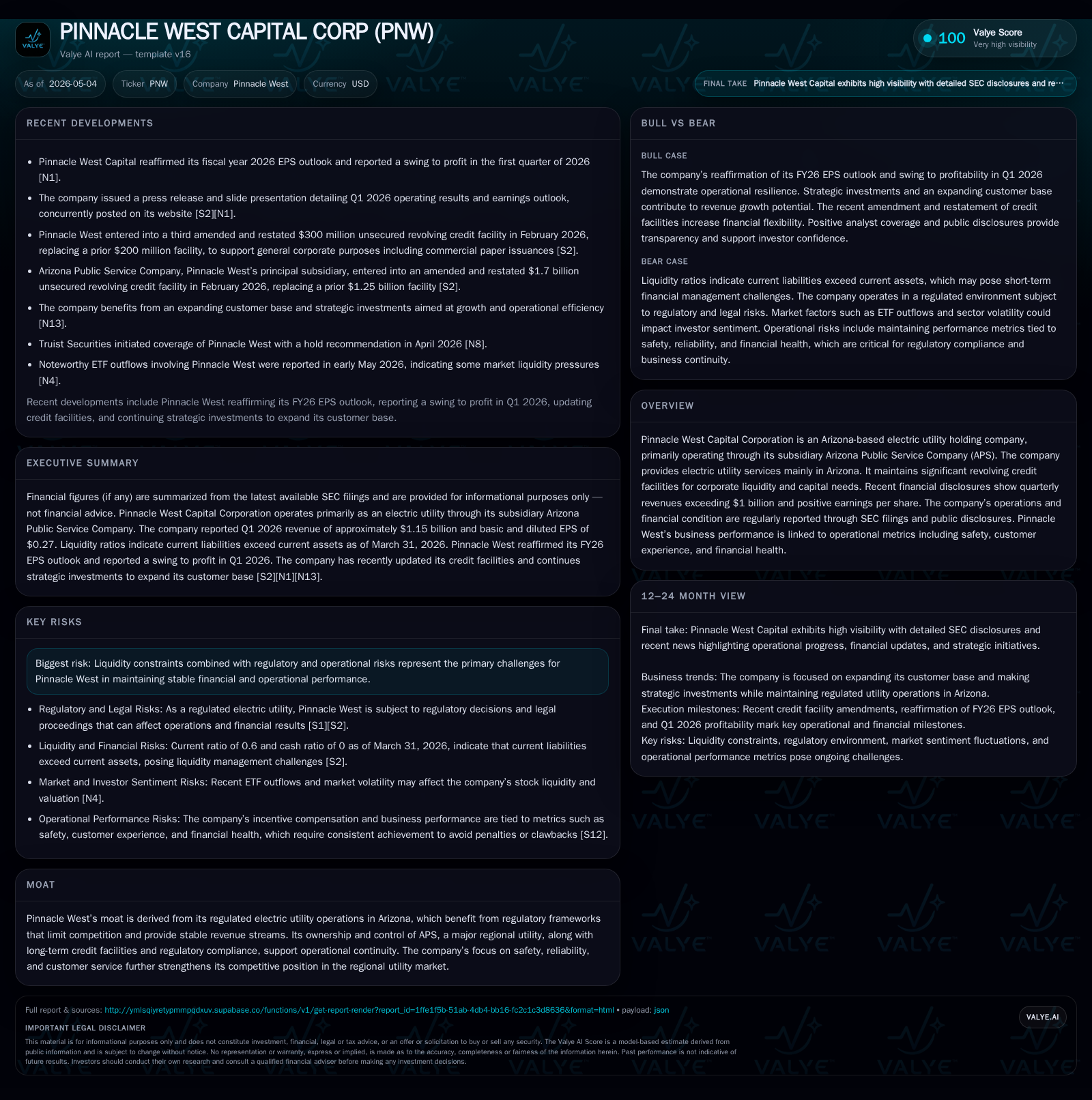
Pinnacle West Capital Corporation reported steady first-quarter 2026 results anchored by its core utility subsidiary, Arizona Public Service Company. The company increased its revolving credit facilities in early 2026, bolstering liquidity to support ongoing capital requirements and maintain operational continuity amid regulatory obligations. Pinnacle West’s business model centers on regulated electricity provision within Arizona, leveraging a defensible regulatory moat that supports predictable revenue streams. Growth drivers include rate base expansion, customer additions, and infrastructure modernization, while risks involve regulatory uncertainties and capital intensity. The company reaffirmed its earnings outlook for fiscal year 2026 during the May earnings release.
Recent Operating Update
Pinnacle West's latest quarterly filing for the period ending March 31, 2026 ([S2]) confirms continued operational stability through its wholly owned utility subsidiary, Arizona Public Service Company (APS). Revenues run above $5 billion annually as per the latest full-year snapshot data ([F1]). The company reported positive earnings per share and sustained strong cash flows necessary for maintaining its highly regulated infrastructure.
Notably, Pinnacle West enhanced liquidity early in 2026 by entering into a Third Amended and Restated unsecured revolving credit facility, increasing capacity from $200 million to $300 million and extending maturity to February 2031 ([S26]). This facility supports ongoing liquidity needs including backing commercial paper issuance and letters of credit for operational contingencies. Similarly, APS raised its own revolving credit facility to $1.7 billion from the prior $1.25 billion level with a similar maturity profile ([S27]). These moves indicate proactive balance sheet management tailored to fund capital expenditures crucial for grid resilience and regulatory compliance.
Alongside these corporate finance actions, the company issued an 8-K event filing on May 4, 2026 presenting a comprehensive earnings overview with reaffirmation of fiscal year EPS guidance amidst steady first quarter performance ([S3][N9]). This underscores management’s confidence during ongoing investment in electricity generation assets and network modernization initiatives.
Business Model
Pinnacle West Capital operates primarily as an electric utility holding company anchored by APS’s service territory across Arizona. Its revenues predominantly derive from regulated electric distribution and generation services billed to residential, commercial, industrial, and governmental customers under state-approved tariff structures ([S1]).
The company's business model emphasizes stable cash flow generation backed by regulatory commissions that approve rates providing reasonable return on invested capital. This framework shelters Pinnacle West from pure market price volatility seen in unregulated power sectors. Consequently, revenues and earnings are largely volume-driven with incremental drivers tied to population growth within Arizona’s expanding metropolitan corridors.
Margins are influenced by factors such as energy procurement costs, fuel mix efficiency (including nuclear and renewables integration), operational maintenance expenses, and regulatory decisions impacting allowed returns or infrastructure spending incentives ([S1]). Fuel procurement strategies combined with hedging agreements help moderate cost volatility. Effective risk management of these inputs is critical given the capital-intensive nature of utility investments.
Strong emphasis on safety protocols, reliability standards, and customer satisfaction reinforces Pinnacle West's standing with regulators and consumers alike — critical factors given the monopolistic nature within its service region.
Industry Structure and Competitive Position
The electric utility industry is characterized by high barriers to entry stemming from massive infrastructure requirements plus dense regulatory oversight at state level. Pinnacle West benefits structurally from Arizona’s regulatory environment that limits competition in power distribution while enabling stable returns via rate setting mechanisms ([S1]).
Competitively, Pinnacle West stands as a regional incumbent with significant scale operating within an established service territory that includes urban centers such as Phoenix. It faces limited direct competition but must navigate evolving regulatory expectations particularly around clean energy mandates and grid modernization.
Regulatory bodies enforce compliance rules tied to service quality metrics including outage frequency/duration benchmarks — compliance influences future rate cases directly affecting Pinnacle West’s revenue trajectory ([S22]).
Peers typically include other vertically integrated utilities concentrated in southwestern U.S., but Pinnacle West's unique combination of assets—such as nuclear facilities—and ongoing investment in renewable resources e.g., solar projects positions it well for long-term adaptability.
Growth Drivers
Key growth vectors for Pinnacle West center on:
- Customer Base Expansion: Arizona is experiencing population growth especially around Phoenix metro areas leading to increased electricity demand contributing volume uplift ([N8]).
- Capital Investment Program: Significant investments into grid upgrades including smart grid technologies increase system capacity and reliability while satisfying future regulatory clean energy targets.
- Renewable Energy Integration: Transition toward solar PV projects supported by state renewable portfolio standards is driving new asset additions coupled with nuclear generation providing baseload reliability ([S1]).
- Regulatory Rate Cases: Periodic approval of rate increases linked to prudent investment in infrastructure can augment allowed ROE thereby underpinning both revenue growth and margin stability.
Monitoring these factors will be critical as the company progresses through its multiyear strategic initiatives.
What to Watch Next
Upcoming milestones include:
- Q2 Earnings Confirmation: Following Q1 results released May 4, investors should track whether trends hold especially demand patterns during summer cooling season peak loads ([N9]).
- Capex Execution Updates: Progress reports on key infrastructure projects post Q1 filings will signal ability to manage costs amid broader economic conditions.
- Regulatory Filings: Outcomes of pending or planned rate case applications will directly inform revenue trajectories.
- Customer Growth Metrics: New customer connections data from APS provide leading indicators of volume expansion potential.
- Liquidity Positioning Updates: Any changes in revolving credit utilization or commercial paper programs bear watching given capital intensity demands ([S26][S27]).
Any material deviation on these fronts could foreshadow either upside opportunities or heighten downside risk profiles.
Financial Profile Snapshot (Q1 2026)
Latest financial snapshot
| Metric | Value | Period |
|---|---|---|
| Cash & equivalents | $6mm | |
| 2026-03-31 | ||
| Current assets | $1615mm | |
| 2026-03-31 | ||
| Current liabilities | $2.7bn | |
| 2026-03-31 | ||
| Current ratio | 0.6x | |
| 2026-03-31 |
Source: SEC companyfacts cache [F1].
Total debt figure is best-effort per latest available data point ([F1]), not explicitly confirmed current quarter balance sheet but useful for context.
Conclusion
Pinnacle West Capital occupies a strategically advantaged position within the regulated utility sector through exclusive service footprint within Arizona operated by APS. The recent enhancement of credit facilities providing greater liquidity buffers combined with a stable first-quarter operational performance reinforce confidence in executing long-term investment plans aimed at meeting growing demand and evolving regulatory expectations. Key focus remains on navigating regulatory processes efficiently while deploying capital effectively to sustain reliable electricity supply under increasingly stringent environmental guidelines. Careful monitoring of near-term execution outcomes alongside regulatory developments will be essential for assessing the trajectory of this capital-intensive but structurally secure business model.
Disclaimer: This analysis is for informational purposes only; it does not constitute investment advice or recommendations.
Disclaimer: This is research-only, informational analysis and not investment advice. It may include AI-generated interpretation and general industry context. Always verify important details using primary sources.

Comments