
Alexander's Inc Faces Revenue Pressures as Rego Park I Sale and Bloomberg Rent Abatement Shape Near-Term Outlook
Q1 2026 earnings reflect tenant concentration risks and portfolio repositioning amid ongoing lease transitions.
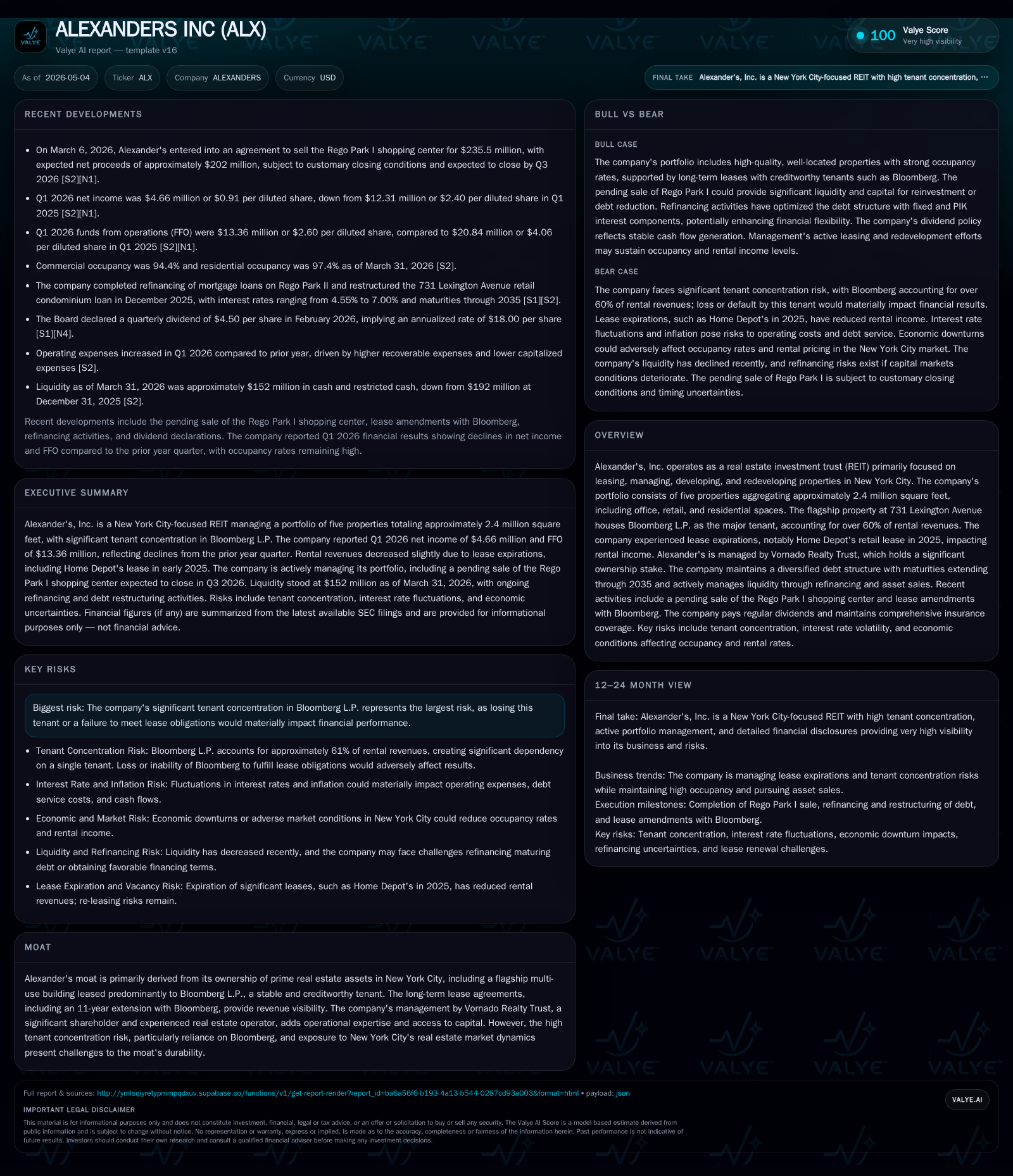
Alexander's Inc reported a sharp decline in Q1 2026 net income and FFO, driven by the absence of Home Depot's sizable lease revenue and a significant rent abatement granted to Bloomberg L.P. The company continues to rely heavily on Bloomberg as its anchor tenant, accounting for over 60% of rental revenues, underscoring tenant concentration risks. Portfolio adjustments include the pending sale of the vacant Rego Park I shopping center, with proceeds expected in Q3 2026. Despite these near-term impacts, strong occupancy rates and long-term lease extensions bolster revenue visibility, with liquidity supported by cash reserves and refinancing efforts.
Recent Operating Update: Q1 2026 Highlights
Alexander's Inc reported its first quarter results on May 4, 2026 [S2], disclosing a marked decline in profitability compared to the prior year period. Net income reached $4.7 million ($0.91 per diluted share), down sharply from $12.3 million ($2.40 per diluted share) in Q1 2025 [S2][S8]. Funds from operations (FFO), a key real estate performance metric excluding depreciation and other non-cash items, also sank significantly to $13.4 million or $2.60 per share versus $20.8 million or $4.06 per share previously [S12][S13].
This reduction reflects several key near-term operational headwinds that have reshaped revenue dynamics:
- The January 31, 2025 expiration of Home Depot’s substantial retail lease (83,000 sq ft) generated approximately $15 million in annual rental revenue previously [S2][S8]. This vacancy at the flagship retail portion of 731 Lexington Avenue has not been replaced.
- During Q1, Alexander's granted Bloomberg L.P., its largest tenant occupying nearly half the company's total portfolio area (~947,000 sq ft), a rent abatement totaling approximately $56.8 million through December 1, 2026 as part of an amendment to Bloomberg’s extended lease agreement [S13][S16].
- Concurrent with the lease amendment, Alexander’s established corresponding lender reserve accounts to manage receivables and debt service related to this tenant fund adjustment [S16].
- The company is progressing with the sale of its vacant Rego Park I shopping center in Queens for $235.5 million; net proceeds after closing costs (~$222.8 million) are expected by Q3 2026 [S13][S26][S9]. This divestiture will reduce portfolio diversification but focus capital deployment.
Despite these impacts on revenue scale and timing, overall commercial occupancy stood resilient at approximately 94.4%, with residential occupancy slightly higher at about 97.4% as of March-end [S2][S8]. This maintained high utilization mitigates some concerns around cyclical demand but leaves room for leasing growth.
Business Model Overview
Alexander's operates exclusively as a real estate investment trust specializing in ownership and leasing of prime properties concentrated primarily in New York City [S1]. The core business model hinges on stable income generation through long-term leases across office, retail, and residential assets totaling roughly 2.45 million square feet [S1][S2].
The company’s flagship asset is the multi-use building at 731 Lexington Avenue comprising approximately one-third of total portfolio square footage – including substantial office space (952,000 sq ft) leased entirely to Bloomberg L.P., retail space (128,000 sq ft) presently suffering vacancy post-Home Depot departure, and adjacency to other commercial tenants [S1][S15][S26]. Other properties include Rego Park II shopping center anchored by Costco among others, with Rego Park I currently vacant pending sale [S1][S9].
Alexander's derives rental revenues primarily from fixed base rents supplemented by recoveries of operating expenses where applicable [S12]. Tenant leases tend toward long duration; for example, Bloomberg extended its office leases from an original February 2029 expiration out eleven additional years to February 2040 in May 2024 [S13][S16]. However, variations such as tenant abatements (e.g., current Bloomberg rent relief) or expirations without replacements (e.g., Home Depot) create fluctuation in near-term cash flows.
Management services and property leasing are outsourced or managed by Vornado Realty Trust—a related party owning over a third of Alexander's shares—providing operational expertise and strategic oversight while maintaining tight alignment via stock ownership structure [S18][S27]. This relationship supports day-to-day execution but concentrates governance influence.
Industry Structure and Competitive Position
The New York City commercial real estate sector remains one of the most competitive yet prestigious markets nationally, marked by high demand for premium office spaces mixed with retail needs tied closely to urban economic cycles and corporate tenancy trends. Alexander's holds a defensible position via its concentrated ownership of iconic Manhattan real estate coupled with large-scale tenants like Bloomberg L.P., ensuring relatively stable occupancy and pricing power underpinned by creditworthy counterparties.
However, this advantage carries visible risks:
- Heavy dependence on a single tenant (Bloomberg) exposes Alexander's to significant concentration risk; any disruption could materially undermine rental income.[S1][S2]
- Retail space vacancies reflect broader challenges facing physical retail formats amid e-commerce acceleration and shifts in consumer behavior impacting secondary leasing prospects.
- Lease inducements like tenant funds or abatements shape near-term revenue negatively despite their role in securing longer-term tenancy stability.
Nonetheless growth tends toward structural steadiness rather than rapid expansion given limited property count and market maturity; upside primarily arises via active asset management rather than significant new development presently.
Risks and Constraints
Key watchpoints curtailing upside include:
- Tenant Concentration Risk: With Bloomberg representing around 61% of total rental income even following ongoing landlord concessions, any impairment or decision not to renew represents a critical threat to both revenue scale and credit reliability [S2][S8].
- Retail Vacancy Challenges: Losses like Home Depot’s lease termination underscore difficulties replacing major box tenants in urban retail environments amid shifting market preferences.
- Rent Abatements & Lease Incentives: While supportive of retention during turbulent periods (e.g., Bloomberg’s rent holiday through Dec ’26), these incentives materially depress near-term revenues impacting earnings quality.
- Interest Rate Sensitivity: Float-linked mortgages adjusted on benchmark rates imply volatility in debt-service costs absent hedging structures; refinancing risk persists despite recent restructurings extending maturities into next decade [S18][S22].
- Limited Geographic Diversification: Concentration solely within New York City limits exposure breadth; localized economic downturns could disproportionately impact Alexanders compared with more regionally diversified REIT peers.
What To Watch Next
Milestones that will clarify operational momentum include:
- Completion of Rego Park I Sale: Expected closing around Q3 2026, which will free considerable capital resources while removing vacant property drag on financial metrics [S13][S9].
- Bloomberg Lease Stability Post-Rent Abatement Period: Monitoring tenant ability to adhere under modified terms post-Dec ‘26 rent abatement period will indicate ongoing credit exposure levels [S16].
- Occupancy Trends Across Portfolio: Fluctuations could signal market demand shifts especially if replacement tenants emerge for expiring agreements aside from core anchor clients.
- Capital Expenditure Execution: Tracking deployment against expected $55 million capex target for asset maintenance/development advised in filings reveals commitment toward sustaining asset quality [S18].
- Dividend Policy & Cash Flow Generation: Given dividend payments are material uses of cash flow evident from recent financing activities; sustainability depends on operating FFO recovery following quarterly dips demonstrated recently [S6],[F1].
Financial Profile Snapshot
Latest financial snapshot
| Metric | Value | Period |
|---|---|---|
| Cash & equivalents | $76mm | |
| 2026-03-31 | ||
| Total debt | 0 USD | |
| 2025-12-31 | ||
| Net debt | $-76mm | |
| 2025-12-31 |
Source: SEC companyfacts cache [F1].
As of March 31, 2026, Alexander's held approximately $76 million in cash & equivalents per companyfacts data [F1], reflecting liquidity available after investment outlays. On balance-sheet terms, total debt was recorded as zero as of December-end due largely to intra-company eliminations tied to mortgage loan restructuring involving senior A-notes purchased internally—however underlying debt instruments persist primarily within structured junior notes accruing PIK interest offsetting headline debt figures per SEC disclosures from late 2025 filings [F1][S18][S22].
Operating expenses rose due predominantly to higher common area maintenance costs passed through leases plus lower capitalization rates affecting expense recognition metrics during Q1 versus prior year comparable periods [S12]. Interest expense remained stable against prior-year quarters partly reflecting refinancing benefits offset by swap expirations increasing effective rates [S12].
Concludingly, despite short-term earnings headwinds fueled by large lease expirations/abatements combined with asset sales altering portfolio composition, Alexander's retains substantial intrinsic value anchored by marquee NYC real estate assets leased chiefly under long dated contracts delivering occupancies well above market averages.
Disclaimer: This analysis is provided solely for informational purposes based on publicly available filings as referenced herein; it does not constitute investment advice or recommendations.
Disclaimer: This is research-only, informational analysis and not investment advice. It may include AI-generated interpretation and general industry context. Always verify important details using primary sources.

Comments