
Rithm Capital Corp. Reports Operating Nuances in Q1: Asset Management and Financing Dynamics
Rithm Capital’s Q1 2026 results reveal steady asset management fee streams driven by diversified portfolios amid financing market pressures.
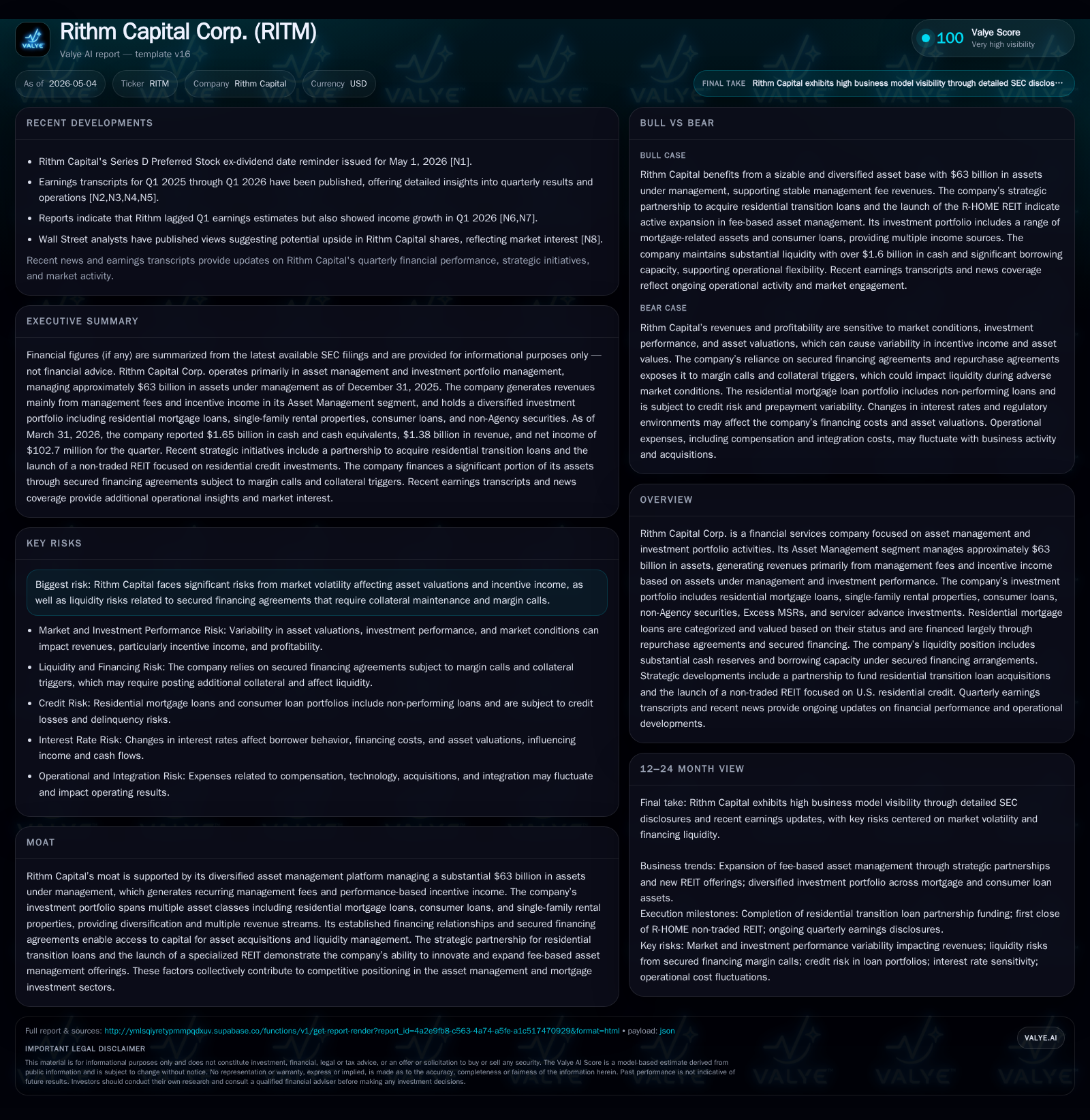
In its latest 10-Q filing dated May 4, 2026, Rithm Capital Corp. detailed operational performance that underscores its resilient asset management revenues partially offset by complexities in secured financing arrangements. Managing approximately $63 billion in assets under management (AUM), the company’s revenue generation blends recurring management fees with episodic incentive income linked to investment performance. The secured financing environment remains a critical factor given margin call risks and collateral valuation sensitivities. Strategic partnerships and product launches are positioned to drive future growth, though financing volatility and market sentiment remain key vulnerabilities.
Q1 2026 Operating Update: Revenue Drivers and Financing Highlights
Rithm Capital’s latest quarterly filing on May 4, 2026 [S2] illuminates steady asset management revenues anchored to approximately $63 billion assets under management as of the end of 2025 [S1]. Management fees continue to provide a reliable baseline since they are generally calculated as a percentage of AUM or invested capital and recognized quarterly. However, incentive income—which is performance-based and subject to crystallization events—remains variable in timing and scale, creating fluctuations in reported earnings across quarters [S1]. The company’s MD&A stresses that the recognition of incentive income depends heavily on the performance realization stage within respective funds or vehicles.
Operationally notable is the reaffirmation of sufficient liquidity reflected by cash and equivalents approximating $1.65 billion at March 31, 2026 [F1]. This cash position supports ongoing portfolio acquisitions and satisfies margin call buffer requirements under secured financing agreements. The April 28, 2026 8-K filing [S3] further confirms no disruption in preferred stock dividends or CFO changes, implying stable governance amidst prevailing market uncertainties.
Business Model and Product Mix: Diversification Across Asset Classes
Rithm Capital’s business model predominantly revolves around two synergistic revenue streams: recurring management fees charged on AUM and variable incentive income contingent on investment performance [S1]. The foundation lies in managing a diversified pool valued near $63 billion encompassing residential mortgage loans (both performing and non-performing), single-family rental properties, consumer loans, non-Agency securities (which include fixed- and floating-rate instruments), Excess Mortgage Servicing Rights (MSRs), and servicer advance investments.
Such diversification offers multiple revenue touchpoints: recurring fees generate steady cash inflows less sensitive to short-term market movements, while incentive income introduces complexity due to recognition lag tied to fund performance cycles [S1]. The mortgage-related assets require nuanced financing structures involving repurchase agreements typically collateralized by the underlying securities. These repurchase agreements are subject to daily mark-to-market valuations with margin calls triggered by declines in collateral values or regulatory capital framework shifts affecting lenders’ appetite. This operational layering creates a delicate balance between leveraging assets for yield generation while managing liquidity risk associated with collateral haircuts.
Industry Context: Competitive Dynamics and Financing Environment
Within asset management players focused on residential mortgage-backed assets and credit strategies, Rithm Capital competes by leveraging internal advisory expertise combined with established servicing platforms like Genesis [S1]. The competitive advantage includes long-standing relationships with investment banks and lending counterparties enabling access to multiple secured financing arrangements [S7]. However, short-term nature of these repos introduces refinancing risk especially in periods of heightened market volatility.
Regulatory developments such as Ginnie Mae's Risk-Based Capital Ratio requirements impose higher capital retention mandates for loan sellers and servicers—including non-bank entities like Rithm—constraining liquidity deployment flexibility [S8,S20]. Lenders correspondingly impose stricter eligibility criteria on assets they accept as collateral along with increased haircuts contributing to potential margin call pressures [S4,S9].
Growth Catalysts: Strategic Partnerships and Product Innovation
A pivotal growth opportunity is Rithm’s strategic partnership announced in Q3 2025 with a major institutional backer targeting acquisition funding for up to $500 million initially—and potentially $1.5 billion over time—of residential transition loans managed by Rithm Advisers [S1,S15]. This initiative broadens the fee-bearing asset base leveraging Rithm’s operational platform without increasing balance sheet leverage directly.
Complementing this is the launch of R-HOME, a non-traded REIT focused on U.S. residential and household credit investments also managed by Rithm Advisers [S15]. This product innovation aims at scaling recurring fee income streams independent from market-dependent incentive fees.
Together these moves indicate a strategic push toward expanding fee-generating vehicles which should help stabilize revenue visibility over coming periods despite external financial market gyrations.
Risks and Constraints: Market Volatility and Funding Dependence
The company continues to face pronounced risks stemming from collateral valuation volatility impacting both asset values underpinning its portfolios and the secured financing mechanisms [S16]. Margin calls related to approximately $13.8 billion face amount in secured financing agreements require prompt liquidity provisioning which could pressure cash resources if adverse movements occur rapidly [S7]. Meanwhile, incentive income unpredictability tied to performance crystallization weighs on quarterly earnings consistency.
Additionally, FHFA and Ginnie Mae capital/liquidity regulations necessitate maintaining tangible net worth thresholds plus incremental buffer requirements based on servicing portfolio scale—non-compliance could trigger restrictive supervisory actions reducing operational flexibility [S20]. Market interest rate fluctuations exert dual effects—influencing borrower prepayment behavior (affecting loan performance assumptions) while also altering funding costs for repurchase agreements as borrowing spreads shift relative to SOFR benchmarks [S14,S28].
Investor sentiment swings can accelerate capital redemptions or slow inflows, weighing on AUM growth which directly modulates base fee revenue levels [S1]. These factors together enforce a watchful stance regarding funding availability continuity alongside sustained portfolio performance metrics.
Forward-Looking Considerations: Key Upcoming Milestones and Indicators
Monitoring trends in AUM growth or contraction remains paramount since it sets the revenue baseline through management fees. Equally important is tracking the pace at which performance-based incentive income crystallizes within respective investment vehicles—a key driver behind reported net income variability from quarter-to-quarter [N4][S2].
Closely observing refinancing terms for short-duration secured financings will reveal how tightening lending conditions may affect access costs or collateral requirements amid macroeconomic uncertainty. Any significant depreciation in collateral prices triggering margin calls could constrain acquisition activity or force asset sales impacting both top-line volumes and future earnings stability.
Finally, progress updates from strategic initiatives such as expanded partnership funding draws or scaling of new REIT offerings will serve as milestones indicating successful growth execution beyond current base operations.
Concise Financial Overview: Balance Sheet and Liquidity Snapshot
At quarter-end March 31, 2026, Rithm Capital held cash & equivalents near $1.65 billion providing a liquidity buffer critical for managing short-term margin calls inherent in its approximately $13.8 billion secured financing commitments outlined previously [F1][S7][S2]. Although total debt figures available are dated (2014 figure shows $6.06 billion total debt) [F1], current filings confirm ongoing compliance with all debt covenants without material disruptions reported through early 2026 [S2][S3].
The company’s reliance on short-term repurchase agreement structures exposed to daily market valuations demands robust treasury oversight to ensure continuous access to refinancing and readiness for collateral postings should adverse conditions arise domestically or globally.
Disclaimer: This analysis is informational only, based solely on disclosed public filings as cited; it does not constitute financial advice or recommendations. Investors should conduct further due diligence before making any decisions related to Rithm Capital Corp.
Disclaimer: This is research-only, informational analysis and not investment advice. It may include AI-generated interpretation and general industry context. Always verify important details using primary sources.

Comments