
Tanger Inc. Advances Portfolio with Outlet and Lifestyle Expansion Amid Refinancing Focus
Tanger Inc.'s latest quarter highlights strong leasing growth and acquisitions, supporting its outlet-centered retail real estate model.
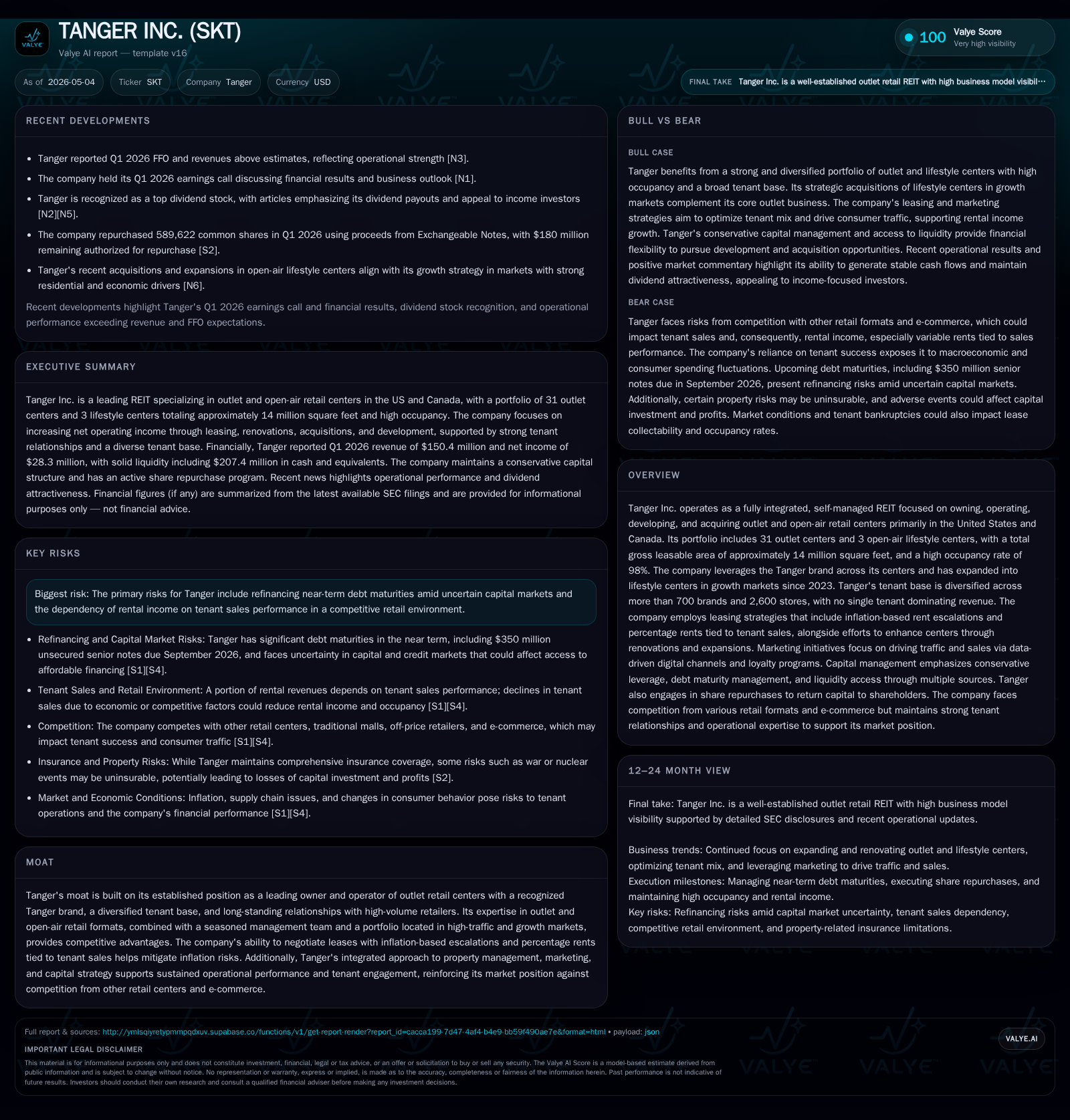
In Q1 2026, Tanger Inc. reported strong rental revenue driven by leasing gains and recent acquisitions amid ongoing share repurchases and refinancing activities. Operating as a self-managed REIT specializing in outlet and open-air lifestyle centers, Tanger leverages its portfolio of 34 consolidated centers to sustain high occupancy and diversified tenant sales-based rent structures. The company’s competitive moat stems from the Tanger brand's recognition and expertise in outlet retail formats across high-traffic U.S. and Canadian markets. Growth is anchored by strategic acquisitions, center renovations, and inflation-linked lease escalations, while key risks include near-term debt maturities and reliance on tenant sales performance under e-commerce pressures.
Recent Operating Update: Resilient Leasing and Strategic Acquisitions
Tanger Inc.'s latest quarterly report for Q1 2026 illustrates solid operating momentum anchored by leasing activity and portfolio growth. Total revenue reached approximately $150.4 million, reflecting a continuation of robust rental trends supported by new leases averaging over $39 per square foot—a notable +9.3% increase in cash rent spreads on comparable leases during 2025 [F1][S1][S2]. This speaks to the durability of demand within Tanger's core outlet retail centers despite broader retail sector challenges.
The company also marked significant acquisitions during the prior year including a prominent open-air mixed-use retail center in Cleveland, Ohio (640k sqft) acquired in early 2025, alongside the Kansas City outlet center (690k sqft) procured later that year [S1][S6]. These additions not only increased gross leasable area but enhanced the geographic diversity across key markets attractive to value-conscious shoppers.
Additionally, Tanger has executed share repurchases in the first quarter of 2026 totaling nearly $20 million under an expanded $200 million buyback authorization granted in mid-2025. The use of privately negotiated transactions at an average price near $33.92 per share signals management's commitment to capital return while supporting stock liquidity [S2].
On financing frontiers, the Operating Partnership issued $250 million of Exchangeable Senior Notes due 2031 at a low fixed coupon rate of 2.375%, embedding capped call options to mitigate shareholder dilution risk upon note conversion—a sophisticated capital markets move illustrating balance sheet prudence during rising rate environments [S17][S18]. Net debt stood at approximately $1.66 billion after factoring cash reserves of about $207 million at March-end, positioning Tanger with manageable leverage though underscored by a substantial maturity of unsecured senior notes ($350 million) looming in September 2026 [F1][S9].
Business Model: Outlet-Centric REIT with Integrated Operations
Tanger operates as a fully integrated, self-managed real estate investment trust focused primarily on owning, operating, and developing outlet centers coupled with select open-air lifestyle retail assets in the U.S. and Canada[S1]. As of late-2025, its aggregated portfolio comprised 31 consolidated outlet centers alongside three lifestyle centers totaling around 14 million square feet of gross leasable area with sustained occupancy near 98%—indicative of strong tenant retention and asset desirability.
Revenue principally derives from rental income paid by tenants occupying over 2,600 stores representing more than 700 brands. Key to its revenue mechanics is a hybrid leasing approach combining fixed base rents indexed to inflationary escalations plus percentage rents linking landlord income directly to tenant sales volumes—a structure that aligns interests but embeds some vulnerability to retail performance cycles [S1]. Tenant diversity mitigates concentration risk; no single retailer dominates the income stream.
Leasing activity is supplemented by targeted renovations, expansions, and outparcel developments that aim to enhance consumer foot traffic and dwell time—crucial for both tenant success and property valuation appreciation[S1]. Marketing initiatives increasingly incorporate data-driven customer engagement strategies tailored to outlet shoppers’ preferences.
Capital deployment balances acquisition opportunities—recently evident with large market-center purchases—and internal capital spend focusing on modernization projects poised to maintain outlets’ competitive edge against evolving consumer behavior patterns including e-commerce competition [S6].
Industry Structure & Competitive Position
In the competitive landscape encompassing traditional malls, off-price retailers, pure e-commerce platforms, and other outlet proprietors, Tanger's moat lies in its dominant brand presence within outlet formats and strategic geographic coverage focused on high-traffic tourist and demographic growth corridors[S9]. Its well-established relationships with national retailers facilitate strong lease negotiations leveraging rent escalations linked to inflation while capturing upside through percentage rent clauses tied to tenant sales performance.
Competition has intensified from institutional investors targeting retail real estate as a core asset class; however, Tanger's integrated property management capability coupled with curated lifestyle elements diversifies its consumer appeal beyond basic discount shopping. This positions Tanger favorably against commoditized retail spaces lacking brand-driven traffic flows or experiential retail components.
Growth Drivers
Portfolio Expansion & Asset Enhancement
The pathway for organic growth remains firmly rooted in selective acquisitions that complement existing markets or enter high growth catchments such as the Cleveland mixed-use center addition and Kansas City's premier outlet hub[S6]. Further development ventures continue—with projections carrying into increased capex budgets (~$120 million forecasted for 2026)—centered around redevelopment initiatives aimed at tenant mix optimization and enhanced shopper experiences[S12].
Lease Rollover & Rate Escalations
Leasing metrics indicate upward trajectory in lease rates evidenced by new lease initial rents increasing 9–10% year-over-year accompanied by lengthened average lease terms (4.4 years), improving rental income predictability[S1]. Inflation-based escalators embedded within leases provide natural hedge mechanisms against input cost pressures enhancing cash flow stability.
Marketing & Consumer Engagement
Enhanced digital marketing platforms enable Tanger to drive visitation frequency leveraging behavioral analytics—an emerging competitive advantage given shifts toward omni-channel retailing hybridizing physical store visits with online commerce.
Risks & Watchpoints
Debt Maturity Concentration & Refinancing Risk
Near-term refinancing demands notably include unsecured senior notes totaling $350 million due September 2026—posing potential liquidity strain should capital markets tighten unexpectedly or borrowing costs spike beyond current hedges[S9][F1]. While management’s recent term loan extensions along with significant cash reserves provide buffer capacity, vigilance is required.
Tenant Sales Volatility & Retail Environment Dynamics
Given percentage rents are tied directly to tenant sales output, softer consumer spending or retailer bankruptcies could materially impact rental income streams creating earnings volatility[S15]. The rise of e-commerce continues reshaping shopper behavior which may exert pressure on physical outlet visitation absent continuous innovation.
Competitive Pressure & Consumer Preferences Shifts
Competition from newer lifestyle centers or other experiential retail concepts may erode market share unless Tanger’s ongoing investments resonate effectively with evolving shopper priorities.
What To Watch Next
- Execution on planned renovations and redevelopments slated through late 2026 will provide tangible evidence on sustaining or growing foot traffic metrics.
- Leasing velocity data on renewals vs expirations alongside initial rent spreads will serve as leading indicators of demand resilience amid macroeconomic uncertainties.
- Near-term refinancing outcomes for September 2026 senior notes constitute critical milestones impacting capital structure outlook.
- Impact assessment from share repurchases will elucidate balance between shareholder returns versus preservation of financial flexibility.
- Tenant sales reports published post-quarterly filings could signal health of revenue streams given percent rent exposure.
Financial Profile Contextualized
Latest financial snapshot
| Metric | Value | Period |
|---|---|---|
| Cash & equivalents | $207mm | |
| 2026-03-31 | ||
| Total debt | $1866mm | |
| 2026-03-31 | ||
| Net debt | $1658mm | |
| 2026-03-31 |
Source: SEC companyfacts cache [F1].
As of March 31, 2026, Tanger reported cash and equivalents totaling approximately $207 million against total debt nearing $1.87 billion resulting in net debt around $1.66 billion—reflective of moderate leverage consistent with REIT industry peers[F1]. Revenues for Q1 stood at about $150.4 million while net income reached $28.26 million highlighting ongoing profitability amidst incremental acquisition-related expenses[F1][S2].
Debt financing structure includes recent refinancings extending maturity horizons via unsecured term loans due December 2030 (amended) and January 2033 (new) priced at favorable SOFR+ margins alongside interest rate swaps fixing costs near mid-3% levels providing interest expense predictability[S7][S8]. The embedded flexibility under lines of credit coupled with ATM equity sale authorization (remaining capacity circa $400 million) underpin capital agility.[S20]
Dividend policy remains consistent with REIT mandates distributing over 90% taxable income which necessitates robust free cash flow generation supported through rental revenues backed by stable occupancy[S16]. Continued monitoring of payout ratios vis-à-vis FFO is prudent given distributable income sensitivity to variable rent fluctuations.
This analysis is based exclusively on publicly available filings as noted without extrapolating unpublished financial metrics or projecting future performance outside disclosed guidance. It is intended as an operational business overview without recommendation for investment decisions.
Disclaimer: This is research-only, informational analysis and not investment advice. It may include AI-generated interpretation and general industry context. Always verify important details using primary sources.

Comments