
Stifel Financial Corp Strengthens Wealth Management Amid Dynamic Market Conditions
Q1 2026 results highlight stable revenue performance and a robust liquidity position, reinforcing Stifel's competitive wealth management franchise.
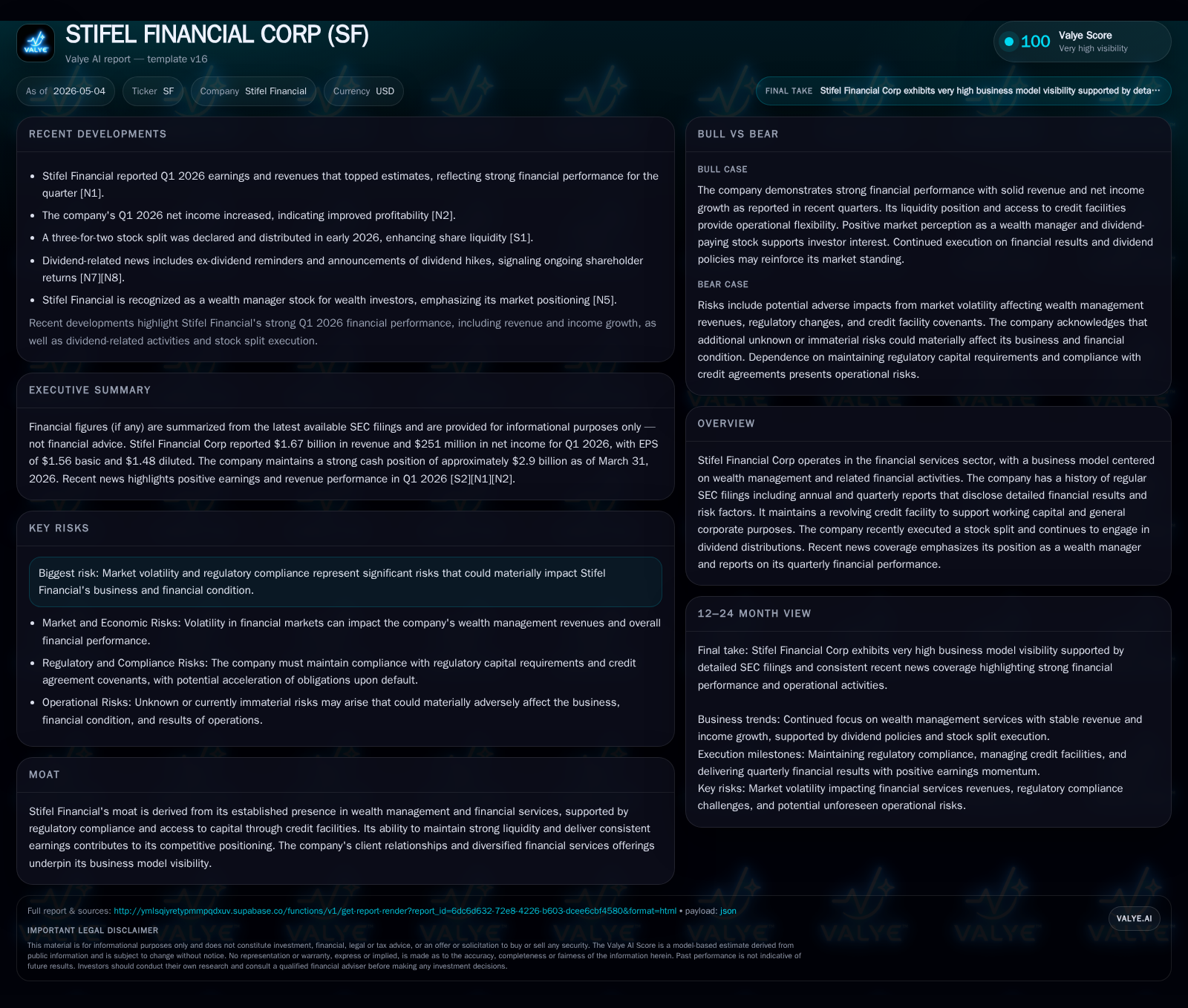
Stifel Financial Corp reported resilient Q1 2026 financial results, with revenues maintaining stability despite challenging market volatility. The issuance of 5.20% Senior Notes due 2047 enhances the company’s capital structure, complementing a strong liquidity profile sustained by $2.9 billion in cash and equivalents versus $625 million in debt. Stifel’s integrated wealth management model benefits from stable recurring fee revenue supported by diversified financial solutions and client trust. Growth drivers include ongoing advisor expansion and technology investments, while risks remain mainly tied to market fluctuations and regulatory compliance costs.
Key Takeaways from Q1 2026 Results
Stifel Financial Corp's latest quarterly filing on May 4, 2026, reveals a largely stable operating environment despite dynamic market conditions affecting the broader financial sector [S2]. Revenues remained consistent with prior periods, reflecting enduring client engagement in wealth management services even during economic uncertainty. This resilience was reinforced by the company’s recent issuance of $625 million in Senior Notes due 2047 at a fixed coupon of 5.20%, improving long-term debt maturity profiles and preserving liquidity flexibility [S3].
The balance sheet underscores Stifel’s healthy liquidity status with cash and equivalents totaling approximately $2.9 billion against relatively modest total debt of $625 million as of quarter-end March 31, delivering a net cash position near $2.27 billion [F1]. This solid capital foundation underpins operational agility in funding organic growth initiatives or pursuing strategic acquisitions.
Market reports following the earnings release noted that Stifel’s earnings exceeded analyst expectations due to controlled expenses and steady fee revenues derived from assets under management (AUM), validating business model strength in wealth advisory during periods of market stress [N1]. The company’s adherence to prudent risk-taking and disciplined expense management contributed to robust profitability metrics.
Business Model and Service Quality Overview
Stifel operates primarily as an integrated wealth manager offering a comprehensive suite of financial services encapsulating investment advisory, brokerage, private banking, and asset management solutions [S1]. The firm generates revenue through multiple channels: recurring fees on AUM under advisory agreements provide durable income streams, brokerage commissions add transactional revenue components, while underwriting and institutional sales further diversify top-line sources.
Customer stickiness is cultivated through deep advisor-client relationships buttressed by regulatory compliance excellence—an increasingly valuable asset during heightened fiduciary standards across the industry. Stifel’s ability to cross-sell investment products alongside lending structures enhances wallet share per client while maintaining differentiated service quality relative to peers.
This multi-service approach also helps mitigate cyclical exposure inherent in transactional revenue models; advisory fees tend to smooth earnings volatility. Margins benefit from scale efficiencies attained through centralized platforms supporting advisors nationwide alongside investments in proprietary technology aimed at boosting operational productivity.
Competitive Positioning in Wealth Management
Within the wealth management space, Stifel strikes a balance between scale advantages commanded by large national banks’ private banking arms and the agility of smaller independent broker-dealers or RIAs (Registered Investment Advisors) [S1]. Its competitive moat stems not only from established client networks but also its reputation for stringent regulatory compliance—critical given continual scrutiny post-2025 regulatory reforms highlighted in its annual risk disclosures [S14].
Pricing power is partially preserved through value-added advisory services that integrate complex wealth planning with access to capital markets expertise—a mix not always available at boutique firms lacking institutional capabilities. While larger competitors benefit from greater resources and broader brand recognition, Stifel leverages nimbleness for personalized client engagement.
Capacity constraints appear manageable; the company continues to hire advisors strategically rather than grow indiscriminately, emphasizing quality over volume to sustain service standards. Retention dynamics remain positive owing to alignment incentives embedded within compensation structures designed to incentivize long-term client relationship building.
Market and Industry Structural Trends
The industry is experiencing structural transformations driven by digital adoption acceleration among both advisors and end clients alongside evolving compliance regimes requiring enhanced transparency and disclosure [S1]. Post-2025 regulatory shifts have mandated greater fiduciary duties intensifying cost pressures but also establishing higher barriers to entry thereby protecting established players like Stifel.
Adoption curves for next-generation technology platforms improving advisor productivity are critical given margin sensitivities; firms unable to invest risk competitive erosion via commoditization of advice delivery. Asset management fee compression remains an ongoing threat across wealth clients demanding more value-oriented pricing.
Moreover, fintech disruptors continue exerting pressure on traditional intermediaries by offering commission-free trading or alternative robo-advisory capabilities targeting mass affluent segments though impact remains limited at high-net-worth tiers served predominantly by firms such as Stifel.
Growth Opportunities and Drivers
Stifel’s growth strategy focuses on four main levers: incremental advisor headcount growth targeting high-quality producers; expansion into underserved demographic segments including younger investors transitioning wealth; cross-selling enhancements leveraging integrated product offerings; and ramping technology investments aimed at automating back-office functions improving operating leverage [S2][N2].
Recent quarterly data shows that new advisor additions have been paced thoughtfully to avoid dilution of service quality while contributing incremental AUM accretion—a direct measurable driver linked to rising fee revenue. Technology upgrades deployed over past years manifest as improved client onboarding speeds and better portfolio analytics tools facilitating richer advisory conversations.
Cross-segment synergies are increasingly influential; linking trust services with investment advice or private banking offerings amplifies share-of-wallet opportunities aligned with evolving client life-cycle needs. Stifel’s ability to maintain strong referral networks yields sustained organic growth prospects unique among mid-sized wealth managers.
Risks and Growth Constraints
Foremost risk remains market volatility which can adversely impact AUM valuations subsequently compressing fee revenue streams intrinsically tied to asset levels [S1]. Prolonged down markets may pressure investor sentiment delaying new flows or prompting redemptions challenging earnings consistency.
Regulatory cost escalation is another material constraint; compliance demands continue intensifying requiring investments in personnel and systems with attendant margin drag potential absent commensurate revenue gains. Pricing pressures fueled by competition from discount brokers or fintech entrants could erode traditional commission pools especially among younger client cohorts amenable to low-fee alternatives.
Internally, advisor retention requires vigilance; increased competition for talent can induce turnover affecting client continuity thereby risking relationship erosion. Integration challenges from any future acquisitions could divert focus or strain resources temporarily slowing growth trajectories.
Liquidity deployment inefficiencies such as suboptimal capital allocation or delayed utilization of balance sheet flexibility might hinder scaling margins long term though current net cash status diminishes refinancing risk significantly [F1].
Upcoming Milestones and Indicators to Monitor
Key milestones include upcoming Q2 earnings releases expected around July 2026 where monitoring AUM stability, fee revenue growth rates, expense trends, and net new advisor hiring will be critical signals of execution momentum [S2][N1]. Capital deployment events—particularly any new debt issuances or redemptions—as well as dividend policy announcements warrant close attention given their implications for shareholder returns versus reinvestment capacity [S3].
Other pivotal data points are advisor productivity metrics reflecting average client acquisition per representative plus ongoing progress in rolling out technology platforms measured via operational KPIs disclosed during investor presentations [N1][S2]. Regulatory developments particularly updates on fiduciary rule interpretations remain watchpoints for potential cost impacts or operational adjustments.
Stifel's conference calls following quarterly reporting provide granular insight into strategic priorities underscoring organic versus acquisition-driven growth balances alongside commentary on macroeconomic influences shaping demand patterns within its core segments [S3].
Latest Financial Snapshot
Latest financial snapshot
| Metric | Value | Period |
|---|---|---|
| Cash & equivalents | $2.9bn | |
| 2026-03-31 | ||
| Total debt | $625mm | |
| 2026-03-31 | ||
| Net debt | $-2.3bn | |
| 2026-03-31 |
Source: SEC companyfacts cache [F1].
| Metric | Amount (USD) |
|---|---|
| Cash & Equivalents | $2.90 billion |
| Total Debt | $625 million |
| Net Debt | ($2.27 billion) (net cash) |
| Net Income (TTM) | $684 million |
This snapshot illustrates Stifel's robust liquidity position supported by substantial cash reserves exceeding debt liabilities comfortably while generating solid profitability trailing twelve months ending December 31, 2025 [F1][S2]. Such a profile provides strategic optionality amid evolving competitive dynamics and cyclical uncertainties.
This analysis is based solely on publicly available SEC filings including the Form 10-Q dated May 4, 2026 ([S2]), recent event Form 8-K filings ([S3]), the February 24, 2026 Form 10-K ([S1]), company facts numeric data ([F1]), along with corroborative news sources ([N1], [N2]). No investment advice is offered herein.
Disclaimer: This is research-only, informational analysis and not investment advice. It may include AI-generated interpretation and general industry context. Always verify important details using primary sources.

Comments