
AGNC Investment Corp. Recalibrates Portfolio Amid Interest Rate Pressures
The latest quarterly filing reveals AGNC's strategic adjustments and the impact of prevailing rate volatility on its mortgage-backed securities portfolio.
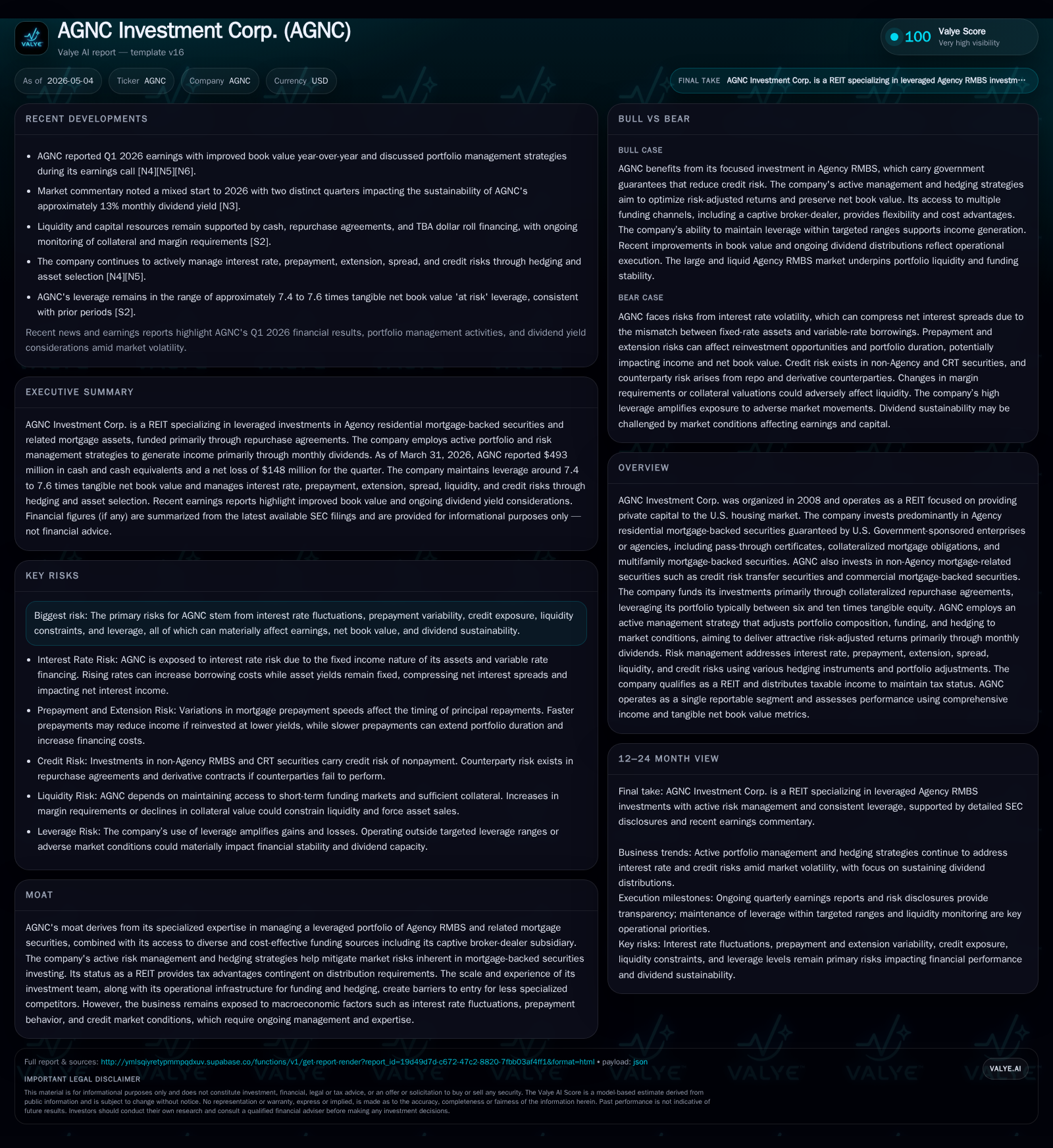
AGNC Investment Corp.'s first quarter 2026 results depict a measured decline in tangible net book value amid continued economic headwinds from rising interest rates. The company maintains a high leverage ratio close to 7.4 times equity while managing a sizable portfolio concentrated in Agency RMBS and leveraging active hedging strategies. Strategic issuance of common equity bolstered liquidity, offsetting market pressures, though mark-to-market losses suppressed net income and economic returns in the quarter. Continued sensitivity to interest rate movements and prepayment variability underscore persistent risks inherent in AGNC’s model, while its scale, financing access, and dynamic risk management remain key competitive advantages.
Latest Quarterly Operating Update Highlights
In its Q1 2026 filing dated May 4, AGNC reported a tangible net book value (TNAV) per common share of $8.38 as of March 31, down from $8.88 at December-end 2025 [S2]. This decrease corresponds with an economic return on tangible common equity of -1.6%, comprised of a $0.36 quarterly dividend payout offset by a $0.50 decline in TNAV per share [S2][S3]. The firm's investment portfolio fair value expanded marginally to $94.7 billion including the net forward positions in the To-Be-Announced (TBA) market [S3]. Leverage remained stable with a tangible net book value 'at risk' ratio steady at 7.4 times as of quarter-end [S3].
Despite growth in portfolio size facilitated by additional equity capital—$401 million raised through At-the-Market offerings—AGNC experienced mark-to-market losses that weighed heavily on net income performance during the quarter [S2][S3]. Economic pressure was largely driven by interest rate increases that suppressed asset valuations and widened spreads in mortgage credit markets.
Cash and unencumbered Agency MBS totaled approximately $7.0 billion providing liquidity buffers [S3]. This capital position supports ongoing leverage deployment while cushioning against repo market volatility.
Business Model and Portfolio Composition
AGNC operates as an internally managed Real Estate Investment Trust (REIT) specializing predominantly in Agency residential mortgage-backed securities (RMBS) guaranteed by U.S. Government-sponsored enterprises (GSEs) such as Fannie Mae and Freddie Mac [S1]. The company's assets encompass pass-through certificates, collateralized mortgage obligations (CMOs), multifamily RMBS issued or guaranteed by GSEs or U.S. agencies such as Ginnie Mae, alongside selective non-Agency credit risk transfer (CRT) instruments and commercial mortgage-backed securities (CMBS) [S1].
Revenue is generated primarily from the interest income on these backed securities minus borrowing costs incurred from financing activity structured mainly through repurchase agreements (repos). These repos are short-dated borrowings collateralized by the portfolio securities themselves [S1]. AGNC leverages between six and ten times tangible equity via this collateralized funding framework.
Further revenue contributions stem from net realized gains or losses on sales of securities alongside derivative-driven hedges designed to manage market risks—particularly interest rate risk—embedded within the portfolio [S1]. The firm's investment strategy focuses on active management to adapt portfolio composition dynamically based on evolving yield curves, spread opportunities, prepayment speed forecasts, and funding cost conditions.
A key component is AGNC’s proprietary brokerage platform, Bethesda Securities LLC, which provides access to diverse collateralized funding pools including bilateral repo markets and clearinghouse-supported General Collateral Finance (GCF) repo mechanisms [S1][S16]. This operational infrastructure enhances funding flexibility and cost efficiency relative to competitors relying on more traditional sources.
Industry Framework and Competitive Environment
AGNC operates within the U.S. residential mortgage-backed securities sector—a market dominated by Agency RMBS with government guarantees effectively backstopping principal repayment risk [S1]. This structural credit support underpins the product’s acceptability among institutional investors while constraining credit loss volatility relative to unguaranteed non-Agency bonds.
Competitively, AGNC stands alongside other publicly traded mortgage REITs such as Annaly Capital Management and Redwood Trust which also deploy leverage to invest in Agency RMBS portfolios [N2][N1]. AGNC’s competitive moat arises from its scale, capital access via Bethesda Securities’ broker-dealer credentials providing diversified repo channels, and seasoned asset-liability management expertise harnessing complex hedging instruments.
Regulatory frameworks favor REIT structures by granting tax advantages contingent on mandatory distribution of taxable income [S1], incentivizing yield-focused investors attracted by payout consistency amidst cyclical volatility in mortgage markets.
Federal Reserve monetary policy critically influences demand-supply dynamics for Agency MBS; changes in policy rates directly affect repo costs, asset yields, prepayment incentives among borrowers (affecting cash flow timing), and ultimately AGNC's earnings profile [S1].
Growth Catalysts and Strategic Initiatives
AGNC’s growth hinges on optimizing portfolio mix toward higher coupon specified pools within Agency RMBS while adapting non-Agency allocations for incremental yield premiums balanced against credit risk tolerance [S2][N4]. The expansion of the TBA portfolio enhances capacity for incremental dollar roll income opportunities—a source of financing carry benefiting from price differentials between forward settlement months.
Enhanced hedging sophistication targeting duration gaps near zero aims to mitigate adverse effects from rising rates or curve shifts that historically erode spreads via negative convexity inherent in mortgage-backed securities [S1][S2]. Dynamic repositioning around prepayment assumptions can unlock valuation improvements as current models adjust to evolving borrower refinancing patterns affected by macroeconomic factors.
Capital raises via At-the-Market offerings support balance sheet growth enabling incremental deployment into attractively priced assets when market dislocations emerge classically post-rate hikes or spread widening events [S3]. Maintaining leverage at sustainable levels aligned with risk appetite allows concurrent dividend stability—a critical factor for investor retention given REIT payout requisites.
Risks and Operational Constraints
Interest rate volatility is paramount among AGNC’s risks with negative convexity magnifying price sensitivity beyond duration measures alone; prolonged upward rate trends tend to compress spreads as fixed-rate agency passes become less attractive relative to funding costs indexed to floating benchmarks like SOFR [S1][N13]. Additionally, unpredictable prepayment speeds can disrupt hedge effectiveness; faster-than-assumed prepayments shorten asset lives resulting in reinvestment risk at potentially lower yields while slower prepayments extend durations adverse to liability costing models.
Exposure within non-Agency segments adds credit event uncertainty where principal protection lacks GSE backing necessitating vigilant underwriting monitoring amid potential housing credit deterioration phases [S1][S8]. Liquidity risks relate chiefly to repo market functioning where sudden contraction or haircuts could compel forced asset sales precipitously impacting NAV levels.
High embedment of 'at-risk' leverage (~7.4x tangible equity) compounds earnings volatility potential especially during periods marked by wide spread repricing or rapid macro shocks complicated further if capital market access tightens unexpectedly despite Bethesda Securities' diversified repo platforms currently mitigating single channel dependency [S2][S3][N13].
Dividend sustainability remains sensitive to taxable income generation given REIT distribution mandates; sustained NAV erosion absent regainful earnings threatens payout continuity which could undermine investor confidence [N13].
Key Milestones and What to Monitor Next
Focus areas over upcoming quarters include tracking TNAV trajectory for signs of stabilization or recovery post initial Q1 stress period, particularly monitoring whether economic returns improve above breakeven thresholds supporting dividend declarations [S2][N3]. Further capital raise activity will indicate management confidence in feeing attractive deployment avenues amid elevated funding costs.
Reduction of duration gaps via hedging adjustments should be assessed closely for effectiveness indications especially if Fed policy evolves countercyclically impacting mortgage spreads differently than prior cycles suggest [N4]. Expansion or contraction in net TBA positions acts as a gauge for strategic use of dollar roll transactions expanding carry revenue streams vis-à-vis outright bond purchases.
Watch evolving prepayment metrics reflective of borrower behavior under fluctuating mortgage rates—for instance accelerated refinancing windows or retention driven extensions—which directly affect hedge calibration precision impacting realized gains/losses reported quarterly.
Dividend yield policies will remain a litmus test for underlying earnings health correlated with stock price reaction given pronounced yield-seeking investor ownership base typical for mortgage REITs like AGNC.
Financial Profile: Current Snapshot and Implications
As supported by available data points through Q1 filings and company facts summary [F1], cash & equivalents stood at approximately $493 million at quarter-end March 31, 2026—a portion of total liquidity alongside unencumbered Agency MBS amounting collectively near $7 billion per disclosures [S3][F1]. The firm's reliance on repos remains pivotal—with outstanding borrowings aligned with strategic target leverage levels around 7.4x tangible common equity adjusted for goodwill exclusion consistent with prior periods indicating prudent balance sheet risk appetite maintenance rather than excessive expansionary posture [S2].[F1]
In conclusion, AGNC continues facing demanding market realities with rising interest rates pressuring returns but levers active dynamic portfolio allocation combined with financing infrastructure optimization present pathways for measured recovery and sustained yield delivery subject to macro-financial environment stabilization alongside tactical execution reliability.
This analysis reflects information disclosed up through AGNC Investment Corp.’s Q1 2026 SEC filings without offering investment guidance or predictions about future performance outcomes.
Disclaimer: This is research-only, informational analysis and not investment advice. It may include AI-generated interpretation and general industry context. Always verify important details using primary sources.

Comments