
Superior Group Advances Profitability and Diversification with Multi-Segment Growth in Q1 2026
Superior Group's latest quarterly filing reveals a profitable quarter backed by strength across branded products, healthcare apparel, and contact centers.
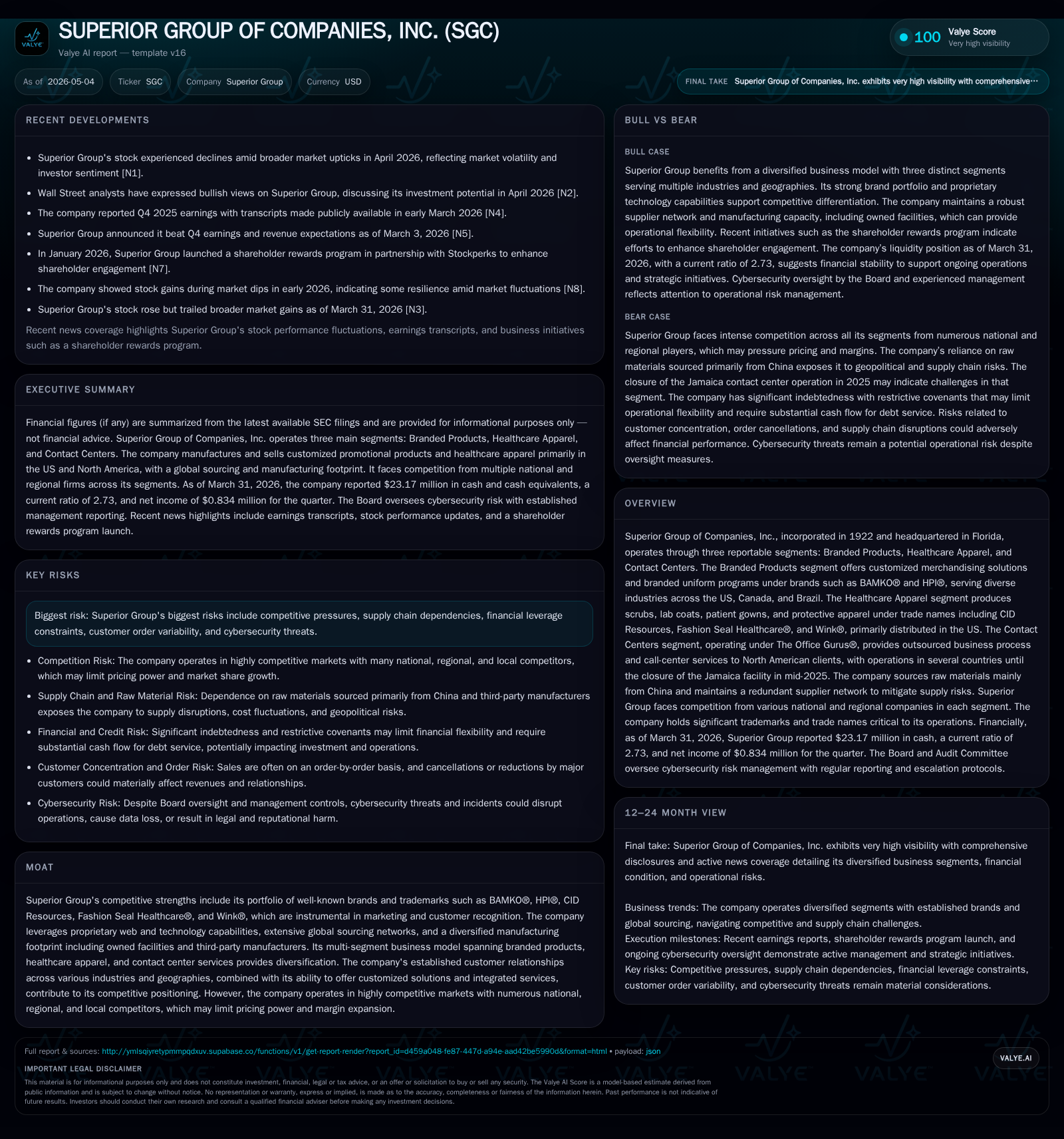
In its 10-Q filing for Q1 2026, Superior Group of Companies, Inc. reported a swing to profitability supported by robust performance in its three business segments: Branded Products, Healthcare Apparel, and Contact Centers. The company’s multi-brand approach spanning customized uniform programs, healthcare-specific apparel, and outsourced call-center services underpins its diversified revenue streams. Despite competitive pressures and supply chain sensitivities, Superior leverages strong brand recognition and integrated service offerings to drive structural growth opportunities. Its well-capitalized balance sheet with a favorable current ratio supports operational stability amidst risks from tariffs and cyber threats.
Recent Operating Update
Superior Group of Companies, Inc. delivered a notable operating update in its Q1 2026 10-Q filing dated May 4th [S2], reinforced by an event filing (8-K) announcing results exceeding analysts' expectations [S3][N1][N2]. The company swung back to profitability this quarter after previous losses while maintaining diverse revenue sources across its three segments.
This recent quarterly performance marks an inflection point underscored by operational improvements across branded merchandise programs under BAMKO® and HPI®, steady demand for healthcare apparel like scrubs and lab coats through CID Resources and Fashion Seal Healthcare®, and optimized contact center services through The Office Gurus®, despite the strategic closure of its Jamaica call center last year to consolidate resources closer to clients.
Business Model Overview
Superior's revenue model is structurally anchored in three reportable segments that collectively mitigate cyclicality risk:
Branded Products: This segment generates approximately two-thirds of net sales by offering customized merchandising solutions and branded uniforms under well-recognized trademarks such as BAMKO® and HPI®. Customers span multiple sectors including retail chains, food service providers, transportation companies, aiming for long-term uniform program partnerships with scheduled deliveries and service-based contract pricing models. This results in recurring revenue flows combined with occasional project-based orders.
Healthcare Apparel: Comprising about one-fifth of sales, this unit caters primarily to the US healthcare sector producing scrubs, lab coats, patient gowns, and personal protective equipment branded under CID Resources, Fashion Seal Healthcare®, Wink®, etc. Sales channels combine direct distribution from company-owned logistics centers alongside vendor drop-shipping options tailored for large hospital systems and laundries.
Contact Centers: Operating under "The Office Gurus," this segment serves North American clients requiring outsourced business process outsourcing (BPO) solutions including call-center support offered through nearshore (US/Mexico/nearby countries) or onshore channels. Service contracts are typically annual or multi-year arrangements ensuring revenue visibility but require careful labor management given personnel intensity.
Revenue drivers involve contract volume growth in custom uniform orders or healthcare apparel replenishment cycles along with pricing adjustments influenced by input cost inflation or tariffs on imported materials. Superior’s proprietary web platforms enhance ordering efficiency while global sourcing networks—largely from China—help balance cost structures against quality demands.
Margins benefit from vertically integrated manufacturing capabilities combined with third-party production partnerships allowing scalability during peak demand periods without excessive fixed costs. Distribution networks utilizing both owned warehouses and third-party logistics centers underpin timely delivery critical for customer retention.
Industry Structure & Competitive Position
Superior operates within a fragmented industry landscape characterized by many national brands like HALO Branded Solutions or Staples’ uniform divisions alongside numerous regional players catering to specialized niches. In branded products especially, competitive differentiation rests heavily on brand equity (established trademarks), customization capability, quality control, and integrated service offerings to simplify client procurement processes.
Healthcare apparel faces stiff competition from established medical garment specialists but benefits from growing demand driven by increased healthcare staffing levels nationwide plus heightened infection control practices boosting PPE consumption—a structural tailwind rather than cyclical.
The Contact Centers unit competes in the broader BPO marketplace often differentiated by language capabilities (English/Spanish/bilingual agents), technical competence in support functions, client proximity (nearshore advantage), and contractual flexibility. Closure of lower-margin foreign operations like the Jamaica site reflects efforts to consolidate toward higher-value geographies enhancing operational efficiency.
Growth Drivers
Emerging growth avenues include:
- Expanding uniform program penetration via greater customization breadth leveraging e-commerce tools to simplify reorders and foster stickiness.
- Capitalizing on healthcare sector growth fueled by rising clinical employment numbers plus regulatory emphasis on protective apparel renewing demand post-pandemic era.
- Scaling contact center services with multilingual capabilities targeting North American clientele desiring nearshore/onshore solutions amid rising scrutiny over data privacy and service quality.
- Strategic acquisitions to add complementary brands or expand geographic reach providing bolt-on scale advantages.
- Technology investments aimed at refining warehouse management systems & enterprise risk management promoting supply chain resilience while reducing overheads long term.
These drivers tie directly into key KPIs such as order backlog expansion in branded products, recurring shipments volume in healthcare apparel, client retention rates in contact centers, pricing/mix improvements responding to tariff shifts, alongside utilization rates of owned vs outsourced manufacturing capacity enabling margin optimization.
Risks & Watchpoints
Among principal risks:
- Competitive Landscape: Superior confronts intense competition which could pressure pricing power or lead to customer loss particularly if larger players intensify uniform program consolidation efforts.
- Supply Chain Dependencies: Predominantly reliant on Chinese raw materials renders it susceptible to geopolitical tensions influencing tariffs/duties impacting cost pass-through ability.
- Financial Leverage: With total debt nearing $87 million offset by cash reserves approximating $23 million resulting in net debt around $64 million as of March 2026-end [F1], debt servicing constraints could arise if operating cash flows falter.
- Customer Demand Variability: Requires accurate forecasting balancing inventory build-up versus stockouts; errors can impair margins due to overstock write-downs or expedited logistic expenses losing customers.
- Cybersecurity Threats: Given digitized order flows & complex ERP/WMS systems handling sensitive client data mandates robust cyber risk frameworks overseen at Board level with dedicated CIO leadership minimizing incident impact [S1].
- Labor & Operational Efficiency: Particularly within contact centers where staffing costs dominate; failures in recruiting/retaining qualified agents or executing technological upgrades could disrupt service levels.
Monitoring tariff policy evolutions affecting imports costs also remains critical since prior price increases have been passed on but could trigger customer attrition if pushed further unchecked [S1].
What to Watch Next
Key upcoming milestones include:
- Quarterly bookings momentum across all segments signaling sustained demand trends.
- Implementation progress reports for technology deployments impacting fulfillment efficiencies and customer experience.
- Updates on any new acquisitions or divestitures expanding brand portfolio or optimizing operational footprint.
- Management commentary on raw material cost trajectory clarifying pricing strategies concerning inflationary pressures/tariffs.
- Execution outcomes related to workforce streamlining especially within contact centers post-Jamaica closure monitoring margin improvement impact.
- Any disclosures around cybersecurity incident trends or enhancements informing enterprise risk profile changes.[S2][S3]
Financial Profile - Latest Contextual Snapshot
Superior maintains healthy liquidity evidenced by a current ratio of 2.73 indicating strong short-term solvency despite moderate net leverage levels due largely to invested working capital tied up in inventory given business nature [F1].
This analysis focuses solely on publicly filed SEC disclosures as of May 4th, 2026 with supplementary news context without issuing investment recommendations.
Disclaimer: This is research-only, informational analysis and not investment advice. It may include AI-generated interpretation and general industry context. Always verify important details using primary sources.

Comments