
ZeroStack Corp. Leverages Hybrid AI and Pharma Model Amid Cryptoregulation Risks
ZeroStack’s latest quarter reveals intensifying integration of its pharmaceutical distribution and decentralized AI treasury businesses amid evolving U.S. crypto regulatory challenges.
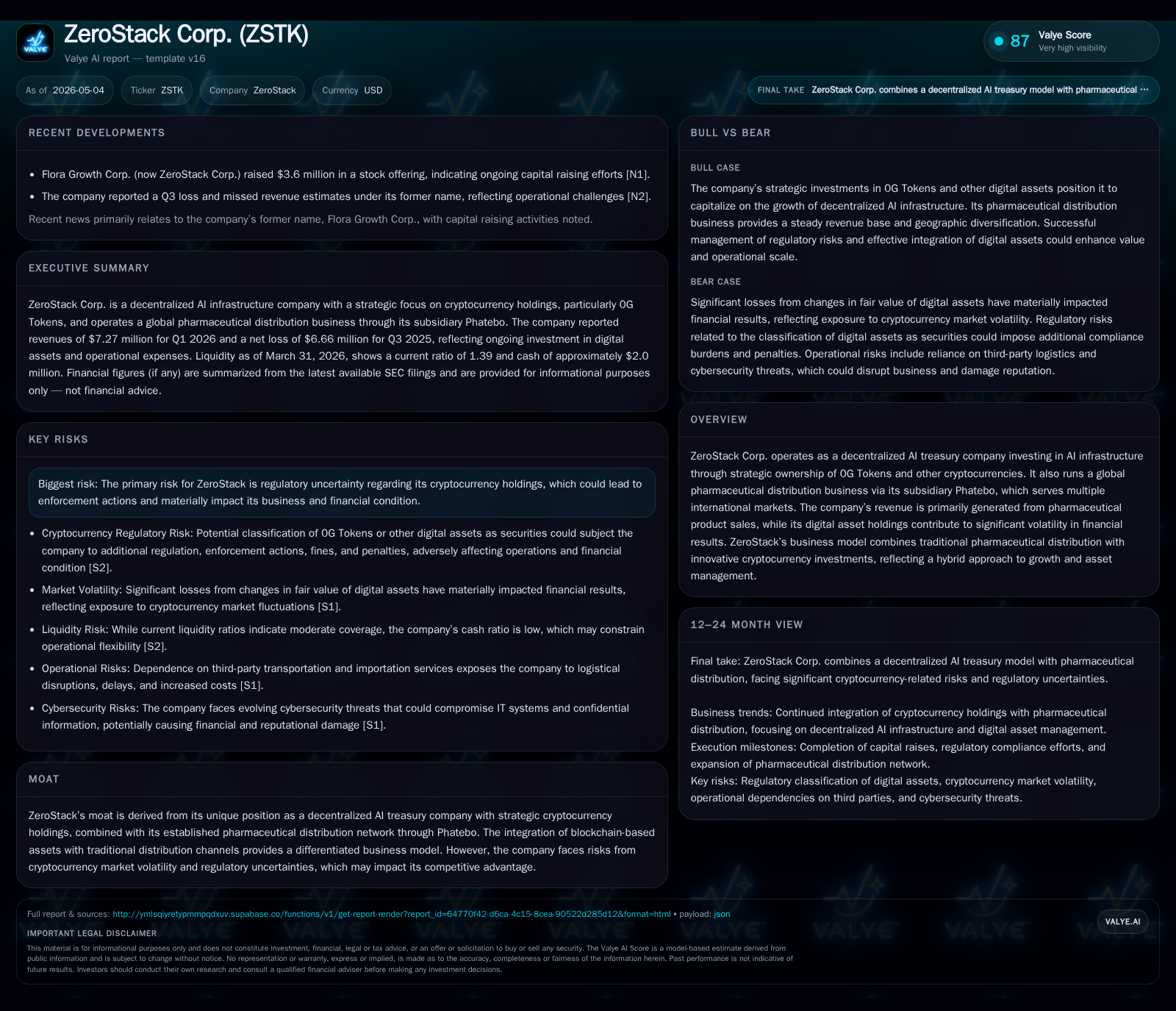
ZeroStack Corp. continues to juggle its dual business lines, combining a global pharmaceutical distribution operation via its subsidiary Phatebo with a pioneering decentralized AI treasury centered on 0G Tokens and other digital assets. The May 2026 quarterly report spotlights ongoing strategic cryptocurrency acquisitions alongside steady pharma revenue generation, illustrating their hybrid growth approach. However, regulatory uncertainty following recent SEC interpretations around cryptocurrency securities classification poses a notable risk to operational flexibility and financial stability.
Latest Quarterly Operating Highlights: Emerging Dual-Model Dynamics
ZeroStack’s Q1 2026 10-Q filing dated May 4 provides the clearest update on how the company is managing its two seemingly divergent business units: a traditional pharmaceutical distribution network headed by its German-based subsidiary Phatebo, and a cutting-edge decentralized AI treasury strategy fueled primarily through substantial holdings of the proprietary 0G Token plus other major cryptocurrencies such as Solana and Ethereum [S2]. The company disclosed active purchases of these digital assets funded partly through recent equity raises conducted in late 2025 [S3], reflecting a commitment to scaling its digital treasury despite headwinds.
Importantly, ZeroStack also highlighted evolving regulatory pressures stemming from the U.S. Securities and Exchange Commission’s March 2026 interpretation of cryptocurrency classifications [S2]. The company believes that all digital assets except Solana do not qualify as "securities" under federal law based on the Howey test analysis embedded in the SEC guidance. However, it concedes substantial risk remains if any court or regulator finds otherwise, which would impose registration requirements triggering operational disruption.
On the pharmaceutical front, ZeroStack continues to generate stable revenues primarily from cancer therapies, ADHD medications, multiple sclerosis treatments, and antidepressants distributed through Phatebo’s established logistics outpost within the European Union [S1]. This segment acts as a cash flow bedrock complementing the volatile returns on digital assets, balancing overall risk exposure.
Business Model Overview: Hybrid Revenue Streams and Strategic Assets
ZeroStack’s business model is bifurcated into two core streams. The first is rooted in pharmaceutical distribution via Phatebo—emphasizing wholesale supply capabilities across 28 countries globally with particular strength in Europe but also meaningful penetration in Asia, Latin America, and North America [S1]. Phatebo’s logistics infrastructure supports efficient import-export operations of diverse therapeutic categories aimed at chronic health conditions.
Simultaneously, ZeroStack functions as a decentralized AI treasury company investing aggressively in AI infrastructure innovation through strategic accumulation of blockchain-based tokens. The flagship asset is the internally branded 0G Token received through convertible notes and private placements totaling millions in valuation as of late 2025 [S1]. These tokens represent non-yielding speculative digital assets whose value fluctuates according to market dynamics but are positioned as long-term infrastructure investments tied to future AI network decentralization.
This hybrid approach offers dynamic economic leverage: Pharma sales provide recurring stable revenue streams impacting top-line volume directly through healthcare product demand; meanwhile token holdings provide optionality for exponential upside tied to blockchain adoption but introduce profit and loss volatility due to price swings recognized each reporting period under ASU 2023-08 fair value accounting [S1][S10]. Capital allocation balances immediate operational needs against longer-duration speculative positioning.
Industry Positioning: Competitive Edge in Pharma Distribution and Crypto Asset Management
In pharmaceutical distribution, ZeroStack’s competitive moat rests on its deep European footprint via Phatebo coupled with multiregional export capability facilitating access to emerging medicine markets [S1]. Despite inherent sector competition and gross margin pressures noted historically (gross margin around 5% reported for FY2025), their diversified portfolio—including high-demand specialty drugs—confers defensibility.
On the digital assets front, ZeroStack positions itself uniquely within an emergent class of decentralized AI treasuries using cryptocurrencies not just as financial instruments but as fuel for open-source AI infrastructures powered by token economics. Unlike conventional crypto hedge funds or exchanges facing purely market-driven risks, ZeroStack blends real-world pharma fundamentals with blockchain-based intellectual property stakes promoting innovation synergy [S1].
Nevertheless, this dual focus also invites regulatory scrutiny uncommon among pure-play pharma distributors. Notably, token custody exposes risks from cybersecurity threats; regulatory uncertainty regarding asset classification threatens compliance costs; and market volatility challenges earnings predictability [S2][S5].
Growth Drivers: Expanding Geographic Reach and Blockchain Innovation
Key growth levers include expanding pharmaceutical distribution channels into untapped international markets beyond core European countries supported by enhanced warehouse capacity and streamlined logistics processes at Phatebo [S1][S2]. Incremental volume gains are coupled with expectations for gross margin improvement driven by scale economies and better pricing leverage in specialty drug segments.
Simultaneously, active strategic acquisitions of additional 0G Tokens plus diversification into other leading cryptos like Ethereum and Ripple reflect management's optimism about broad ecosystem participation accelerating demand for decentralized AI platforms [S2]. This is buttressed by favorable capital markets activity including recent PIPE offerings raising over $13 million cash alongside token-based convertible notes valued above $50 million that fund treasury expansion [S1][S3].
The company's plans also emphasize building technological infrastructure necessary to sustain token utility over time—a critical factor underpinning expected appreciation—and nurturing partnerships within blockchain communities to foster adoption beyond speculative trading.
Risk Profile And Regulatory Watchpoints: Crypto Classification and Market Volatility
The dominant risk confronting ZeroStack lies squarely in evolving U.S. federal securities law treatment of its cryptocurrency holdings. Recent SEC clarification released in March 2026 exposes the company to potential reclassification of certain digital assets such as Solana as "securities," necessitating registration under the Investment Company Act [S2]. Such a determination could materially impair operational flexibility through increased compliance costs, licensing hurdles, or litigation exposure.
Moreover, volatile pricing inherent to digital tokens like 0G subjects reported earnings to large unrealized mark-to-market swings undermining predictability and investor confidence [S14][S10]. Custodial security risks threaten asset loss from hacks or mismanagement exposing balance sheet impairments. Concurrently, lingering legal uncertainties around legacy businesses formerly owned add further complexity though divestitures have reduced that burden recently [S1][S20].
Operationally also challenging is maintaining skilled talent capable of navigating both regulated pharmaceutical frameworks across jurisdictions alongside fast-evolving blockchain technology—a rare cross-disciplinary capability demanding continuous investment.
Milestones and What To Watch: Upcoming Catalysts and Execution Indicators
Investors should monitor several measurable developments closely: first is clarity around SEC or legislative actions on cryptocurrency classifications impacting the regulatory standing of key tokens such as 0G and Solana [S2]. Any enforcement action or rule changes could precipitate significant shifts in compliance obligations.
Second is progress in expanding Phatebo's international footprint—tracking new country entries or enhancement of logistic throughput with corresponding volume or margin gains will be instructive [S1][S2].
Thirdly capital raising activity especially under exchange agreements recently executed (allowing up to $50M Common Share sales) will influence liquidity profiles supporting both pharma operations and crypto treasury funding demands [S3][S19].
Finally improvements in key financial metrics such as reduction in net operating losses or stabilization of adjusted EBITDA would signal successful integration of dual business lines while sustained crypto portfolio valuation trends will reveal treasury strategy traction.
Financial Profile Snapshot: Liquidity, Leverage, and Revenue Analysis
Latest financial snapshot
| Metric | Value | Period |
|---|---|---|
| Cash & equivalents | $1.978 million | |
| 2026-03-31 | ||
| Total debt | $3.157 million | |
| 2026-03-31 | ||
| Net debt | $1.179 million | |
| 2026-03-31 | ||
| Current assets | $11.248 million | |
| 2026-03-31 | ||
| Current liabilities | $8.104 million | |
| 2026-03-31 | ||
| Current ratio | 1.39x | |
| 2026-03-31 |
Source: SEC companyfacts cache [F1].
From a financial standpoint at quarter-end March 31, 2026 ([F1],[S2]), ZeroStack holds $1.978 million in cash & equivalents against total debt of $3.157 million resulting in net debt of $1.179 million.
Reported full-year revenue was roughly $35.7 million concentrated mainly within pharmaceutical product sales with operating income deeply negative at -$154.7 million stemming largely from mark-to-market writedowns on volatile crypto holdings plus continuing investment costs related to expansion initiatives [F1].
This financial profile underscores a company navigating growth while managing leveraged exposure with moderate liquidity cushions amid external volatility.
This analysis is based solely on publicly available filings from May 4, 2026 or earlier without any investment recommendations or speculative forecasts.
Disclaimer: This is research-only, informational analysis and not investment advice. It may include AI-generated interpretation and general industry context. Always verify important details using primary sources.

Comments