
OceanFirst Financial’s Strategic Expansion via Flushing Merger Signals Regional Bank Resilience
OceanFirst Financial finalized regulatory approvals for its $579 million merger with Flushing Financial, positioning the combined entity for growth within the competitive Northeast banking market.
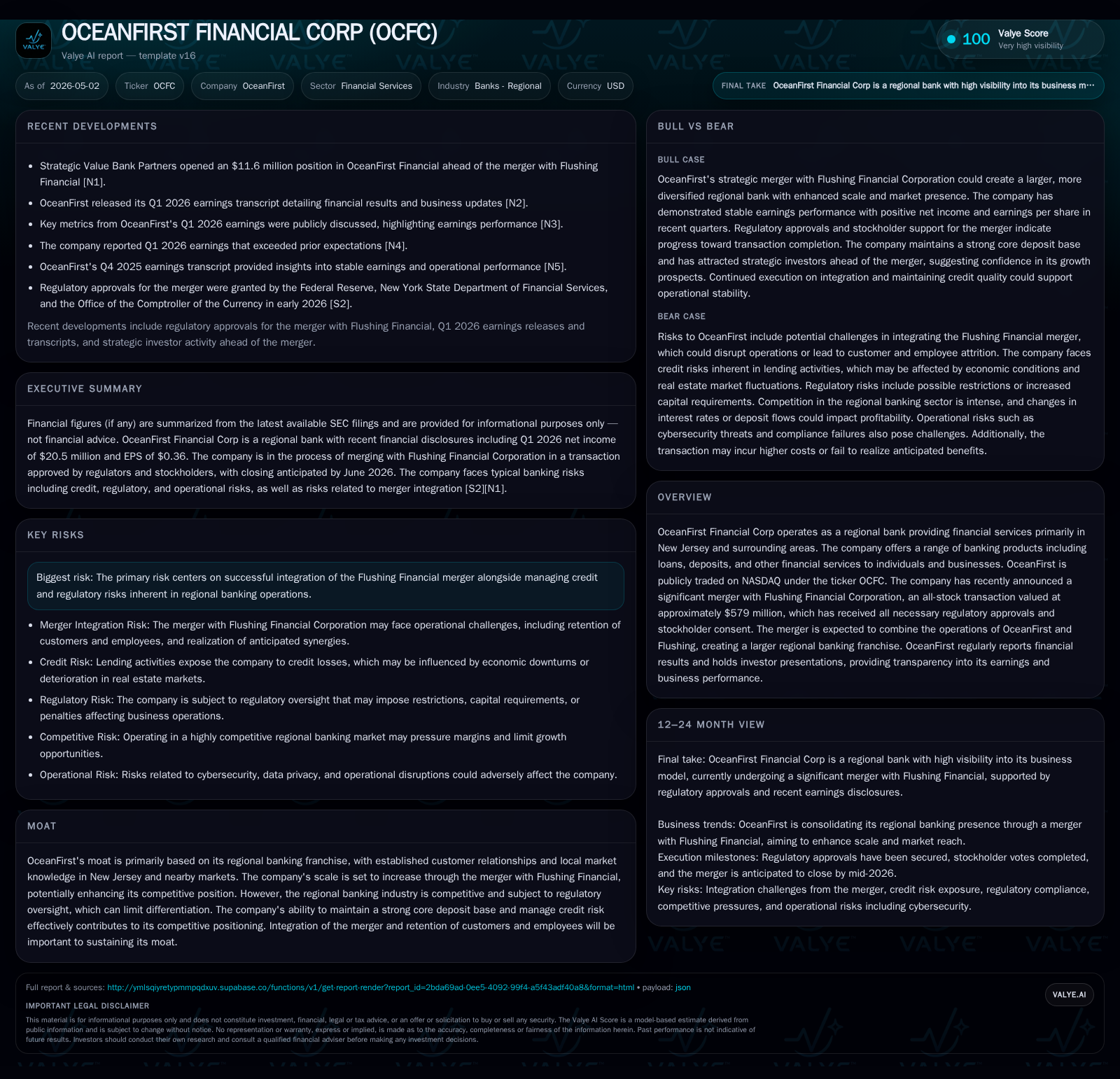
In its Q1 2026 filing, OceanFirst Financial Corp confirmed completion of key regulatory and shareholder approvals enabling the imminent closure of its all-stock merger with Flushing Financial Corporation. This strategic transaction expands OceanFirst’s regional footprint in New Jersey and surrounding areas, enhancing scale and competitive positioning. The merger offers potential synergies in lending capacity, deposit growth, and cost efficiencies, while integration execution and credit risk management remain critical going forward. Monitoring post-merger metrics such as deposit retention, loan pipeline evolution, and expense trends will be essential.
Latest Quarterly Update and Merger Finalization
OceanFirst Financial Corp’s first quarter 2026 10-Q filing dated May 1 confirms that all required regulatory approvals for its strategic acquisition of Flushing Financial Corporation have been secured. These include approvals from the Federal Reserve Board (April 24), the New York State Department of Financial Services (March 23), and the Office of the Comptroller of the Currency (April 6) [S2][S3][S26]. Shareholders of both companies likewise provided consent at respective meetings held in early April [S9][S26]. The combined transaction is valued at approximately $579 million in an all-stock deal structure.
With closing anticipated no later than June 1, 2026 subject to customary closing conditions [S26], OceanFirst sets a new operating framework centered on leveraging expanded scale across New Jersey and northeastern markets. As discussed in recent investor presentations attached to filings [S3][S21], management highlights robust integration planning underway to realize synergy potentials.
Business Model and Core Regional Franchise
OceanFirst’s business model principally revolves around traditional community banking activities with a strong regional focus in New Jersey and adjacent states [S1]. Revenue generation derives primarily from net interest income on loans funded by a stable core deposit base complemented by noninterest income streams such as wealth management fees and transactional services.
The company emphasizes credit risk management prudence alongside leveraging long-standing local customer relationships to drive cross-selling of diversified financial solutions. Its branch network reinforces client engagement given elevated switching costs for retail depositors relying on regional convenience. The significant proportion of deposits classified as 'core' underpins low-cost funding advantages critical amid rising interest rate environments.
Competitive Positioning within Regional Banking
The regional banking sector in which OceanFirst operates features substantial competition from both mid-tier regional peers and mega-national banks increasingly active in Northeast markets. The merger with Flushing enlarges OceanFirst’s market share footprint—strengthening its capacity to compete more effectively on pricing terms for deposits and loans.
However, competitive constraints persist due to regulatory compliance costs that limit rapid expansion or product innovation agility. Pricing power is generally modest given comparable offerings across institutions; differentiation stems mainly from service quality excellence backed by embedded local market knowledge. Economies of scale gained via this consolidation may permit modest efficiency ratio improvements but require careful capacity rationalization.
Growth Drivers: Merger Synergies and Market Expansion
The recent Flushing acquisition chiefly propels growth by expanding OceanFirst’s lending pipeline capacity and deposit gathering capabilities through an augmented branch network. Potential exists to increase fee income via broader wealth management offerings integrated across legacy Flushing clients [S3].
Cost synergies anticipated include reduction of overlapping administrative functions and optimized branch footprint deployment—key to improving operating leverage metrics over time. Investment in digital platforms aimed at harmonizing customer experience across both franchises may unlock further customer engagement benefits.
Growth is structurally driven rather than cyclical given demographic trends favoring suburban retail banking demand around New Jersey metropolitan areas. Enhanced scale also arms OceanFirst better against fintech encroachment by facilitating technology investments otherwise prohibitive for smaller peers.
Risks and Integration Watchpoints
The foremost risk arises from execution challenges inherent in integrating two distinct corporate cultures, IT systems, and operational workflows following the Flushing merger [S20]. Customer attrition or employee turnover could hinder synergy realization. Regulatory scrutiny remains heightened post-merger requiring strict compliance adherence.
Credit risk evaluation continues as a prominent concern amidst economic fluctuations impacting borrowers’ repayment capabilities especially in commercial real estate sectors which compose notable portfolio segments [S5]. Market dynamics including deposit flight risk or adverse interest rate movements may also pressure margins.
Finally, dilution effects stemming from share issuance to finance the acquisition represent governance considerations requiring ongoing stockholder communication.
Execution Milestones and What to Monitor Next
Critical near-term execution milestones include:
- Successful completion of legal closing by June 1, followed by staged integration rollouts;
- Monitoring deposit retention rates among Flushing clientele during transition periods;
- Tracking loan originations growth post-integration reflecting expanded salesforce effectiveness;
- Expense trend developments indicating realization of planned rationalizations;
- Updates on synergy capture progress provided in upcoming quarterly earnings releases [S3][N1][N2][N3].
These operational KPIs will serve as early signals validating strategic rationale behind the merger or highlighting potential execution gaps requiring remediation.
Supporting Financial Overview
While explicit latest quarter debt commentary is absent from the Q1 filing [S2], company facts data as of year-end 2025 show OceanFirst holding approximately $255 million in total debt less cash balances approximating $62 million resulting in a net debt position near $193 million [F1]. This capital posture provides a liquidity buffer to fund integration-related investments.
Stable net income generation indicated for 2025 supports steady internal cash flows aiding working capital needs post-merger [F1]. Maintaining a healthy core deposit base will be crucial to funding ongoing loan growth sustainably without excessive reliance on wholesale borrowings.
This analysis synthesizes public SEC disclosures alongside recent earnings comments and transaction announcements to delineate OceanFirst Financial Corp.’s evolving business stance following its transformative acquisition of Flushing Financial Corporation. Comments are grounded strictly in documented evidence without speculation on unreported figures or outcomes.
Disclaimer: This is research-only, informational analysis and not investment advice. It may include AI-generated interpretation and general industry context. Always verify important details using primary sources.

Comments