
Currenc Group’s Strategic Shift: From Digital Remittance Growth to Blockchain and AI Initiatives
Currenc Group leverages blockchain tokenization and AI infrastructure development while executing strategic divestitures amid fintech competition.
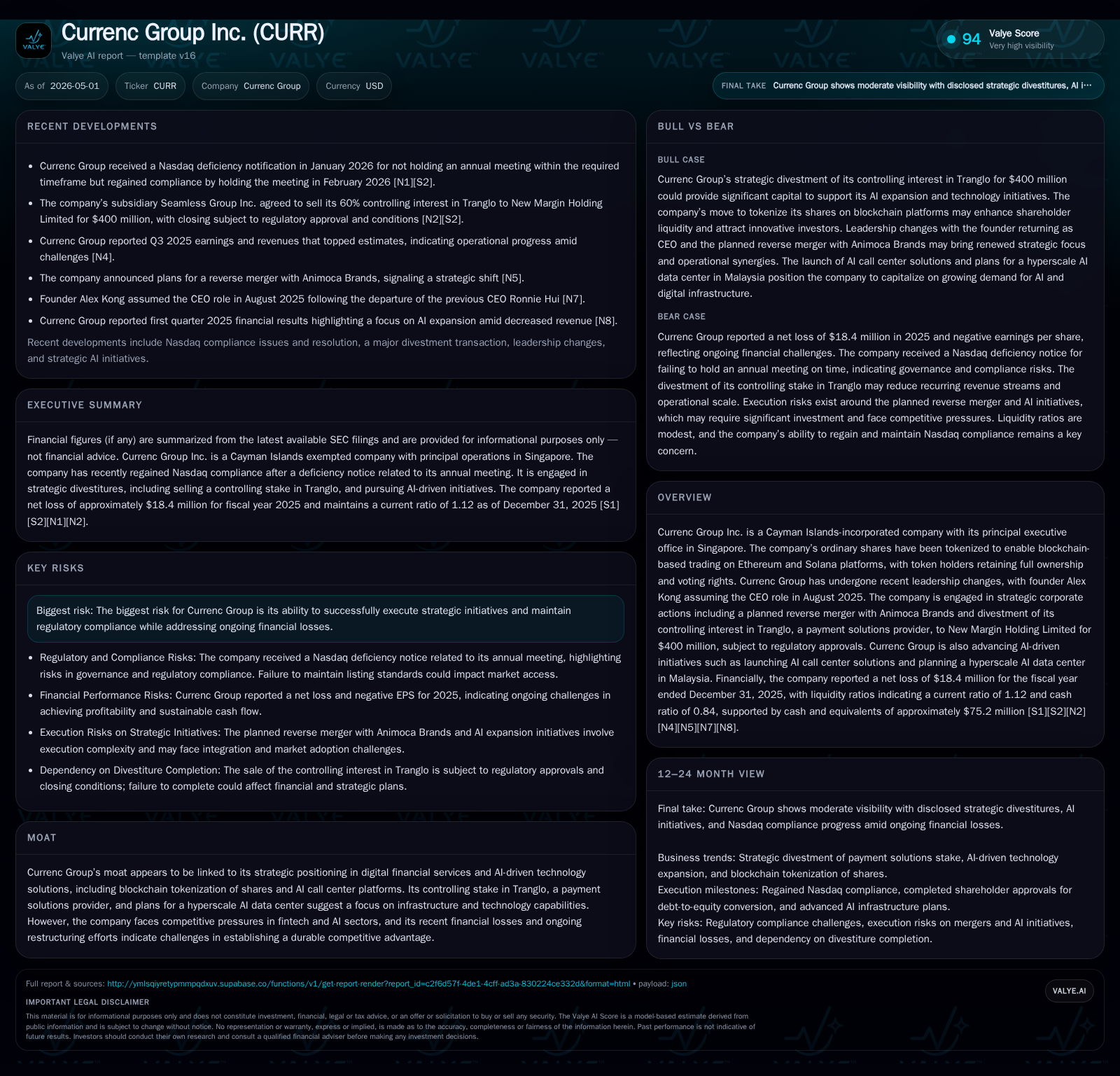
In its latest quarterly update ending April 2026, Currenc Group has launched blockchain-based tokenization of its ordinary shares, enabling on-chain trading with equal ownership and voting rights as traditional shares. The company has resolved Nasdaq listing compliance issues by holding a timely shareholder meeting and continues to advance strategic corporate actions including the planned $400 million divestment of its controlling stake in Tranglo. Currenc's core business shows mixed trends with remittance transaction volume growing but revenue declining due to pricing pressures and shifts in airtime demand. Looking forward, Currenc is investing in AI-driven solutions such as call center platforms and a hyperscale AI data center in Malaysia, repositioning towards technology infrastructure amid industry cost pressures.
Latest Quarterly Operating Developments
Currenc Group’s April 9, 2026 Form 6-K reveals a significant operational milestone: the launch of blockchain-based tokenization of the company’s ordinary shares on the Securitize platform, enabling on-chain trading across Ethereum and Solana networks [S2]. Tokenized shares convey identical rights to traditional ordinary shares, including voting power and participation in corporate actions such as mergers or stock splits. This innovation potentially broadens liquidity avenues, enhances shareholder engagement, and aligns Currenc with evolving digital asset trends.
Concurrently, Currenc resolved Nasdaq listing deficiencies related to delays in holding its annual shareholder meeting within twelve months of fiscal year-end [S3]. After receiving the Nasdaq Annual Meeting Deficiency Letter in January 2026 and submitting a plan for compliance, the company held its shareholder meeting by February 25, 2026, thereby regaining compliance status [S3][S6]. This closure removes an overhang on market confidence tied to governance.
Strategically, in January 2026 Currenc announced entering into a definitive agreement to divest a controlling 60% interest in Tranglo, its international remittance hub subsidiary, to New Margin Holding Limited for $400 million—a transaction contingent on regulatory approvals with a closing deadline set for September 30, 2026 [S5][S7]. The divestiture signals a pivot from legacy remittance operations toward capitalizing on technology-enabled growth avenues.
Tokenization of Ordinary Shares: Business Model Innovation
Currenc’s adoption of equity tokenization represents an evolution in capital markets integration where securities are digitized as transferable tokens on public blockchains. By maintaining parity between tokenized holders’ rights and those of conventional shareholders—including voting and corporate action entitlements—the model mitigates friction commonly associated with security digitization (e.g., legal uncertainties or fragmented rights).
This structural innovation promises enhanced liquidity through peer-to-peer transfers without intermediaries, potentially stimulating trading volumes beyond traditional exchanges or OTC channels. Moreover, operating across both Ethereum and Solana chains offers diversification benefits by combining Ethereum's widespread adoption with Solana's high throughput capabilities.
From a revenue mechanics perspective, although tokenization itself may not directly generate recurring fees, it underpins broader ecosystem development—such as increased investor participation or fractional ownership models—that could indirectly benefit Currenc's valuation and access to capital.
Core Business Units and Service Quality Assessment
Currenc operates primarily through digital financial services segmented into three units: global digital remittance via Tranglo (its international remittance hub), airtime trading platforms globally (including ‘Global Airtime’), and WalletKu retail business focused on Indonesia.
The latest annual filing indicates that transactional payment volume (TPV) processed through Tranglo grew by 8.4% year-over-year to $5.57 billion in 2025 [S1]. Meanwhile, remittance revenue excluding divested entities rose modestly by about 22% from $18.2 million to $22.2 million; however, total consolidated revenue fell by nearly 18.5% to $37.8 million largely due to declines elsewhere.
A key challenge is the persistently low take rate—at approximately 0.37%, comprising an average transaction fee take rate of about 0.26% plus forex spread income near 0.11%. While TPV growth signals higher usage volumes (transaction count rose marginally to ~11.5 million), competitive pricing pressure is compressing margins [S1]. The direct remittance payout rate also ticked up slightly to 0.13%, reflecting increased costs potentially linked with enhanced service levels or client acquisition efforts.
A declining trend also characterizes the Global Airtime segment whose revenue dropped over 15% from $9.3 million to $7.9 million between years due to evolving consumer behavior — notably greater availability of free Wi-Fi in Southeast Asia impacting demand for paid airtime top-ups [S1]. WalletKu experienced even steeper revenue contraction (~47%) paralleling regional challenges and possible substitution effects among Indonesian consumers.
Emerging product lines encompass AI-driven call center solutions designed to improve customer engagement efficiency while addressing cost pressures [S1]. Such innovations allow Currenc to differentiate from commoditized remittance services but remain nascent relative to established fintech competitors.
Competitive Environment and Industry Positioning
Within the global fintech landscape, Currenc’s principal competitive battleground centers on the cross-border remittance market—a sector characterized by fierce rivalry among payment hubs serving large financial institutions downstream [S1]. Companies must balance quality service reliability with aggressive price competition given thin margins typical for remittances.
Tranglo’s role as an upstream remittance hub underscores reliance on establishing enduring financial institution partnerships subject to rigorous clients' demands for both cost efficiency and regulatory compliance adherence. The pressing need for ongoing cost control juxtaposed against expanding TPV volumes reflects sector-wide dynamics where scale economies compete with downward fee pressures [S1].
Blockchain-enabled share tokenization marks Currenc's attempt at technological differentiation; however, adoption barriers within regulated capital markets persist due to integration complexity and investor familiarity constraints.
Another dimension involves regulatory risk stemming from Nasdaq listing standards enforcement—although recent compliance re-establishment alleviates this concern short term—and cybersecurity risks acknowledged explicitly within risk disclosures that require vigilant governance mechanisms given increasing threat landscapes [S1].
Growth Drivers Fueled by AI and Strategic Divestitures
Currenc’s forward strategy clearly aligns with broad industry trends emphasizing artificial intelligence application scaling [S1]. Deployment of AI-driven call center products exemplifies leveraging advanced automation to reduce operating expenses while enhancing customer experience quality—a critical factor under margin compression conditions.
A transformative growth catalyst lies in plans for building a hyperscale AI data center in Malaysia that could serve regional enterprise workloads beyond Currenc’s internal needs [S1]. This infrastructure move positions the company within emerging cloud computing ecosystems, potentially unlocking new B2B revenue streams tied to data processing capacity provisioning.
Financially underpinning these technology investments is the strategic divestiture of Tranglo’s controlling stake for $400 million [S5][S7], providing liquidity that can be redeployed into high-growth segments aligned with AI infrastructure advancements rather than legacy fintech platforms.
Further balance sheet restructuring includes executing debt-to-equity conversion agreements—involving issuance of approximately 35.7 million ordinary shares valued at $1.53 each—to reduce financial leverage obligations [S18], complemented by adoption of a new equity incentive plan aimed at aligning employee interests around future technology-driven growth initiatives.
Risk Factors and Operational Headwinds
Notwithstanding progress made, substantial execution risk shadows Currenc’s pivot from traditional digital finance toward blockchain and AI domains [S1]. Successful rollout of novel technologies depends on achieving technical milestones while gaining market acceptance amid entrenched competitors well versed in scaling similar capabilities.
Regulatory frameworks governing blockchain-based security offerings remain dynamic; ongoing compliance expenditures could burden non-scalable governance structures especially if regulatory scrutiny intensifies around untraditional token trading mechanisms [S2].
Nasdaq compliance remediation demonstrates improved governance responsiveness but also highlights prior control gaps necessitating sustained oversight improvements [S3].
Operationally, elevated net losses totaling over $18 million for fiscal year-end 2025 reflect continuing investment-heavy phases requiring careful cost management [F1]. Cybersecurity threats pose additional reputational risks exacerbating fiduciary responsibilities among directors overseeing technology risk management committees [S1].
Consumer behavioral disruption impacting airtime revenues illustrates vulnerability to external factors like connectivity ecosystem changes that dilute product relevance unless offset by diversified offerings [S1].
Upcoming Catalysts and Execution Milestones
Near-term markers include monitoring product adoption metrics related to tokenized share transactions across blockchain platforms initiated April 2026 [S2], with potential implications for secondary market volumes driving liquidity enhancements.
Closing of Tranglo stake sale remains contingent upon regulatory approvals expected before end-September 2026 deadline [S5]; successful completion would materially advance capital redeployment plans.
Subsequent quarterly earnings reports will serve as barometers for measuring traction gained by newly introduced AI solutions alongside assessment of margin stabilization in shrinking core legacy units [S2][S3][S1].
Shareholder engagement levels post-tokenization launch also warrant attention as they may reflect underlying investor appetite for innovative capital structures amidst persisting net loss trajectories.
Financial Snapshot and Liquidity Overview
Latest financial snapshot
| Metric | Value | Period |
|---|---|---|
| Cash & equivalents | $75mm | |
| 2025-12-31 | ||
| Total debt | $1.15mm | |
| 2025-12-31 | ||
| Net debt | -$74mm | |
| 2025-12-31 | ||
| Current assets | $101mm | |
| 2025-12-31 | ||
| Current liabilities | $90mm | |
| 2025-12-31 | ||
| Current ratio | 1.12x | |
| 2025-12-31 |
Source: SEC companyfacts cache [F1].
As of December 31, 2025, Currenc holds approximately $75 million in cash and equivalents against nominal total debt near $1.15 million resulting in a favorable net cash position exceeding $74 million according to best-effort estimates [F1]. Current assets stand at just over $101 million against current liabilities near $90 million yielding a current ratio above unity at approximately 1.12—indicative of manageable short-term liquidity despite ongoing operating losses driven by technology transition investments [F1].
Operating income remained negative at almost -$7.9 million with net income losses exceeding -$18.4 million reflecting continued heavy spending on restructuring initiatives plus AI development programs [F1].
| Metric | Amount (USD) |
|---|---|
| Cash & Equivalents | 75,244,405 |
| Total Debt | 1,150,386 |
| Current Assets | 101,022,285 |
| Current Liabilities | 90,261,821 |
| Current Ratio | 1.12 |
| Net Income (Loss) | -18,431,134 |
This analysis synthesizes information solely available from SEC filings specified herein without conjecture or investment recommendations. It aims at evaluating Currenc Group’s strategic realignment toward blockchain facilitation combined with technologically infused growth initiatives amid persistent competitive challenges within the fintech space.
Disclaimer: This is research-only, informational analysis and not investment advice. It may include AI-generated interpretation and general industry context. Always verify important details using primary sources.

Comments