
Krystal Biotech Advances Commercial Scale While Expanding Rare Disease Gene Therapy Pipeline
Latest quarter shows rising VYJUVEK revenues supported by proprietary HSV-1 platform and commercial manufacturing capacity.
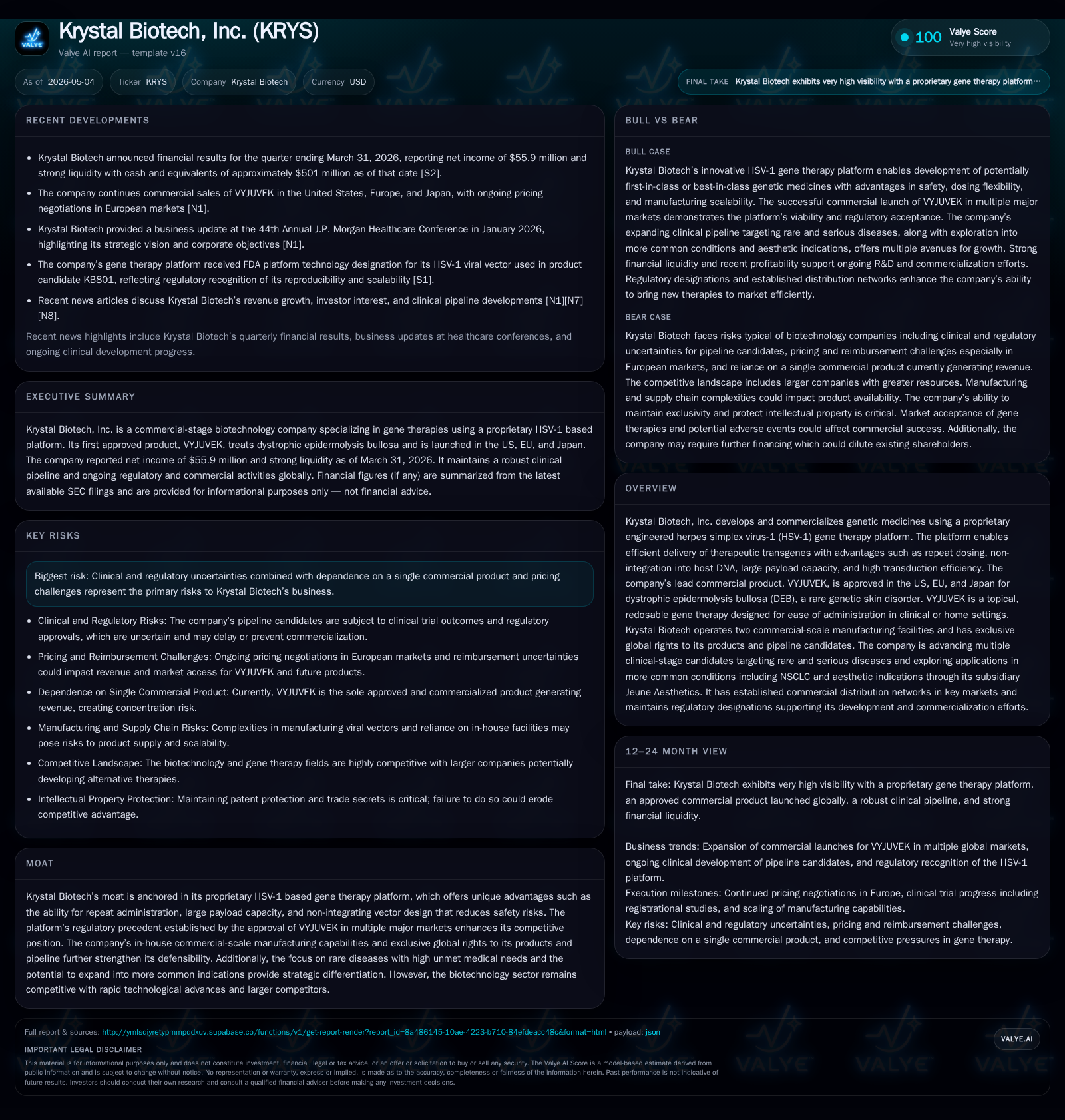
Krystal Biotech reported solid operational progress in Q1 2026, primarily driven by growth in sales of its gene therapy product VYJUVEK for dystrophic epidermolysis bullosa (DEB). The company leverages a differentiated HSV-1 vector platform enabling topical, redosable gene therapies with strong patent protection and regulatory approvals across the US, Europe, and Japan. Krystal’s vertical integration with two CGMP manufacturing sites supports scalability and supply control. While pipeline diversification into rare and some common diseases continues, reliance on VYJUVEK revenue and regulatory/pricing risks remain notable constraints. Monitoring clinical advancements and market penetration of existing and pipeline products will be key near-term indicators.
Recent Operating Update: Q1 2026 Financial Results and Commercial Progress
Krystal Biotech’s Q1 2026 filings ([S2], [S3]) confirm continuing momentum in its core commercial offering, VYJUVEK (beremagene geperpavec-svdt), with revenues driven by expanding launches beyond the United States into Europe and Japan. The company maintained its leadership in treating dystrophic epidermolysis bullosa (DEB), a rare genetic skin disorder characterized by fragile skin that blisters easily due to mutations in the COL7A1 gene affecting type VII collagen production.
Crucially, Krystal’s redosable gene therapy enables repeat topical administration suited for both clinical settings and at-home use—an important factor affecting patient adherence for chronic orphan diseases. This quarter reinforced supply capabilities anchored by the ANCORIS manufacturing facility’s CGMP certification from FDA (2022) and EMA (2024), ensuring quality compliance across major markets.
The latest disclosures also highlight pipeline progression with clinical-stage candidates addressing additional rare genetic conditions while selectively exploring common disease applications such as non-small cell lung cancer. Interim data from KB407 program signaled successful lung delivery of wild-type CFTR protein in cystic fibrosis patients ([S26]), underscoring technical breadth of the HSV-1 vector.
Business Model: Proprietary HSV-1 Platform Powered Gene Therapy
Krystal Biotech operates a fully integrated model encompassing R&D, manufacturing, regulatory approvals, and global commercialization. Its proprietary engineered herpes simplex virus-1 (HSV-1) vector platform forms the cornerstone of its approach. Unlike other viral vectors that often face immunogenicity limitations restricting treatment to single doses, Krystal engineered HSV-1 vectors to evade host immune response allowing repeat dosing—a critical advantage enhancing durability of therapeutic effects.
The gene therapy product portfolio leverages composition-of-matter and methods-of-use patents extending intellectual property protections through at least 2036 ([S1]). This comprehensive coverage spans delivery mechanisms targeted to multiple organ systems including skin and eyes with ongoing research into lung delivery.
Revenue is generated primarily from sales of VYJUVEK targeting DEB patients across approved regions. Pricing dynamics depend on negotiated healthcare reimbursement terms within fragmented markets that increasingly restrict specialty drug costs. Krystal’s vertically integrated commercial-scale CGMP manufacturing capability both reduces costs and supports scale needed for broader market penetration.
Secondary revenue streams aim to derive from future pipeline approvals spanning rare diseases fitting high unmet medical needs as well as aesthetics applications under wholly-owned subsidiary Jeune Aesthetics.
Industry Structure and Competitive Position
Krystal occupies a specialized niche within the broader gene therapy sector focused on rare monogenic disorders where treatment options remain limited. Competitors vary from larger biotech firms pursuing viral vector-based gene replacement therapies to early-stage ventures investigating next-generation non-viral platforms.
The company’s core differentiation roots in:
- The engineered HSV-1 platform allowing redosable topical therapies distinct from conventional single-administration viral vectors.
- Demonstrated lead product approval across three major regulatory jurisdictions establishing favorable precedents.
- Ownership of two commercial-scale manufacturing facilities granting control over production quality, IP protection, lead times, and cost structure.
These factors combine to form a credible moat against new entrants though rapid technological innovation argues for continued R&D investment to maintain competitive edge.
Growth Drivers
Geographic Expansion of VYJUVEK Sales
Continued rollout in Europe and Japan following initial US launch expands addressable patient populations with chronic DEB requiring innovative treatment solutions accessible both clinically and at home.
Pipeline Clinical Development Progression
Multiple clinical trials in rare diseases aim to broaden revenue sources beyond VYJUVEK. Positive proof-of-concept data such as CFTR delivery in cystic fibrosis signal platform versatility and potential for label expansions or new indications.
Increasing Adoption via Patient-Friendly Delivery
Topical administration simplifies treatment logistics enhancing patient acceptance compared to invasive systemic procedures typical in gene therapy markets.
Enhanced Manufacturing Capacity Utilization
Leveraging existing CGMP facilities supports cost control while satisfying growing commercial demand without dependency on external contract manufacturers.
Research Into Common Disease Indications & Aesthetic Markets
Exploratory initiatives targeting more prevalent severe diseases like NSCLC provide optionality for long-term growth opportunities beyond rare disease specialization.
Risks / Watchpoints / Growth Constraints
Single Commercial Product Concentration Risk
Despite pipeline breadth, current revenues depend heavily on VYJUVEK sales making growth vulnerable to regulatory challenges or payor reimbursement pressures.
Regulatory Uncertainty & Clinical Trial Outcomes
Gene therapies face high development complexity; any unfavorable trial results or delays can materially impact timelines or market confidence.
Pricing & Reimbursement Environment
Global healthcare cost containment efforts impose sustained pressure on orphan drug pricing which may limit revenue scaling despite clinical benefits demonstrated.
Compliance With Evolving Manufacturing & Healthcare Laws
Multi-jurisdictional operations expose Krystal to differing regulations including anti-kickback statutes, fraud prevention laws (e.g., FCA), privacy laws (HIPAA/CCPA), increasing compliance expenditures.[S4], [S6], [S16]
Market Education & Patient Identification Challenges
Awareness within clinical communities about novel treatments influences penetration speed; identification of eligible patients can limit immediate uptake rates especially given disease rarity.[N5]
What To Watch Next
- Clinical data updates from KB407 cystic fibrosis programs and other pipeline candidates expected during upcoming quarters will indicate platform applicability beyond dermatology indication.[S26]
- Market uptake metrics for VYJUVEK outside US including patient access and reimbursement advances across EU/Japan remain key indicators of international growth trajectory.[S2]
- Regulatory milestones particularly additional approvals or indications expanding addressable markets could materially enhance value proposition.[N4]
- Cost management related announcements regarding manufacturing efficiency gains or capacity expansions provide insight into margin improvement potential.[S1]
- Negotiations with insurers/government payors impacting pricing dynamics will influence commercial sustainability given broader drug pricing scrutiny globally.[S4]
Financial Profile Supportive but Not Dominant Narrative Factor
Latest financial snapshot
| Metric | Value | Period |
|---|---|---|
| Cash & equivalents | $501mm | |
| 2026-03-31 | ||
| Current assets | $1020mm | |
| 2026-03-31 | ||
| Current liabilities | $108mm | |
| 2026-03-31 | ||
| Current ratio | 9.46x | |
| 2026-03-31 |
Source: SEC companyfacts cache [F1].
Krystal Biotech displays a sound financial position underpinning operational execution capability:
- Cash & equivalents stood at $501 million as of March 31, 2026 ([F1]), providing ample runway to fund ongoing R&D investments alongside commercialization efforts without reliance on near-term capital raises.
- Debt levels are minimal ($4.14 million historical metric), suggesting low leverage risk ([F1]).
- Current ratio near 9.5 indicates liquidity strength supporting working capital demands ([F1]).
- Operating income reported as $161 million at end of last fiscal year highlighting emerging profitability though details on quarterly profitability trends remain limited within latest quarter disclosures ([F1]).
While these metrics confirm financial health facilitating strategic initiatives, ultimate value creation is fundamentally linked to successful product commercialization trajectories plus advancement of innovative pipeline candidates within highly regulated biotech ecosystems.
This analysis is based exclusively on publicly filed SEC documents dated through May 4, 2026 ([S1]-[S29]) supplemented by current factual market references () without speculative forecasts or investment advice.
Disclaimer: This is research-only, informational analysis and not investment advice. It may include AI-generated interpretation and general industry context. Always verify important details using primary sources.

Comments