
Oyster Enterprises II Acquisition Corp Explores Business Combination Amid Geopolitical Risks
The SPAC maintains capital readiness while geopolitical tensions and competitive pressures shape its business combination prospects.
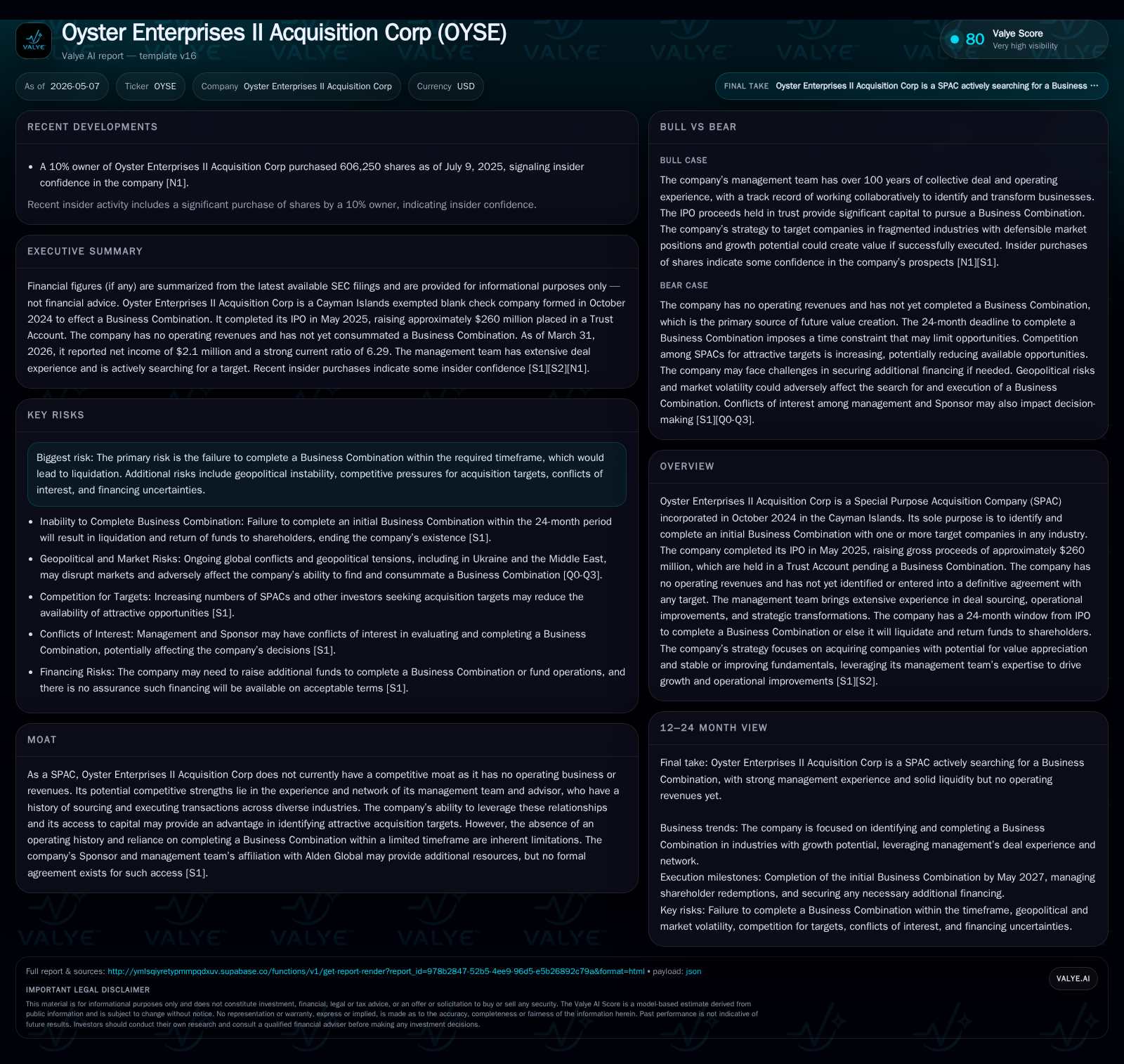
Oyster Enterprises II Acquisition Corp, a Cayman Islands-based SPAC launched in May 2025, holds approximately $260 million in trust as of Q1 2026 with no definitive business combination target yet identified. The latest quarterly disclosure underscores increasing geopolitical risks from the Russia-Ukraine conflict and Middle East tensions impacting market volatility and deal sourcing. The company leverages an experienced management team connected to Alden Global for sourcing potential acquisition targets in diverse industries. However, the highly competitive SPAC marketplace and strict 24-month deadline to consummate a business combination present material pressures and risks. Investor focus centers on upcoming deadlines and any public deal signals that would catalyze value creation or capital deployment.
Latest Operating Update: Q1 2026 SEC Filing Insights
Oyster Enterprises II Acquisition Corp’s most recent quarterly filing dated May 6, 2026 ([S2]) reveals no material changes in its risk profile but highlights intensifying geopolitical challenges impacting the broader acquisition environment. As of March 31, 2026, the company continues to hold gross proceeds of approximately $260 million in its Trust Account that remain earmarked exclusively for an initial business combination event. Despite active management efforts since the IPO in May 2025, no definitive agreement has yet been entered into with any target company. The filing explicitly identifies ongoing global geopolitical instability related to armed conflicts between Russia and Ukraine, as well as hostilities in the Middle East involving the United States, Israel, Iran, and others. These events have generated market volatility through disruptions such as sanctions, commodity price shocks especially in oil markets, and military escalations which collectively increase economic uncertainty that could adversely affect Oyster's ability to locate suitable targets or successfully negotiate deals [S2].
SPAC Business Model Explained: Mechanisms and Ambitions
Established in October 2024 as a Cayman Islands exempted company ([S1]), Oyster Enterprises II Acquisition Corp operates strictly as a Special Purpose Acquisition Company (SPAC) — essentially a blank check vehicle without operating revenues until it consummates an initial business combination (IBC). Following its IPO in May 2025 ([S1], [S14]), the SPAC sold over 25 million public units at $10 each plus private placement units totaling approximately $7 million to sponsors and affiliates. Proceeds net of fees are held in trust for potential acquisition capital.
The operational model depends entirely on successfully identifying and completing an IBC within a statutorily mandated 24-month period ending May 23, 2027 ([S1], [S14]). Absent consummation by this deadline or approved extension, the entity must liquidate and return funds net of expenses to shareholders. Shareholders have redemption rights either as part of tender offers regulated under Exchange Act Rule 14e-1(a) or through proxy solicited votes depending on deal structure ([S1]). Moreover, post-combination governance entails dilution risk given shares issued to target owners while sponsors rely upon transaction fees plus equity incentives for alignment. The management team actively sources targets using their broad industry experience across media, technology, financial services among others ([S18], [S21]).
Competitive Landscape: Targeting Deals in a Crowded Market
The marketplace for SPAC-facilitated acquisitions remains intensely competitive ([S1], [S20]). As many similar entities plus private equity firms and strategic acquirers scout overlapping sectors with substantial capital caches, valuable mid-market companies capable of scaling publicly have become scarce. Further complicating selection is the growing stigma surrounding some SPAC mergers deterring prospective sellers wary of share price pressures post-deal.
Oyster competes not only against generalist SPAC peers but also against well-resourced alternative buyers who may offer more favorable terms or longer timelines given Oyster’s binding deal horizon constraints. This scarcity elevates valuations that can impair expected returns or dissuade shareholders from approving combinations if accretion metrics falter ([S1]). The structural dynamics narrow Oyster’s margin for error even though its management boasts meaningful deal execution expertise.
Growth Drivers: Leveraging Capital and Management Network
Despite these headwinds, Oyster’s core growth driver centers on leveraging its substantial capital reserve combined with deep sector-spanning relationships cultivated by executives affiliated with Alden Global – a respected investment firm known for opportunistic value creation ([S1], [S24]). This network enhances proprietary access to off-market opportunities often unavailable to less connected acquirers.
Additionally, Oyster’s flexible financing optionality allows combinations financed not only through cash from the trust but also via debt or equity issuance simultaneously with deal closure according to target needs ([S7]). Rigorous due diligence complemented by management’s operational experience positions Oyster well to transform acquired businesses operationally post-combination generating pathway visibility toward value appreciation ([S18], [S21]). The diversified industry focus mitigates sector cyclicality risk although actualized growth depends critically on pacing execution before expiration dates.
Risks and Constraints: Time Pressure, Market Volatility, and Deal Competition
Explicit risks include failure to consummate an IBC within the prescribed timeframe triggering mandatory liquidation ([S1], [S2]). Geopolitical uncertainties further exacerbate transaction timing risk by causing sudden shifts in market appetite or regulatory landscapes. Competitive pressure amplifies target scarcity making favorable pricing difficult.
Potential conflicts of interest emerge from underwriters’ dual role providing advisory services alongside deferred fee arrangements contingent on deal closings creating inherent incentive misalignment ([S1]). IPO-era investor redemption rights may reduce effective available capital particularly if share prices fall pre-deal necessitating additional financing raising which itself presents dilution or cost-of-capital considerations ([S1], [S7]). Finally, regulatory compliance requirements including Sarbanes-Oxley controls create procedural overheads potentially delaying integrations post-acquisition ([S16], [S18]).
What to Watch: Upcoming Deadlines, Deal Announcements, and Capital Movements
Market participants should closely monitor announcements regarding:
- Identification or signing of definitive agreements on acquisition targets as milestone indicators ([S1], [S2]).
- Proxy solicitation filings or tender offer launches signaling impending shareholder votes ([S1])
- Redemption levels post-announcement revealing investor sentiment toward transaction terms.
- Amendments proposing extensions beyond May 2027 that could signal prolonged uncertainty.
- Possible private placements or debt offerings indicating necessity for supplemental funding rounds ahead of transaction closure ([S7]).
Given no announcement yet nearly one year after IPO closure August 2025 raises execution pressure especially heading towards mid-2026.
Financial Snapshot: Liquidity Position Supporting Transaction Readiness
Latest financial snapshot
| Metric | Value | Period |
|---|---|---|
| Current assets | $888171 | |
| 2026-03-31 | ||
| Current liabilities | $141145 | |
| 2026-03-31 | ||
| Current ratio | 6.29x | |
| 2026-03-31 |
Source: SEC companyfacts cache [F1].
Operating without revenues remains typical for a SPAC pre-combination; thus balance sheet liquidity is paramount:
| Metric | Value |
|---|---|
| Current Assets (USD) | $888,171 |
| Current Liabilities(USD) | $141,145 |
| Current Ratio | 6.29 |
This elevated current ratio reflects conservative cash preservation mainly within the Trust Account designated for future deals ([F1]). No debt obligation disclosures exist as expected since external financing discussions remain preliminary pending transaction needs ([F1], [S2], [S7]). Such liquidity fundamentals equip Oyster comfortably for transactional costs without reliance on external leverage.
This analysis is based solely on publicly filed SEC documents up to May 6th, 2026. It reflects observed disclosures without forward-looking projections or investment advice.
Disclaimer: This is research-only, informational analysis and not investment advice. It may include AI-generated interpretation and general industry context. Always verify important details using primary sources.

Comments