
Warner Bros Discovery Consoles Growth Amid Debt Refinancing and Streaming Shifts
Q1 2026 filings reveal critical debt management actions alongside strategic content and streaming expansions shaping Warner Bros Discovery’s trajectory.
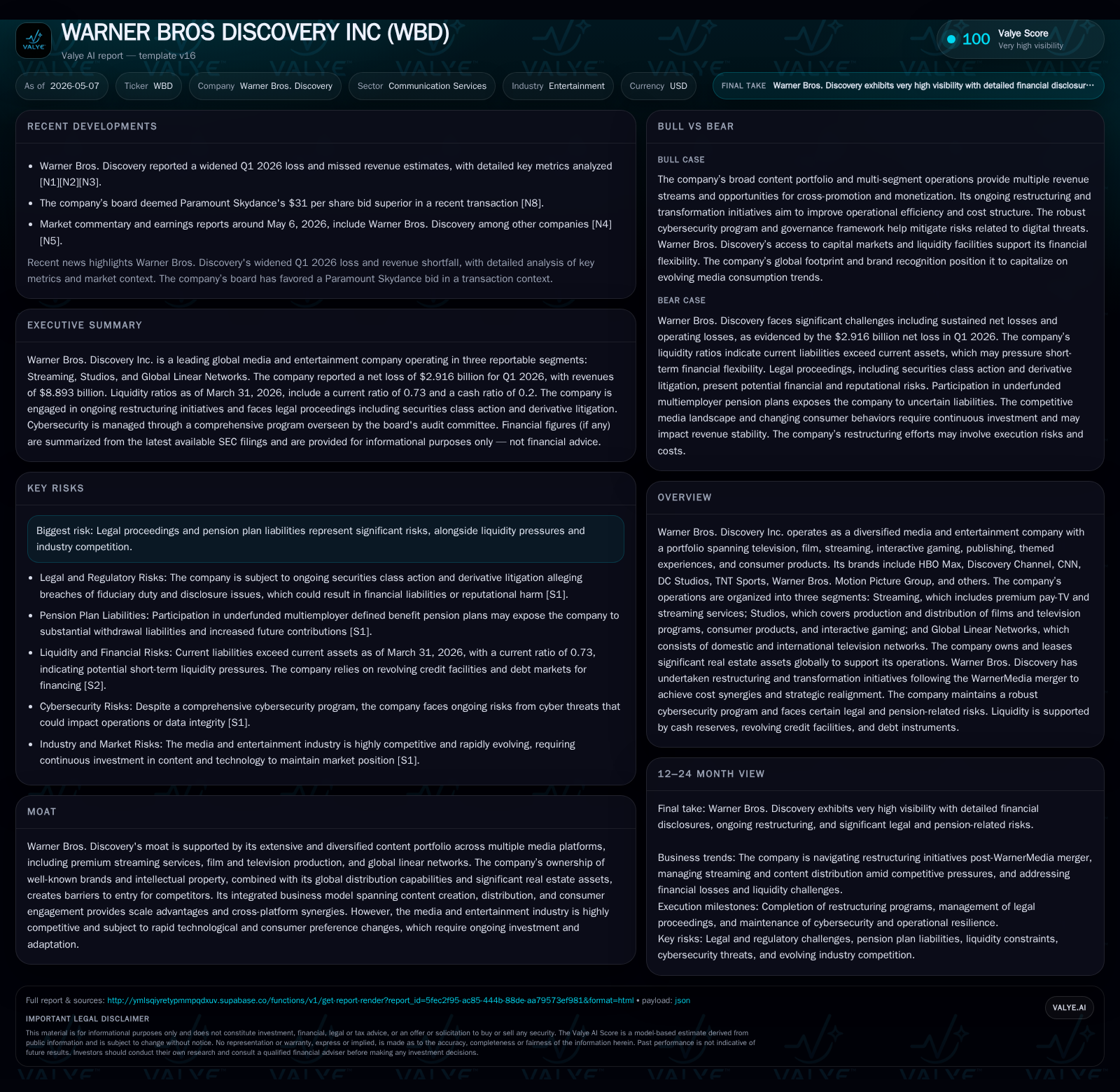
Warner Bros Discovery’s Q1 2026 operational disclosures highlight a pivotal moment with its Junior Lien Exchange Offer and a $3 billion potential termination fee tied to the PSKY merger agreement. The company continues to leverage its extensive content IP and multi-platform distribution across streaming, studios, and linear networks amidst competitive pressures. Growth is anchored on streaming subscriber expansion, franchise-driven releases, and monetization through new joint ventures. However, a heavy debt load and pension exposure represent key constraints requiring focused execution and refinancing milestones.
Q1 2026 Operational Highlights and Key Developments
Warner Bros Discovery’s most recent quarterly filing (10-Q dated May 6, 2026) spotlights critical restructuring initiatives that frame the company's near-term strategic priorities [S2]. At the forefront is the commitment to execute a Junior Lien Exchange Offer by December 30, 2026. This exchange involves swapping certain senior notes issued by subsidiaries DGH and DCL for junior lien secured notes that maintain equivalent economic terms including interest rates and maturity provisions. This maneuver is designed to extend debt maturities and manage leverage during ongoing refinancing challenges.
Additionally, the PSKY Merger Agreement contains customary termination rights effective until June 4, 2027 (extended from an original March 4 deadline under specific conditions) [S2]. If terminated under stipulated circumstances by Warner Bros Discovery (WBD), the company is liable for a $3 billion termination fee payable to PSKY along with reimbursement of up to $1.528 billion linked to the Junior Lien Exchange Offer obligations plus the Netflix Termination Fee accrued. These sizable contingent liabilities create marked pressure on WBD's liquidity planning as they represent significant cash outflows potentially materializing within roughly a year.
Another noteworthy transaction disclosed in Q1 involves WBD’s formation of a joint venture with Cutting Edge Group by contributing a 70% interest in its music catalog operation which generated net proceeds of $601 million [S2]. Despite relinquishing majority equity economically, WBD retains controlling financial interest with operational rights guiding catalog exploitation strategies; this provides diversified revenue streams beyond traditional media.
Taken together, these developments paint a picture of WBD balancing aggressive capital structure recalibration with monetization of non-core assets while navigating merger-related contractual dynamics [S2][S3]. Given net losses were cited at around $2.9 billion for the quarter — significantly impacted by impairment charges including a $2.8 billion accrual related to Netflix termination fees — operating cash flow generation faces near-term compression risks [S2][N1][N2].
Business Model Complexity and Premium Content Assets
Warner Bros Discovery operates an integrated three-segment business model crafted from its legacy WarnerMedia and Discovery merging lineage [S1]. The Streaming segment anchors premium direct-to-consumer offerings via HBO Max and other pay-TV services where subscription revenue growth drives top-line momentum but is often offset by hefty content investment costs.
The Studios segment encompasses film production/release (especially theatrical window films), television program licensing both internally to streaming/networks and externally to third parties, alongside consumer products licensing (including DC Comics franchises), interactive gaming tie-ins, and themed entertainment experiences [S1]. This vertical leverages well-established intellectual property portfolios — ranging from DC superheroes to iconic cinematic franchises — which remain strategic moats that underpin durable audience engagement.
Global Linear Networks comprise domestic/international cable and broadcast channels such as CNN, TNT Sports, Discovery Channel among others providing traditional ad-supported revenue streams [S1]. Although facing secular declines due to cord-cutting trends industry-wide, these offerings still contribute sizeable recurring revenues buttressing cash flows.
Critically, WBD’s value proposition lies in integrated control over premium IP creation coupled with multi-platform distribution enabling cross-promotion amplifying user engagement while mitigating subscriber churn through brand loyalty drivers [S1]. The expansive real estate footprint supporting studio facilities worldwide also facilitates scale advantages uncommon among many peers.
Competitive Position within Global Media and Streaming Markets
Within a fiercely contested entertainment ecosystem dominated by Disney+, Netflix, Comcast’s Peacock platform among others, WBD grapples to sustain pricing power amid shifting consumer preferences that accentuate ease of switching [S1][N7][N8]. Premium content acquisition costs have escalated materially—a function of global competition for marquee talent ownership rights—pressuring margins especially in streaming where ARPU gains must offset expensive content pipelines.
The company’s legacy linear networks face headwinds as live sports broadcasting invests heavily yet yields diminishing carriage fees due to audience fragmentation across digital platforms [N7]. Meanwhile, HBO Max represents a key battleground market where subscriber growth post rebranding strategies is pivotal for competing against deep-pocketed streaming incumbents.
WBD's scale advantage allows it some room for negotiating distribution deals internationally yet must continue innovating on product offerings such as bundling or ad-supported tiers to align pricing strategies with consumer elasticity. Its multi-vertical presence affords resilience but demands synchronized execution across differing business cycles intrinsic to studios versus linear or streaming divisions.
Growth Catalysts: Streaming Expansion, Franchise Output, and Joint Ventures
Several distinct growth engines position Warner Bros Discovery for top-line uplift:
Streaming Subscriber Acceleration: Ongoing programs aim at increasing HBO Max penetration rates—targeting expansions into emerging international markets where broadband adoption surges create new addressable audiences [N13][S2]. Substantial rebranding efforts seek stronger identity alignment leveraging DC Universe content releases improving subscriber retention metrics.
Studios Franchise Releases: Blockbuster film launches tied notably to DC Studios properties underpin not just box office revenues but extend through PVOD windows, merchandizing licenses, gaming tie-ins generating diversified revenue streams relatively resilient to theatrical cyclicality.
Content Monetization through Joint Ventures: The music catalog JV exemplifies diversification beyond visual media into audio royalties providing steadier non-linear income partially insulated from seasonality or viewership volatility [S2]. Similar future partnerships could unlock latent asset monetization potentials.
International revenue contribution is another vector benefiting from tailored local-language productions distributed via linear networks or digital platforms offering long-duration subscription contracts enhancing visibility on future revenue flows [S1][N13].
Risks Featuring Debt Structure, Pension Liabilities, and Industry Volatility
Warner Bros Discovery operates under elevated financial leverage constraints with net debt approximating $29.4 billion against cash reserves near $3.26 billion as of March-end 2026 per latest filings [F1][S2].
Pension liabilities related to participation in multiple underfunded multiemployer defined benefit plans also pose latent risk potentially crystallizing large withdrawal liabilities affecting future cash flow availability [S1][S26]. These exposures add complexity beyond typical corporate credit challenges.
Legal proceedings including derivative litigation around governance decisions connected with merger-related disclosures add uncertainty over contingent liabilities or reputational impacts that could disrupt stakeholder confidence [S26]. Furthermore, technology disruption accelerating consumer migration away from traditional media creates ongoing pressure on return profiles necessitating agile content investment reallocation.
Upcoming Milestones and Strategic Indicators to Monitor
Key immediate milestones include successful completion of the Junior Lien Exchange Offer slated for year-end 2026 offering significant leverage management progress [S2]. Closely related is monitoring fulfillment of contractual timing tied to the PSKY Merger Agreement which mandates potential termination fees be settled if deal closure fails before June 4, 2027 acting as critical liquidity checkpoints.
Subsequent quarterly earnings releases will be scrutinized for subscriber net additions particularly outside North America alongside margin trajectory reflecting cost discipline on streaming content spend [N1][N2]. Execution efficacy in scaling joint ventures beyond music catalogs will also be indicative of strategic diversification success.
Investor focus may tighten on balance sheet improvements notably current ratio enhancements above sub-1 thresholds addressing short-term liquidity concerns documented at quarter-end (0.73 as measured) [F1][S2].
Latest Financial Profile Snapshot
Latest financial snapshot
| Metric | Value | Period |
|---|---|---|
| Cash & equivalents | $3.3bn | |
| 2026-03-31 | ||
| Total debt | $32.7bn | |
| 2026-03-31 | ||
| Net debt | $29.4bn | |
| 2026-03-31 | ||
| Current assets | $11.7bn | |
| 2026-03-31 | ||
| Current liabilities | $16.1bn | |
| 2026-03-31 | ||
| Current ratio | 0.73x | |
| 2026-03-31 |
Source: SEC companyfacts cache [F1].
| Metric | Value (USD) | Date Ended |
|---|---|---|
| Cash & Equivalents | 3.26B | |
| 2026-03-31 | ||
| Total Debt | 32.7B | |
| 2026-03-31 | ||
| Net Debt | 29.4B | |
| 2026-03-31 | ||
| Current Assets | 11.74B | |
| 2026-03-31 | ||
| Current Liabilities | 16.12B | |
| 2026-03-31 | ||
| Current Ratio | 0.73 | |
| 2026-03-31 |
This financial portrait underscores high leverage balanced against limited near-term liquidity ratios consistent with a capital-intensive entertainment conglomerate managing legacy merger obligations alongside rapid industry transformation [F1][S2]. Net losses are inflated partly by non-cash impairments linked directly to contractual terminations setting challenging profitability hurdles for coming periods.
This analysis draws exclusively on Warner Bros Discovery’s most recent publicly available SEC filings combined with contemporaneous industry commentary to contextualize operating performance without offering investment recommendations or speculative forecasts.
Disclaimer: This is research-only, informational analysis and not investment advice. It may include AI-generated interpretation and general industry context. Always verify important details using primary sources.

Comments